

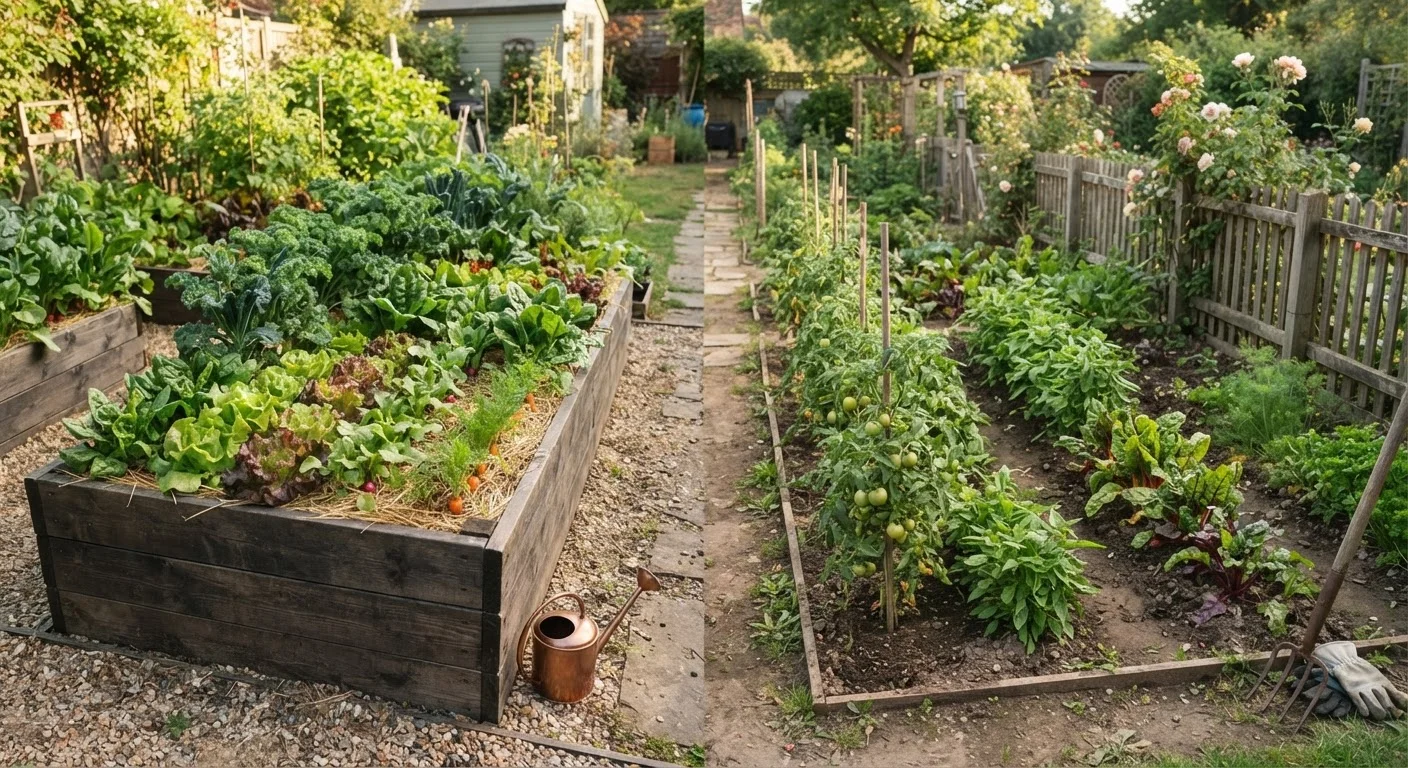
Key Takeaways
- Raised beds give you full control over soil quality and drainage, at a higher upfront cost.
- In-ground planting costs less to start and scales easily to larger growing areas.
- Raised beds warm up faster in spring, often extending your growing season slightly.
- In-ground plots depend heavily on your native soil health - testing is strongly recommended.
- Either method can be highly productive when matched to the right site conditions and plants.
Option A
Raised Beds
The controlled, high-performance growing environment.
Best for: Gardeners with poor native soil, limited mobility, or who want to maximize yields in a compact, defined space.
Option B
In-Ground Planting
The traditional, low-barrier approach to growing.
Best for: Gardeners with good existing soil who want to grow across a large area with minimal upfront investment.
If your native soil is compacted, rocky, or poorly draining
Raised Beds
Raised beds let you fill with a custom soil mix, bypassing poor ground conditions entirely without extensive remediation.
If you're gardening on a tight budget and have reasonable soil
In-Ground Planting
In-ground plots require little more than soil amendments and seeds, making them far less expensive to establish.
If you have physical limitations or back and knee pain
Raised Beds
Elevated beds reduce bending and kneeling, making gardening more accessible and comfortable for many people.
If you want to grow a large volume of vegetables or spread perennials
In-Ground Planting
Open ground scales affordably and accommodates deep-rooted or spreading plants that outgrow confined beds.
If you're a first-time gardener starting small and want early success
Raised Beds
A single 4×8-foot raised bed with quality soil mix is forgiving, easy to manage, and tends to produce reliably in year one.
What Sets These Two Approaches Apart
At their core, raised beds and in-ground plots differ in one fundamental way: where your plants' roots actually live. A raised bed is a contained structure - typically framed in wood, metal, or composite material - filled with a soil mix you choose and control. An in-ground garden uses the existing earth beneath your feet, amended as needed.
That distinction shapes almost every other variable: soil quality, drainage, weed pressure, cost, and how much physical work the garden demands year to year. Neither method is universally superior. The right choice depends on what's already in your ground, your budget, your physical comfort, and how much space you want to dedicate to growing. To understand why soil composition matters so much in this decision, see our guide to garden soil basics.
| Criterion | Raised Beds | In-Ground Planting |
|---|---|---|
| Upfront cost | Moderate to high (frames + fill soil) | Low (amendments only) |
| Soil quality control | Complete - you choose the mix | Depends on native soil |
| Drainage | Excellent by design | Variable - site dependent |
| Weed pressure | Generally lower | Can be significant |
| Spring soil warm-up | Faster | Slower |
| Scalability | Limited by frame cost and space | Easily expanded |
| Accessibility | Better for limited mobility | Requires bending and kneeling |
| Best crop fit | Compact, high-value crops | Large, deep-rooted, spreading crops |
The Case for Raised Beds
Raised beds shine in situations where the native soil is working against you. Compacted clay, sandy ground that drains too fast, contaminated urban soil, or a yard that sits in standing water after rain - all of these problems can be sidestepped entirely when you fill a raised bed with a custom blend of compost, topsoil, and other amendments.
Because the soil in a raised bed is never walked on, it stays loose and aerated season after season. That loose structure benefits root development, reduces the need for tilling, and generally allows seeds to germinate more reliably. If slow or uneven germination has frustrated you before, our article on why seeds fail to germinate covers the soil and temperature factors involved.
Raised beds also warm up several degrees faster than open ground in spring, which can allow earlier planting in cooler climates. Drainage is typically excellent, and many gardeners find weeding considerably easier because there's a clear boundary between garden and lawn.
The main trade-offs are cost and maintenance. Building or buying frames, sourcing enough quality fill to top them off - these expenses add up. Raised bed soil also dries out faster than in-ground plots, which can mean more frequent watering during hot stretches.
6-8 inches
Minimum recommended raised bed depth
Most vegetable crops need at least 6 inches of root space; 10-12 inches suits deeper-rooted plants like carrots and tomatoes.
4 feet
Ideal maximum raised bed width
A 4-foot width allows most people to reach the center from either side without stepping into the bed and compacting the soil.
6.0-7.0
Target soil pH for most vegetables
This slightly acidic to neutral range suits the majority of common garden vegetables grown in the United States.
The Case for In-Ground Planting
In-ground gardening has sustained food production for millennia for good reason: it's accessible, scalable, and in the right conditions, highly productive. If a soil test reveals that your yard's native earth is already reasonably healthy - good structure, adequate organic matter, a pH near neutral - then breaking ground and amending in place is often all you need.
The cost advantage is significant. You don't need to purchase frames or haul in large volumes of fill soil. A bag or two of compost worked into existing beds each season can maintain fertility over time. For gardeners who want to grow a diverse mix of vegetables, companion planting strategies pair well with the open, flexible spacing that in-ground plots allow.
In-ground plots also suit deep-rooted crops - think squash, corn, melons, and established perennial herbs - that can feel restricted in shallower raised beds. If you're planning a garden that includes both annuals and perennials, in-ground space gives perennials room to expand naturally over the years.
The challenges are real, though. Weeds can be more persistent. Soil compaction from foot traffic is a constant concern if pathways aren't clearly defined. And if your native soil has drainage problems or contamination, amendment alone may not be enough - this is where in-ground gardening loses its cost advantage quickly.
Making the Decision for Your Yard
Before committing to either approach, a basic soil test is worth the modest cost. Many cooperative extension services affiliated with land-grant universities offer them for a small fee. A test will tell you your soil's pH, nutrient levels, and sometimes organic matter content - information that directly determines how much work your in-ground plot will need before it's productive.
If you're starting completely from scratch, our resource on starting a vegetable garden from scratch walks through the full site-selection and preparation process for both methods. And if your outdoor space is very limited - a patio, balcony, or small backyard - container gardening may be worth considering alongside or instead of either option.
Many experienced gardeners ultimately use both methods in combination: raised beds for high-value crops like salad greens, tomatoes, and herbs where soil control pays dividends, and open in-ground rows for sprawling crops like winter squash or established berry patches. Whichever direction you go, pairing your garden with the right mulch can help retain moisture and suppress weeds - see our comparison of organic and inorganic mulch options for guidance on that next step.