

Key Takeaways
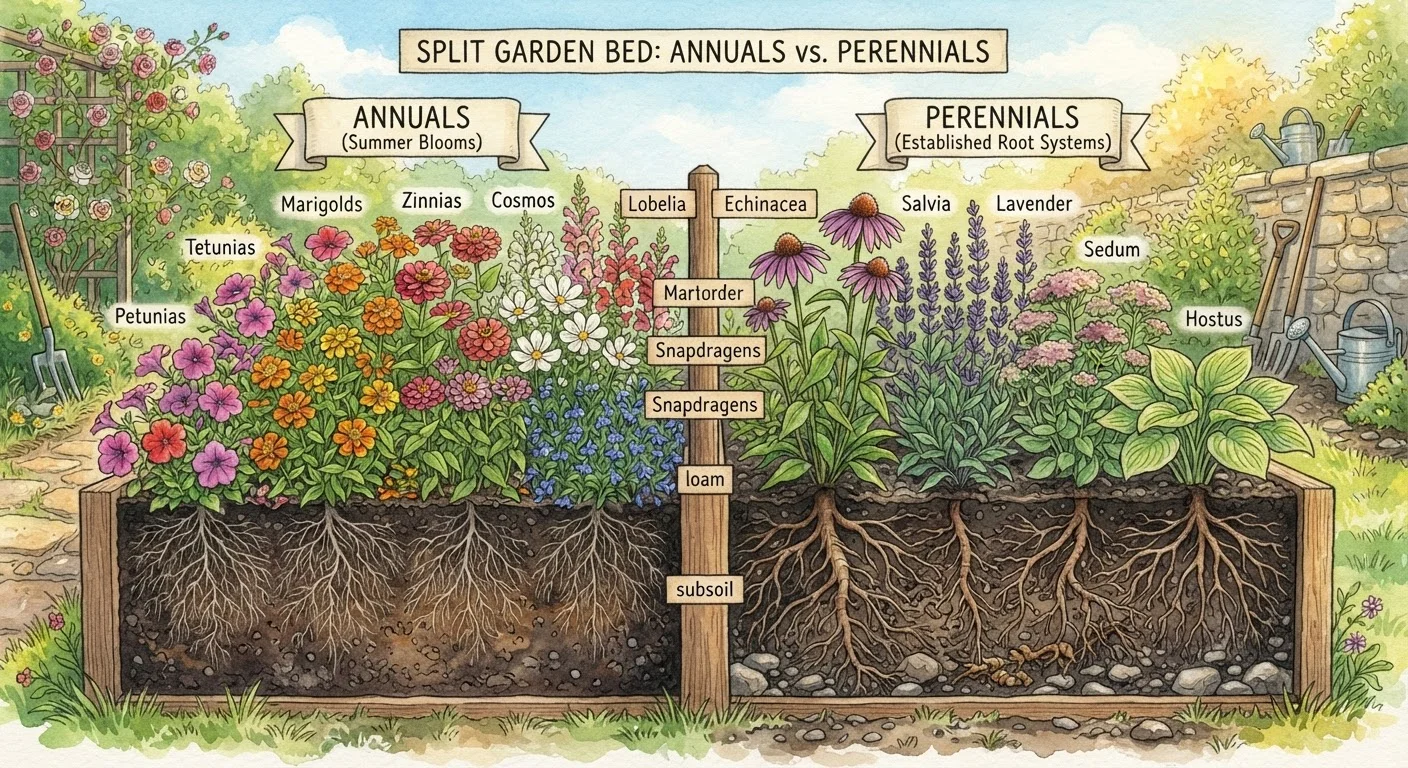
- Annuals complete their entire life cycle - germination, bloom, seed set, and death - within one growing season.
- Perennials die back in winter but regrow from established root systems each spring for three or more years.
- Annuals generally produce longer, more prolific blooms; perennials offer lower long-term labor and cost.
- Mixing both types gives you continuous seasonal color alongside a dependable garden structure.
- Climate and USDA hardiness zone significantly affect which perennials survive winter in your area.
- Neither type is universally better - the right choice depends on your goals, budget, and available time.
Option A
Annual Plants
The bold, season-long performers.
Best for: Gardeners who want intense, continuous color or who like to redesign their garden each growing season.
Option B
Perennial Plants
The reliable, returning foundation.
Best for: Homeowners building a long-term garden that fills in and requires less replanting over time.
If you want maximum color and flexibility each season
Annual Plants
Annuals bloom continuously from planting until frost, letting you swap varieties and color schemes every year without being locked into a permanent layout.
If you want to reduce replanting work over time
Perennial Plants
Once established, perennials return on their own each spring, gradually spreading to fill space and requiring little replanting investment after the first year.
If you're gardening on a tight budget long-term
Perennial Plants
The upfront cost is offset by years of regrowth without repurchasing plants, and many perennials can be divided and multiplied for free after a few seasons.
If you're a first-time gardener wanting quick, visible results
Annual Plants
Annuals establish quickly from transplants and begin blooming fast, giving new gardeners immediate rewards and a low-stakes learning environment.
If you want a complete, well-rounded garden
Annual Plants
Use perennials as your garden's framework, then fill gaps with annuals for uninterrupted color - this combination delivers structure and season-long vibrancy.
What Makes a Plant Annual or Perennial?
The terms annual and perennial describe a plant's natural life span - specifically, how many growing seasons it lives through before completing its cycle.
An annual plant germinates, grows, flowers, sets seed, and dies all within a single growing season. Common examples include zinnias, marigolds, petunias, and basil. Because annuals pour all their energy into producing as many seeds as possible before frost, they tend to bloom heavily and continuously throughout the season. Once the first hard freeze hits, the plant is done - you'll need to replant the following year.
A perennial plant, by contrast, lives for three or more years. Most perennials die back to the ground in fall or winter, but their root system remains alive underground. When temperatures rise in spring, that root system sends up new growth. Coneflowers, hostas, black-eyed Susans, and daylilies are familiar perennials in American gardens. Some perennials, particularly in mild climates, may stay green year-round rather than dying back at all.
Don't Forget Biennials
Biennials like foxglove and hollyhock are a lesser-known third category - they live for two years, typically producing foliage in year one and flowers in year two before dying. Because they self-seed readily, they can appear to behave like perennials in an established garden. Check the plant label carefully so you know what to expect.
There's also a middle category worth knowing: biennials (such as foxglove and hollyhock) complete their life cycle over two years - growing foliage in year one and blooming in year two before dying. They aren't as commonly discussed, but they show up in many garden centers and can be mistaken for perennials.
Head-to-Head: Key Differences at a Glance
Understanding how annuals and perennials compare across practical gardening factors helps you make planting decisions with confidence. Here's how they stack up:
| Criterion | Annual Plants | Perennial Plants |
|---|---|---|
| Life span | One growing season | 3+ years |
| Bloom duration | All season until frost | 2-6 weeks per year |
| Replanting required | Every year | Rarely, once established |
| Upfront cost | Lower per plant | Higher per plant |
| Long-term cost | Adds up each season | Lower over time |
| Garden flexibility | Change layout yearly | More fixed placement |
| Establishment speed | Fast from transplant | Slower; improves year 2-3 |
| Winter hardiness | Does not survive frost | Root survives winter (zone-dependent) |
One factor not captured in a table is visual impact timing. Annuals typically outperform perennials in raw flower count during a single season. Perennials, however, often have a shorter peak bloom window - sometimes just two to four weeks - but return reliably without replanting. This is why many experienced gardeners layer both: perennials anchor the bed while annuals fill in color gaps.
For guidance on structuring the physical beds that house these plants, see our comparison of raised beds vs. in-ground planting.
How to Mix Annuals and Perennials Effectively
The most productive home gardens rarely rely on just one plant type. Combining annuals and perennials gives you the structural reliability of perennials alongside the continuous color and flexibility of annuals.
A practical approach is to plant perennials first as your garden's backbone. Choose varieties suited to your USDA hardiness zone - a designation from the U.S. Department of Agriculture that categorizes regions by average minimum winter temperatures and helps predict which plants will survive year to year. Then use annuals to fill gaps between perennials, especially in the first year or two before perennials have spread to fill their allotted space.
Consider bloom timing when mixing: select perennials that peak at different points in the season (spring, midsummer, fall) so there's always something cycling in. Fill the gaps with long-blooming annuals like impatiens in shaded areas or lantana in full sun.
Watering needs should also factor into your plant groupings. Clustering plants with similar moisture requirements simplifies your routine considerably. Our practical watering guide for home gardens covers how to match your watering schedule to different plant types. And when planning which plants to position near one another, the principles in companion planting apply beyond vegetables - certain combinations simply support each other better than others.
Starting small is always wise. A mixed border with three to five dependable perennials, supplemented with a flat or two of annuals, gives you manageable maintenance while you learn what thrives in your specific soil and light conditions.