

Key Takeaways
- Certain plant combinations actively deter common pests without chemical sprays.
- Legumes like beans and peas add nitrogen to soil, feeding neighboring heavy-feeding crops.
- Some plants compete for the same nutrients and should be kept apart.
- The 'Three Sisters' - corn, beans, and squash - is one of the most proven companion planting systems.
- Flowers like marigolds and nasturtiums serve practical pest-management roles in vegetable gardens.
- Companion planting works alongside good soil care, not as a replacement for it.
Companion Planting
Companion planting is the practice of growing different plants near each other so they benefit one another. Some pairings repel insects, others improve soil, and some help neighboring plants use space more efficiently. It's a time-tested gardening strategy that works with natural plant chemistry rather than against it.
The benefits are attributed to mechanisms such as allelopathy (chemical signals released by roots or leaves), nitrogen fixation by legumes, and aromatic compounds that confuse or repel pest species.
Why Plants Make Better Neighbors Than You Might Expect
Plants aren't passive. They release chemicals through their roots and leaves, attract or repel insects, and alter the soil around them. Companion planting takes advantage of these natural interactions by positioning plants so their individual traits benefit the garden as a whole.
If you're starting a vegetable garden from scratch, thinking about plant placement from the beginning - not just spacing and sunlight - gives you a significant head start on common problems like pest pressure and nutrient depletion.
There are three main mechanisms at work in successful companion planting:
- Pest deterrence: Aromatic plants confuse or repel insects that target nearby crops.
- Soil improvement: Certain plants, particularly legumes, add nutrients that neighboring plants can use.
- Space efficiency: Plants with different growth habits can share the same bed without competing.
3-in-1
Benefits delivered by the Three Sisters system
Corn, beans, and squash together provide structural support, nitrogen fixation, and ground cover - addressing three separate garden challenges simultaneously.
~30%
Potential reduction in pest damage with diverse plantings
Research published in agricultural ecology journals has found that polyculture plantings - growing multiple species together - can reduce pest incidence compared to monoculture plots, though results vary by crop and pest type.
100+ years
Documented use of marigolds as companion plants
Marigolds have been used in vegetable gardens across Europe and North America for well over a century, with scientific investigation into their nematode-deterring root compounds dating to the mid-20th century.
Proven Combinations Worth Knowing
Some pairings have been used for centuries and hold up well to observation. Here are the most reliable ones for home vegetable gardens:
The Three Sisters
Corn, beans, and squash form one of the most famous companion planting systems, developed by Indigenous farmers of North America. Corn provides a climbing structure for beans, beans fix nitrogen in the soil, and squash spreads wide leaves that shade the ground - reducing weeds and holding moisture. Each plant supports the others without taking more than it gives.
Tomatoes and Basil
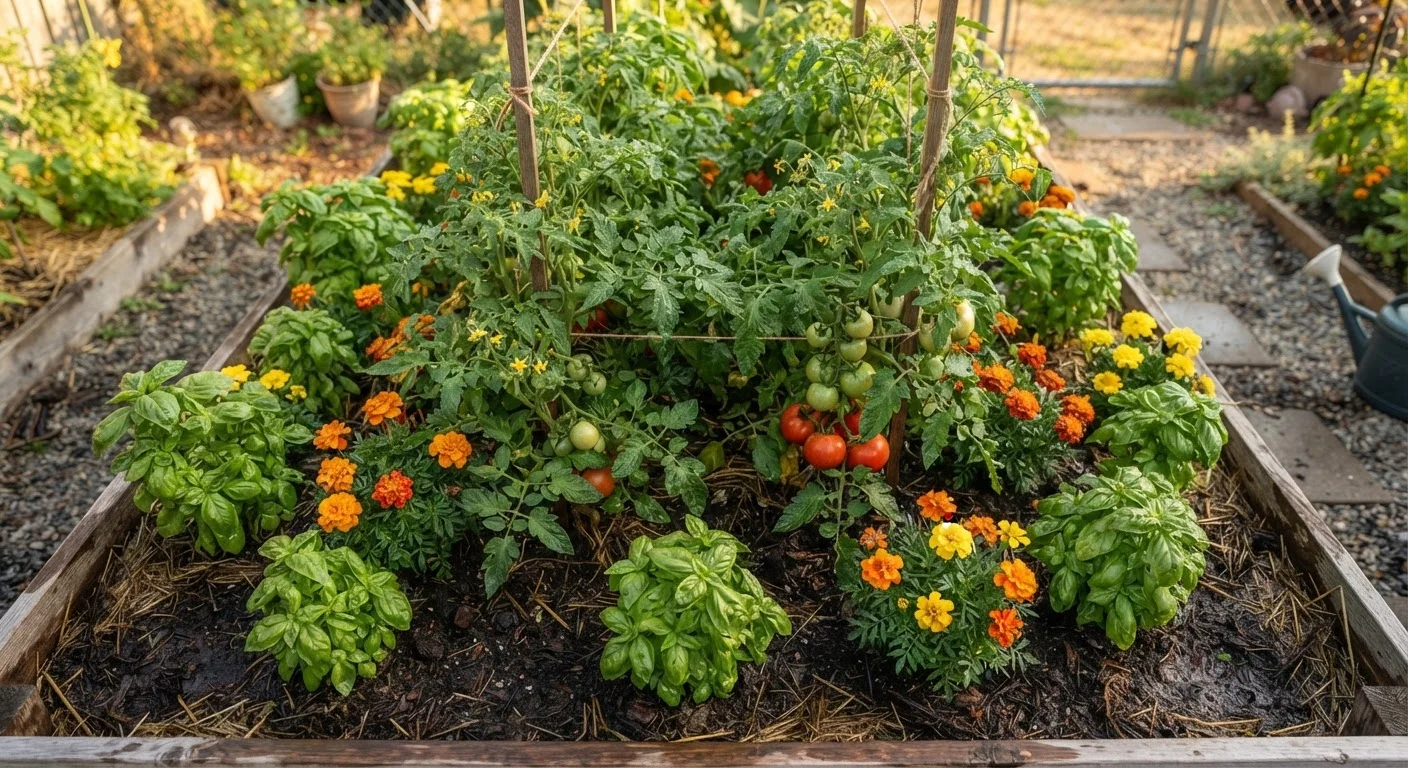
Basil is commonly planted near tomatoes and is thought to repel aphids, spider mites, and thrips. Both plants prefer similar conditions - full sun, consistent moisture - making them easy to manage together.
Carrots and Onions
Carrot flies and onion flies are each deterred by the scent of the other crop. Alternating rows of carrots and onions creates a natural barrier that reduces damage from both pests.
Brassicas and Nasturtiums
Nasturtiums act as a trap crop - aphids prefer them to broccoli, cabbage, and kale, drawing pests away from your main harvest. They're easy to grow and add color to the garden as a bonus.
A home gardener plants marigolds as a border around her tomato bed each spring. By midsummer, she notices significantly fewer aphid clusters on her plants compared to a bed without marigolds.
A first-time gardener grows green beans next to his corn. At the end of the season, the soil in that bed tests higher in nitrogen than his other beds, even though he applied the same amount of compost across all of them.
A gardener tries growing fennel in his raised vegetable bed to attract beneficial insects. His nearby tomatoes and peppers show stunted growth despite good watering and fertilizing.
A community garden plot features interplanted rows of carrots and onions. Gardeners in adjacent plots growing carrots alone report more carrot fly damage than the companion-planted row.
Plants That Compete - Keep These Apart
Companion planting isn't only about what grows well together; it's equally about recognizing poor neighbors. Some plants release compounds that inhibit their neighbors, or simply compete aggressively for the same nutrients and water.
- Fennel releases allelopathic compounds from its roots that stunt or kill most vegetables. Give it its own isolated spot.
- Onions and garlic suppress the growth of beans and peas - keep them on opposite sides of the garden.
- Tomatoes and brassicas are both heavy feeders and compete strongly for calcium and other nutrients.
- Potatoes and tomatoes share common diseases, including blight. Planting them together increases the risk of rapid disease spread.
When planning your layout, especially if you're weighing raised beds versus in-ground planting, keeping incompatible plants in separate beds makes management much easier.
Flowers as Functional Garden Members
Ornamental flowers earn their place in a vegetable garden by doing real work. Marigolds are among the most studied companion plants - their roots produce a substance that deters certain soil nematodes, and their strong scent is thought to confuse aphids and whiteflies. Plant them as a border around vegetable beds for broad coverage.
Borage is another functional flower: it attracts pollinators, which benefits fruiting vegetables like squash, cucumber, and tomatoes. Borage is also said to deter tomato hornworm, though this is harder to confirm than its pollinator-attracting role.
Start Small With One or Two Pairings
You don't need to redesign your entire garden to benefit from companion planting. Choose one well-documented pairing - like tomatoes and basil, or the Three Sisters combination - and observe the results over a full season. Starting small makes it easier to notice what's actually working before scaling up.
If you're working with limited space, container gardening allows you to create intentional companion pairings even on a balcony or patio - a pot of tomatoes with basil, for instance, works just as well above ground as in a garden bed.
Companion planting also complements soil-preservation approaches. Gardeners who practice no-till gardening often find that companion planting adds an additional layer of pest management without requiring the soil disturbance that comes with heavy mulching or mechanical intervention.