

Key Takeaways
- Soil is made of four components: mineral particles, organic matter, water, and air.
- Sand, silt, and clay are the three mineral particle types - their ratio determines your soil texture.
- Loam soil, a balanced mix of all three particle types, is considered ideal for most gardens.
- Organic matter improves nearly every soil type by boosting drainage, water retention, and nutrient availability.
- A simple soil test reveals pH and nutrient levels, guiding smarter amendments before planting.
Garden Soil
Garden soil is the top layer of earth in which plants anchor their roots and draw water and nutrients. It's made up of four main components: mineral particles (sand, silt, and clay), organic matter, water, and air. The balance of those ingredients determines whether your garden thrives or struggles.
Soil scientists classify texture by the relative proportions of sand, silt, and clay particles measured in a standard laboratory analysis called a particle-size distribution test.
The Four Building Blocks of Soil
Dig a handful of earth from your garden bed and you're holding a remarkably complex mixture. Healthy soil is roughly 45% mineral particles, 5% organic matter, 25% water, and 25% air - though those proportions shift constantly with weather, plant activity, and management.
Mineral particles are the skeleton of your soil. They come in three sizes: sand (the largest), silt (medium), and clay (the finest). Sand drains quickly and feels gritty. Clay is sticky when wet, dense when dry, and holds nutrients well. Silt falls in between - smooth to the touch and moderately fertile. The ratio of these three particles defines your soil's texture, which affects drainage, aeration, and how tightly roots can move through the ground.
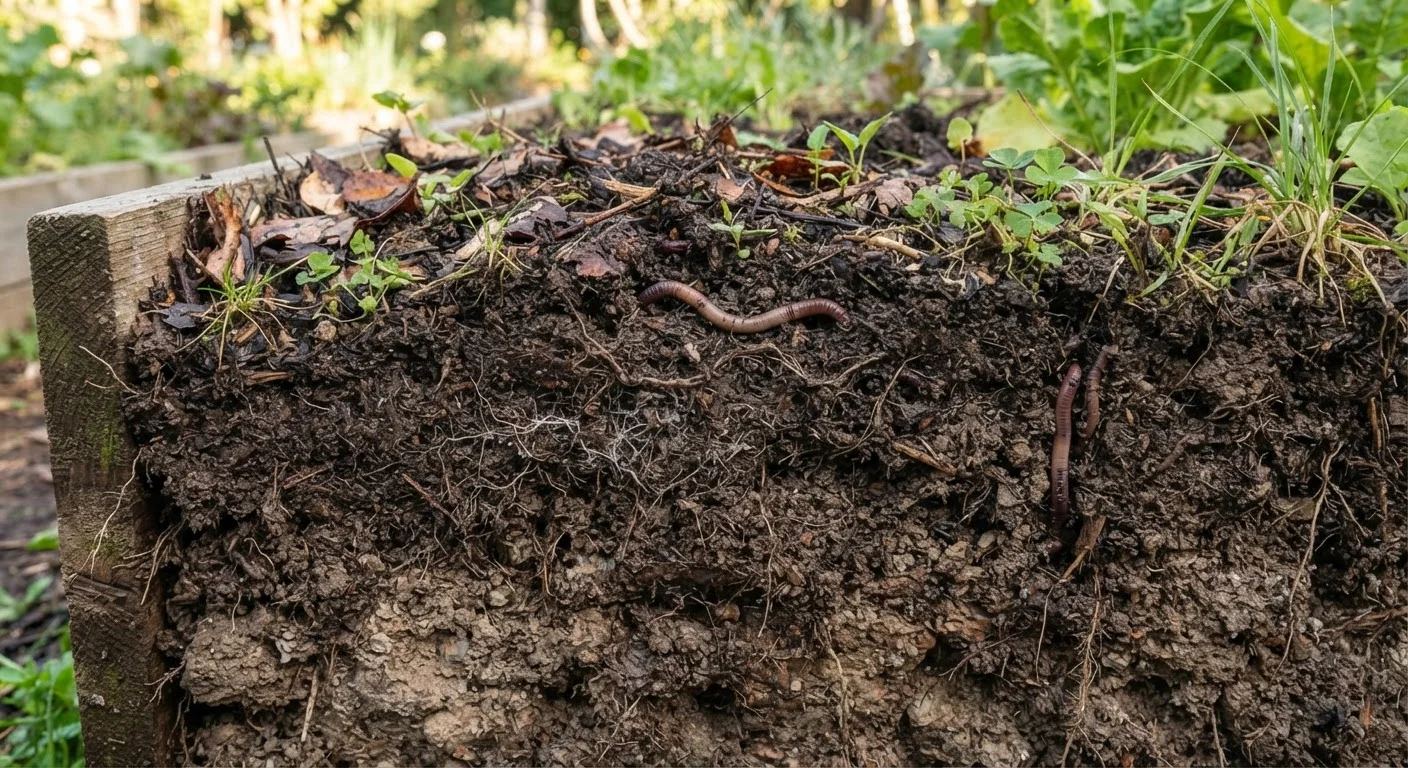
Organic matter is the lifeblood. It includes decomposing leaves, plant roots, animal waste, and the bodies of billions of microorganisms. Even at just 5% of soil volume, organic matter has an outsized effect: it binds mineral particles into clumps (called aggregates) that create the pore spaces plants need for both water and oxygen.
Water and air fill those pore spaces alternately - good soil drains well enough that roots aren't waterlogged, but holds enough moisture that plants aren't stressed between rains. Compacted or heavily clay-dense soil forces out air, essentially suffocating roots.
~1 billion
Bacteria per teaspoon of healthy soil
USDA Natural Resources Conservation Service estimates that a single teaspoon of productive soil contains up to one billion bacteria alone.
5%
Organic matter in ideal garden soil
Most agronomists consider 5% organic matter content a target for productive garden soil, though many American home gardens fall well below this level.
6.0-7.0
Optimal pH range for most vegetables
University extension programs broadly recommend maintaining soil pH between 6.0 and 7.0 for the widest range of vegetable crops.
Soil Texture: Sand, Silt, Clay, and Loam Explained
Most garden problems trace back to texture imbalance. Here's what each type means in practice:
- Sandy soil drains fast and warms up quickly in spring - great for root vegetables and drought-tolerant plants - but nutrients leach out rapidly and plants may dry out between waterings.
- Clay soil retains water and nutrients effectively, but compacts easily, drains slowly, and can crack in dry weather. Heavy clay is tough on roots and makes digging a workout.
- Silty soil is fairly fertile and holds moisture better than sand, but it can also compact and crust over with repeated foot traffic or rain.
- Loam - a roughly equal blend of sand, silt, and some clay - is the gardener's gold standard. It drains well, holds adequate moisture, and stays loose enough for roots to spread freely.
If your soil is far from loam, the fix is almost always organic matter. Compost improves drainage in clay and water retention in sand. It's one of the few amendments that helps no matter what you're starting with. Before you dig anything in, consider running a basic soil test - your local cooperative extension service typically offers low-cost kits - so you're not guessing. Our Spring Garden Prep Checklist walks through soil testing as part of a complete season-opening routine.
Try the Jar Test Before You Buy Amendments
Fill a quart mason jar about one-third with soil from your garden, top it up with water, shake vigorously, and set it on a level surface. After 24 hours, you'll see distinct layers: coarse sand on the bottom, silt in the middle, and fine clay near the top. The relative depths tell you your approximate soil texture - no lab required. Use the results to guide what amendments actually make sense before spending money.
Why Soil Biology and pH Matter
Soil isn't just rocks and dirt - it's an ecosystem. A single teaspoon of healthy garden soil can contain millions of bacteria, fungi, and other microorganisms that break down organic matter, suppress some plant diseases, and convert nutrients into forms plant roots can actually absorb. Earthworms are the most visible workers: they physically mix and aerate soil as they tunnel, and their castings are exceptionally rich in plant-available nutrients.
Equally important is pH - a measure of soil acidity or alkalinity on a scale of 0 to 14. Most edible plants prefer a pH between 6.0 and 7.0. Below that range, soil becomes acidic; above it, alkaline. In both extremes, nutrients may be chemically unavailable to roots even if they're physically present in the soil. Lime raises pH; sulfur lowers it. But adjusting pH should always follow a soil test - adding amendments blindly can push things further in the wrong direction.
Understanding your soil's biology and pH is essential groundwork before you plant anything. If you're building a new bed from scratch, our guide on starting a vegetable garden from scratch covers how to prepare the ground before your first seeds go in.
A gardener in Georgia struggles with heavy red clay that puddles after every rain and cracks into hard plates in summer heat.
A homeowner in Arizona finds that newly planted tomatoes wilt just days after watering, even though the soil looks dark and rich.
A first-time gardener in the Midwest plants blueberries in a raised bed but sees yellowing leaves despite regular fertilizing.
Improving Your Soil Over Time
Good soil rarely happens by accident - it's built gradually through consistent practices. The most effective habit most home gardeners can adopt is annual compost addition. Spreading 1-3 inches of finished compost over beds each season and working it into the top few inches feeds soil biology, improves structure, and slowly shifts texture toward loam.
Avoid over-tilling. While tilling breaks up compaction, repeated deep tilling destroys the fungal networks and aggregate structures that make soil productive. Many experienced gardeners use a no-till or minimal-till approach, relying instead on top-dressing with compost and letting earthworms do the mixing.
Mulching - covering bare soil with wood chips, straw, or shredded leaves - reduces moisture evaporation, moderates soil temperature, suppresses weeds, and breaks down slowly into organic matter. It's one of the simplest and most cost-effective practices available to any gardener.
One area where many gardeners go wrong is fertilizer. Nutrient supplements can be useful, but only when targeted to actual deficiencies. Our article on common fertilizer myths separates the science from the guesswork so you're not inadvertently harming the soil biology you've worked to build.
Healthy soil is a long-term investment. The time you put into understanding and improving it pays dividends in every growing season that follows.
Soil Improvement Takes Seasons, Not Days
Many gardeners expect dramatic results after a single compost application. In reality, meaningful texture and fertility improvements typically develop over two to three growing seasons of consistent organic matter additions. Setting realistic expectations helps you stay the course rather than reaching for quick chemical fixes that can disrupt soil biology.