

Key Takeaways
- Teen drivers are significantly overrepresented in U.S. crash statistics relative to their share of licensed drivers.
- Graduated Driver Licensing (GDL) laws restrict nighttime driving and passenger limits to reduce early exposure to high-risk conditions.
- Supervised practice hours in varied conditions - not just quantity - build the judgment new drivers need most.
- Parent-teen driving agreements that set clear rules are linked to safer driving behavior.
- Distraction, passengers, and nighttime driving are the three conditions that most sharply elevate teen crash risk.
Start here
Why Teen Drivers Face Higher Crash Risk
Next
How Graduated Driver Licensing Works
Then
Building Skills Through Supervised Practice
Going deeper
Conversations That Actually Reduce Crash Risk
Final step
Setting Rules and Monitoring Progress
Why Teen Drivers Face Higher Crash Risk
Motor vehicle crashes remain a leading cause of death among teenagers in the United States. The reasons behind this aren't primarily recklessness - they're rooted in neuroscience and inexperience. The adolescent brain, particularly the prefrontal cortex that governs judgment and impulse control, continues developing into the mid-twenties. That neurological reality means teen drivers process risk differently than adults do.
Compounding brain development is the simple fact of skill gaps. Experienced drivers handle hazards largely through pattern recognition built over thousands of miles - anticipating the car that might drift, sensing an intersection about to close. New drivers lack that mental library. They respond to situations rather than reading them in advance.
Three conditions consistently amplify teen crash risk:
- Nighttime driving: Reduced visibility and late-night fatigue combine to create a disproportionate share of fatal teen crashes.
- Peer passengers: Research shows crash risk rises with each additional teen passenger, as social dynamics compete with road attention.
- Distraction: Phones are the most cited culprit, but as our guide on distracted driving beyond the phone explains, attention threats extend well beyond the screen.
Graduated Driver Licensing (GDL)
A staged licensing system that grants new drivers increasing privileges as they gain experience and maintain a clean record, designed to limit exposure to high-risk conditions early on.
Learner's permit
The first stage of GDL, allowing a teen to drive only when accompanied by a licensed adult supervisor.
Prefrontal cortex
The area of the brain responsible for judgment, impulse control, and decision-making. It continues developing into the mid-twenties, which is a key reason teen drivers process risk differently than experienced adult drivers.
Cognitive load
The total amount of mental effort a driver is using at any given moment. High cognitive load - from conversations, navigation, or emotion - reduces the attention available for the driving task.
Telematics
Technology that collects and transmits data about how a vehicle is driven, including speed, hard braking, and location. Some families and insurers use telematics to monitor new drivers.
How Graduated Driver Licensing Works
Graduated Driver Licensing - commonly called GDL - is a structured, multi-stage system that eases new drivers onto public roads by incrementally expanding their privileges as they gain experience. Every U.S. state operates some version of a GDL program, though the specific rules vary by jurisdiction.
Most GDL frameworks include three stages:
- Learner's permit: The teen may only drive with a licensed adult supervisor present. There are often minimum age requirements and a mandatory holding period before the next stage.
- Restricted license (intermediate): The teen can drive without a supervisor but faces limitations - typically no unsupervised driving after a set hour (often 9 or 10 p.m.) and a cap on the number of teen passengers allowed.
- Full license: All restrictions lift, usually when the driver reaches a specified age and has held the intermediate license without violations for a minimum period.
GDL systems work because they limit exposure to the highest-risk conditions - nighttime and peer passengers - during the most dangerous phase of a new driver's career. Parents should familiarize themselves with the exact rules in their state, as details vary meaningfully.
GDL Rules Vary Significantly by State
While all U.S. states have some form of Graduated Driver Licensing, the specific age thresholds, required supervised hours, nighttime curfews, and passenger restrictions differ considerably. Always verify the exact requirements in your state through your state's Department of Motor Vehicles or equivalent agency before your teen advances to the next licensing stage.
Building Skills Through Supervised Practice
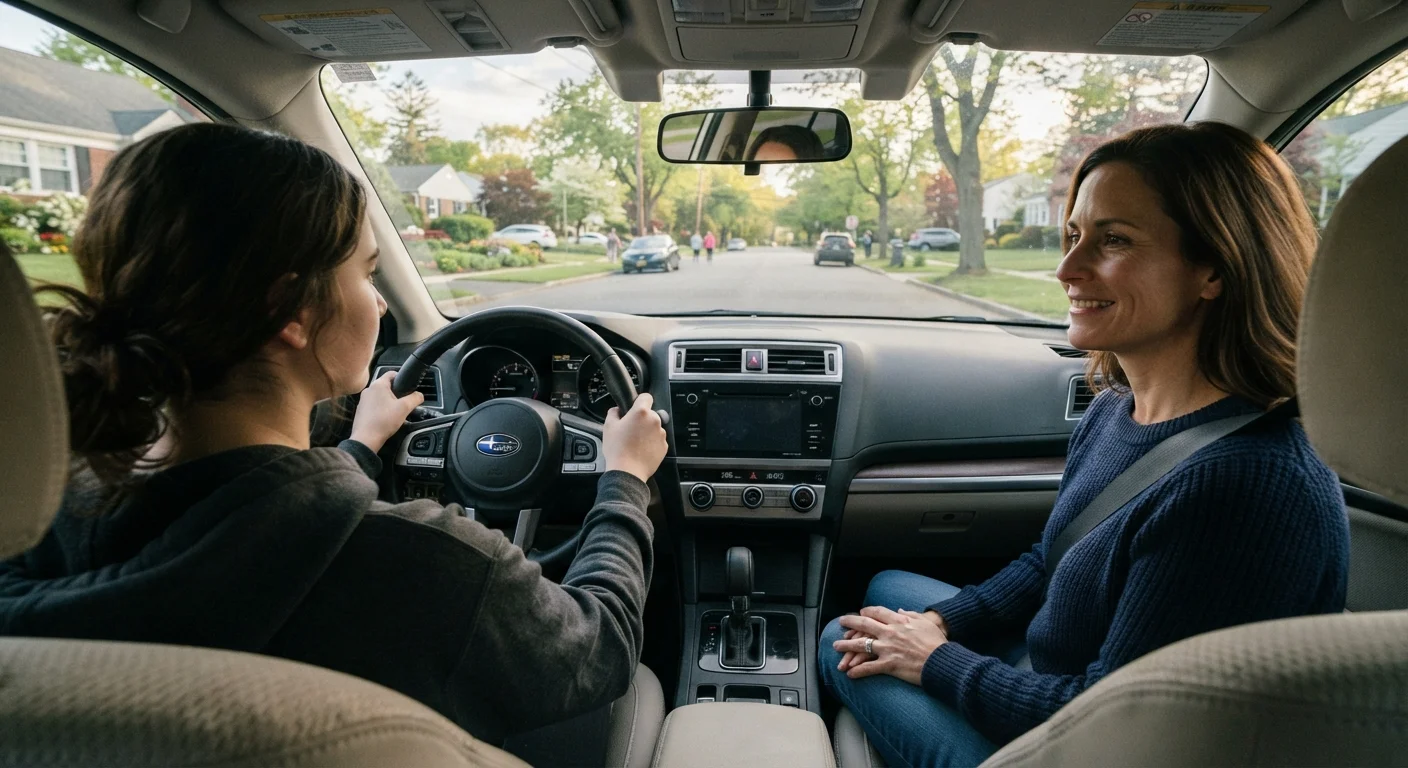
Supervised practice is where actual driving competence is built. Most GDL programs set a minimum supervised hour requirement, but meeting the minimum is a floor, not a ceiling. The quality and variety of those hours matter enormously.
A well-structured practice plan should expose a new driver to:
- Residential streets and low-speed maneuvering early on
- Suburban arterials with traffic signals and turning lanes
- Highway and freeway merging - a skill covered thoroughly in our guide on highway on-ramp etiquette
- Night driving (within GDL rules and with a supervisor present)
- Adverse weather conditions such as rain or reduced-visibility situations
- Unfamiliar routes that require real-time navigation decisions
During practice, supervising parents are most effective when they narrate hazards aloud before intervening - helping the teen build the same anticipatory mental models that experienced drivers rely on. Coaching, rather than simply correcting, accelerates the development of genuine judgment.
Make Each Practice Drive Count
Prioritize variety over volume when scheduling supervised practice. A single session on a rainy night or on an unfamiliar highway teaches more about real-world hazard management than several laps on familiar neighborhood roads. Set a deliberate goal for each session - for example, "today we practice highway merging" - and debrief afterward on what went well and what to adjust.
Conversations That Actually Reduce Crash Risk
Research into teen driver safety consistently finds that parental involvement - beyond supervising practice - is one of the strongest predictors of safer driving behavior. The conversations parents have with teens before, during, and after driving matter.
Effective conversations focus on specific scenarios rather than general warnings. Rather than saying "be careful," discuss what to do when a driver tailgates, how to handle a tire blowout, or why following distance is a survival tool, not a courtesy. Our article on defensive driving mindset provides a framework that's useful to share with teen drivers directly.
Topics worth covering explicitly include:
- What to do if they feel unsafe as a passenger in another teen's car
- How to handle peer pressure to speed or use a phone
- What to do after a minor collision - staying safe, exchanging information, notifying parents
- The mechanics of aggressive driving and how to disengage, as covered in our guide on road rage and aggressive driving
Setting Rules and Monitoring Progress
Structure and clear expectations significantly reduce teen crash risk. A parent-teen driving agreement - a written document laying out rules, privileges, and consequences - provides that structure in a concrete, revisitable form. Effective agreements specify nighttime curfew, passenger limits, phone policies, and what happens when a rule is broken.
Beyond the agreement, ongoing monitoring matters. Many families use vehicle telematics or manufacturer-provided family apps to receive data on speed, braking habits, and location. These tools are most effective when treated as coaching aids rather than surveillance - reviewing the data together creates opportunities for constructive conversation rather than confrontation.
As teens demonstrate consistent safe behavior over months, privileges should expand gradually and be acknowledged explicitly. Rewarding safe performance reinforces the habits you want to see continued. Teaching your teen to conduct a pre-trip safety walk-around before each drive is another habit worth building early - it instills responsibility for the vehicle itself, not just the act of driving.
Finally, the vehicle your teen drives should be part of the safety equation. Consult our car maintenance hub for guidance on keeping the car your teen drives in sound working condition - properly inflated tires, functioning lights, and reliable brakes are foundational safety factors no rule or conversation can replace.