

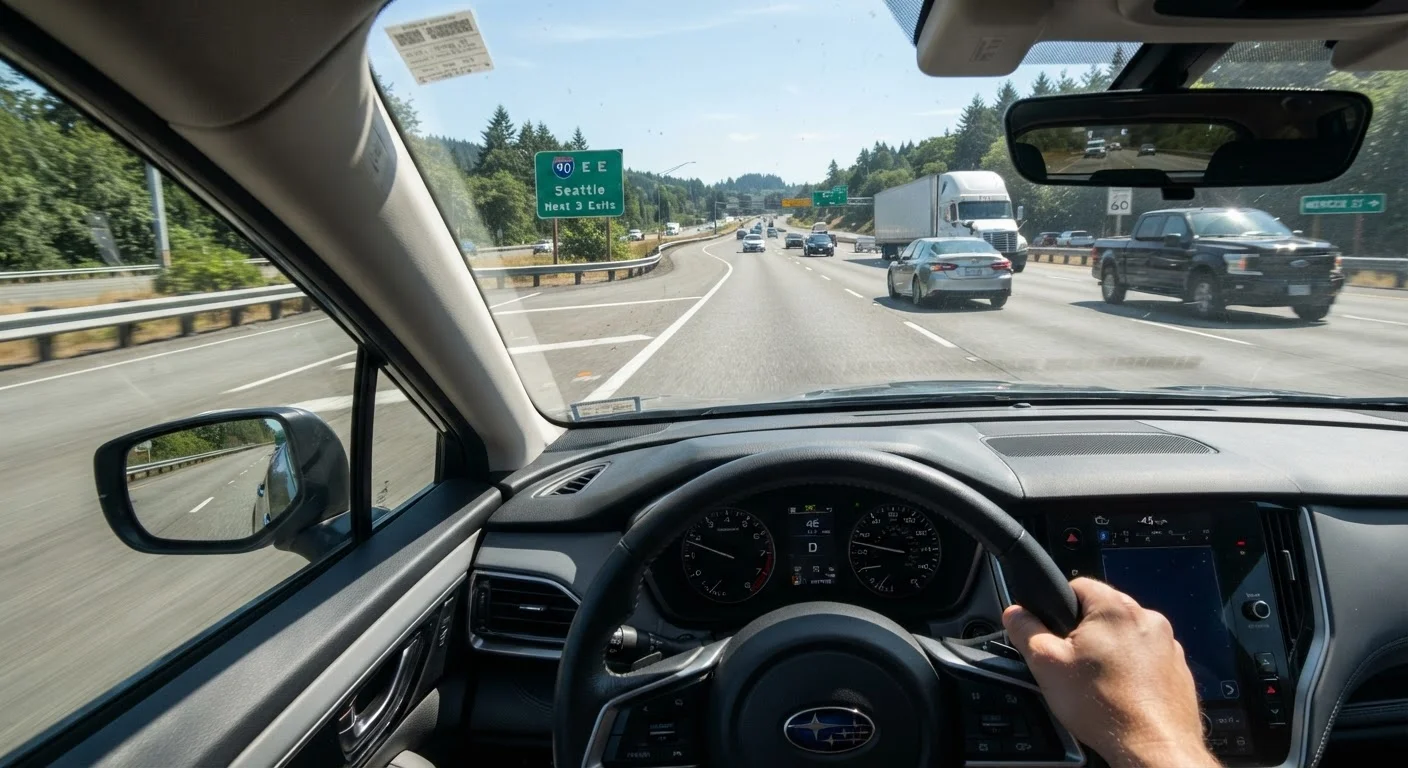
Key Takeaways
- Use the full length of the acceleration lane to match highway traffic speed before merging.
- Signal your intent early - your turn signal communicates to highway drivers before you need to move.
- Yielding to highway traffic is your legal responsibility as the merging driver in all U.S. states.
- Highway drivers can help by moving over one lane when it is safe to do so.
- Stopping at the end of an acceleration lane is dangerous and should be a last resort only.
- Poor merging technique is a common trigger for road rage and rear-end collisions.
Highway On-Ramp Merging
Highway on-ramp merging is the process of entering a high-speed roadway from an acceleration lane - the short stretch of road that connects a surface street to the highway. The goal is to match the speed of highway traffic and smoothly join the flow without forcing other vehicles to brake or swerve. Done correctly, it is one of the most important safety skills a driver can have.
Traffic engineers design acceleration lanes to a specific length based on the expected speed differential between surface streets and highway travel speed; the length determines how much time a driver has to reach merging speed before the lane ends.
What the Acceleration Lane Is Actually For
The acceleration lane - sometimes called the merge lane - is not a place to wait or slow down. It exists for one purpose: to give you enough distance to reach highway speed before you enter the travel lanes. Treating it as anything else creates the exact hazard it was designed to prevent.
Many drivers instinctively reduce their speed as they approach the end of the ramp, feeling uncertain about when to commit to the merge. This instinct is counterproductive. A slower vehicle entering fast-moving traffic forces highway drivers to react suddenly, which can cascade into a rear-end collision or a sideswipe. The physics are straightforward - the greater the speed differential at the point of merge, the greater the risk.
The correct approach is to use every foot of the acceleration lane to build speed, so that by the time you reach the gore point (the painted nose where the ramp meets the highway), you are already traveling at or near traffic speed and looking for your gap - not still accelerating.
Scan the Highway Before You Reach the Ramp
Where traffic conditions allow, begin assessing the right lane of the highway while you are still on the surface street approaching the ramp. If you can see that the right lane is congested or moving slowly, you can mentally prepare to adjust your acceleration strategy before you even enter the ramp. This early scanning removes some of the time pressure once you are in the acceleration lane.
The Step-by-Step Mechanics of a Safe Merge
A controlled merge follows a deliberate sequence, not a single last-second lurch into traffic:
- Signal early. Activate your turn signal as soon as you enter the acceleration lane. This alerts highway drivers to your presence before you need to move.
- Build speed aggressively but smoothly. Accelerate toward the posted highway speed limit. Do not wait until the lane is almost over.
- Scan with purpose. Use your mirrors and a quick shoulder check to identify a workable gap in the right lane. A gap is adequate when it gives you and the vehicle behind you room to settle without braking.
- Commit to your gap. Once you identify it, merge decisively. Hesitation causes you to drift alongside another vehicle, which is more dangerous than a confident, slightly early merge.
- Cancel your signal and establish lane position. Once you are fully in the travel lane and stable, cancel the turn signal and match surrounding traffic flow.
This is a learnable sequence, and it becomes automatic with practice. If you are helping a new driver build this skill, the guidance in our guide for parents of teen drivers covers how to introduce complex highway scenarios progressively.
~300,000
Annual U.S. merge and lane-change crashes
The Federal Highway Administration has identified lane changes and merges as a leading crash type on U.S. highways, contributing to hundreds of thousands of reported incidents annually.
25 mph+
Typical speed differential in poor merges
Traffic safety research consistently shows that speed differentials greater than 15-25 mph between a merging vehicle and highway traffic substantially increase the severity of any resulting collision.
~1,500 ft
Typical acceleration lane length on U.S. interstates
AASHTO design guidelines target acceleration lane lengths in the range of 1,000-1,500 feet for standard interstate entry ramps, though actual lengths vary widely by location and age of infrastructure.
What Highway Drivers Should Understand
Merging is a two-driver conversation, even if only one driver is legally obligated to yield. Highway drivers who understand this create safer roads for everyone.
When you see a vehicle on an on-ramp, the least-risk option - if your lane is clear - is to move one lane left. This is not legally required in most states, but it eliminates the merge conflict entirely. If moving over is not possible, a small, gradual ease off the accelerator can open a gap without disrupting the vehicles behind you.
What highway drivers should not do is accelerate to close a gap, maintain a position alongside a merging vehicle, or lean on the horn as a first response. These reactions escalate tension and increase risk. Our article on road rage and aggressive driving explains how quickly minor friction on the highway can become a dangerous situation - and how to avoid letting it reach that point.
Common Errors and How to Avoid Them
Most on-ramp problems trace back to a small set of repeatable mistakes:
- Stopping at the end of the ramp. This puts you - and anyone behind you on the ramp - at serious risk. Only stop if traffic is at a complete standstill. Otherwise, continue moving and find your gap.
- Merging too slowly. If you enter the highway at 40 mph when traffic is moving at 65 mph, you are a slow-moving obstacle in a fast environment. Speed up first, merge second.
- Merging without looking. Mirrors alone are not sufficient. A quick shoulder check eliminates the blind spot that mirrors miss. Make it a habit on every merge.
- Failing to signal. Highway drivers cannot read your intentions. Your turn signal is the only tool you have to communicate before you move.
- Over-correcting after a bad gap. If you miss your gap and the lane ends, it is safer to reduce speed carefully on the shoulder than to force your way in. Forcing a merge from a stopped or near-stopped position is dangerous.
Understanding how speed management applies in other situations - such as the dilemma zone at a yellow traffic light - reinforces the same core principle: commit early, do not hesitate, and manage speed proactively rather than reactively.
A driver joins a busy interstate during rush hour. She accelerates firmly through the entire length of the ramp, signals early, identifies a gap between two cars, and enters the highway already matching traffic speed.
A nervous driver slows to 35 mph near the end of an on-ramp while waiting for what feels like a 'perfect' gap. The vehicle behind him on the ramp has to brake hard to avoid a collision.
A highway driver sees a car accelerating up an on-ramp to his right. His lane is clear to his left, so he smoothly moves over one lane without braking.
A driver realizes too late that she has not found a gap and the lane is ending. She carefully reduces speed onto the paved shoulder and waits for a clear opening before re-entering.