
City Break vs. Nature Escape: Deciding What Your Next Vacation Actually Needs to Be

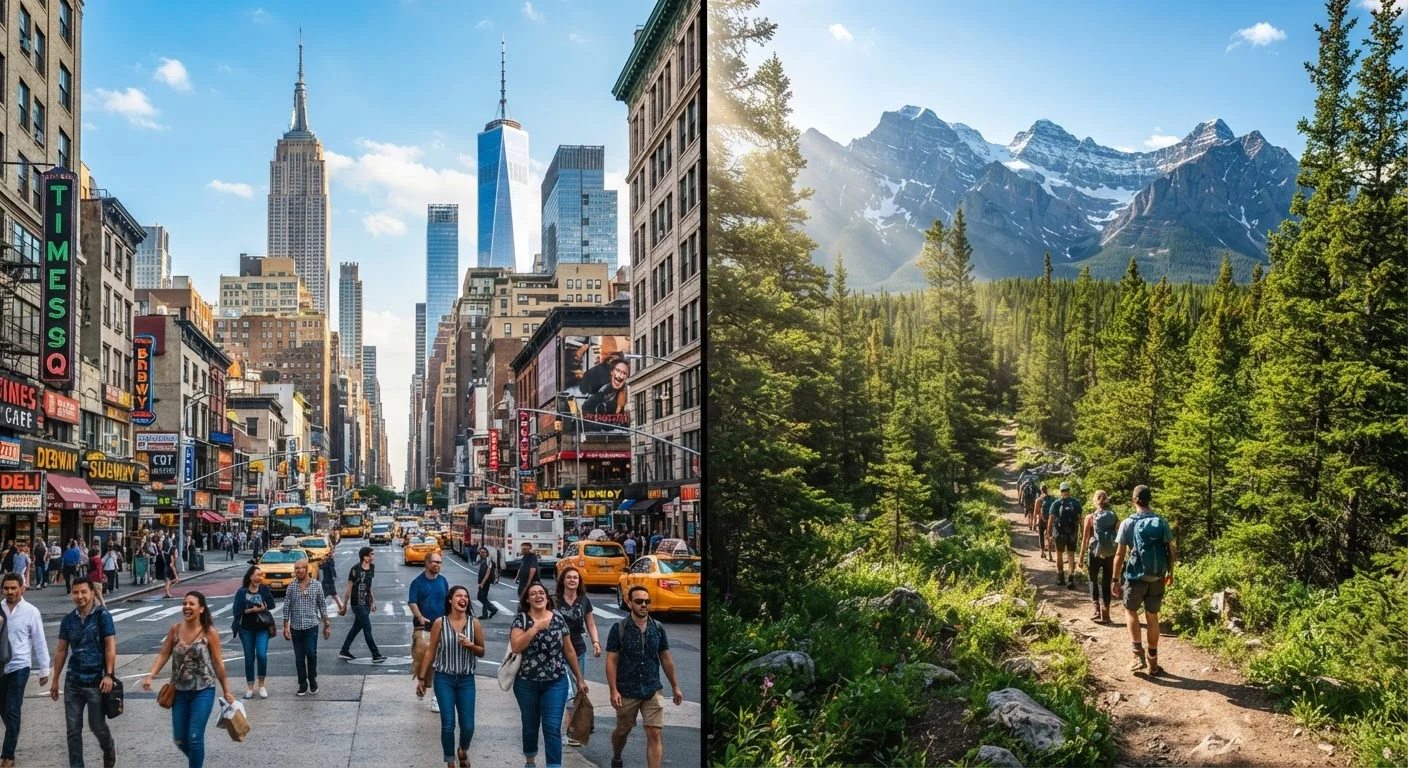
Key Takeaways
- City breaks offer cultural density, dining variety, and walkable convenience - ideal for short trips.
- Nature escapes prioritize decompression, outdoor activity, and disconnection from daily routines.
- Your ideal trip type depends on why you're burned out, not just what sounds appealing right now.
- Budget, travel party, and trip length all meaningfully shift which option fits best.
- Hybrid trips blending city access with nearby nature are a practical middle-ground worth considering.
Our Verdict
Neither a city break nor a nature escape is universally superior - the right choice hinges on what you genuinely need from time away. If you're craving stimulation, culture, and social energy, a city trip delivers more per day. If you need silence, physical reset, and a break from screens and schedules, nature wins decisively. Many travelers find that their gut instinct at the planning stage is the most reliable signal.
| Best for | Recommended |
|---|---|
| Short trips (2-4 days) with a packed schedule | City Break |
| Travelers feeling mentally exhausted or overstimulated | Nature Escape |
| Groups with mixed interests or activity levels | City Break |
| Solo travelers seeking physical challenge and solitude | Nature Escape |
What Are You Actually Running From?
Before you open a booking site, ask yourself one honest question: what does your daily life feel like right now? The answer often points directly to what your vacation should be - and it's not always what you'd guess.
If your days are quiet, routine, and a little stale, a city break's constant stimulation - new restaurants every night, museums, street life, unexpected discoveries around every corner - can feel like a genuine jolt. But if your life is already loud, deadline-driven, and screen-heavy, dropping into more urban density could exhaust you further rather than restore you.
Nature escapes work differently. They remove friction. No crowds competing for the same sidewalk, no notifications demanding your attention, no noise that isn't wind or water. Research consistently suggests that time in natural environments can reduce cortisol levels and improve mood, though individual responses vary. For many people, this low-stimulation environment is exactly the reset a depleted nervous system needs.
Think about what kind of traveler you generally are before committing. Our guide on matching destinations to your travel style can help you clarify your baseline preferences beyond just this one trip.
Comparing the Two: A Side-by-Side Look
City breaks and nature escapes differ across nearly every practical dimension - cost structure, logistics, physical demands, and the kind of memories they produce. Here's how they stack up.
| City Break | Nature Escape | |
|---|---|---|
| Ideal trip length | 2-5 days works well | 4-7+ days to fully decompress |
| Physical demands | Mostly walking, low to moderate | Variable - hiking, altitude, terrain |
| Budget predictability | High upfront, flexible daily | Low daily costs, gear investment upfront |
| Group compatibility | High - diverse options for all | Requires more shared interest |
| Connectivity & convenience | Transit, hotels, services everywhere | Remote areas need advance planning |
| Mental stimulation level | High - culture, food, people | Low to moderate - restorative quiet |
| Best season flexibility | Year-round, weather-dependent | Strongly seasonal in many regions |
A few nuances worth noting: city trips tend to front-load costs (flights into major hubs, hotels in walkable neighborhoods) but give you more daily flexibility. Nature trips can be surprisingly affordable once you're there - camping fees and trail access are often low - but gear, permits, and reaching remote areas can add up. Season matters for both types: peak season timing affects crowds and pricing significantly for popular national parks and major city events alike.
Trip Length, Group Size, and Budget: The Practical Filters
Your constraints often do more decision-making than your preferences. A long weekend strongly favors a city break - you can fly into a well-connected hub, cover meaningful ground on foot, and feel satisfied even with limited time. A nature escape in that same window can feel rushed, especially if the destination requires a long drive or a travel day just to reach the trailhead.
Group dynamics matter enormously. Traveling with people who have different energy levels or interests? Cities are more forgiving - someone can visit a gallery while another person naps or finds a coffee shop. Nature trips demand more alignment: if one person wants to summit a peak and another wants a gentle lakeside walk, logistics get complicated fast. Our piece on planning trips for mixed-comfort groups has practical strategies for exactly this situation.
Try the 'Sunday Night Test'
When you picture your last evening before flying home, what do you want to be doing? If the honest answer is 'sitting at a rooftop bar or catching a final museum,' lean city. If it's 'watching the sun go down over open water or mountains,' lean nature. This small mental exercise often cuts through decision fatigue faster than any checklist.
Solo travelers often find nature escapes particularly rewarding - the solitude is a feature, not a bug. But cities offer easier social spontaneity, which some solo travelers genuinely need. For a fuller look at how travel style interacts with group size, see our comparison of solo vs. group travel.
The Case for Going Hybrid
The most underrated option is one that doesn't force the choice at all. Many of the most satisfying trips blend urban access with nearby wilderness - a few days in Portland before heading into the Columbia River Gorge, or a night in Asheville as a gateway to the Blue Ridge Parkway. For nature without total remoteness, lesser-known US national parks often sit within reasonable distance of mid-size cities.
If you're drawn to international options, destinations like Mexico's interior - explored in our guide to Mexico beyond Cancún - offer colonial cities alongside remarkable natural landscapes, sometimes within the same region.
Once you've landed on a direction, your next step is building a plan that actually holds up. Whether you prefer a tight schedule or a looser framework, our article on structured vs. open-ended trips helps you figure out which planning style suits your chosen trip type - and our guide to building a solid itinerary can take it from there.