

Key Takeaways
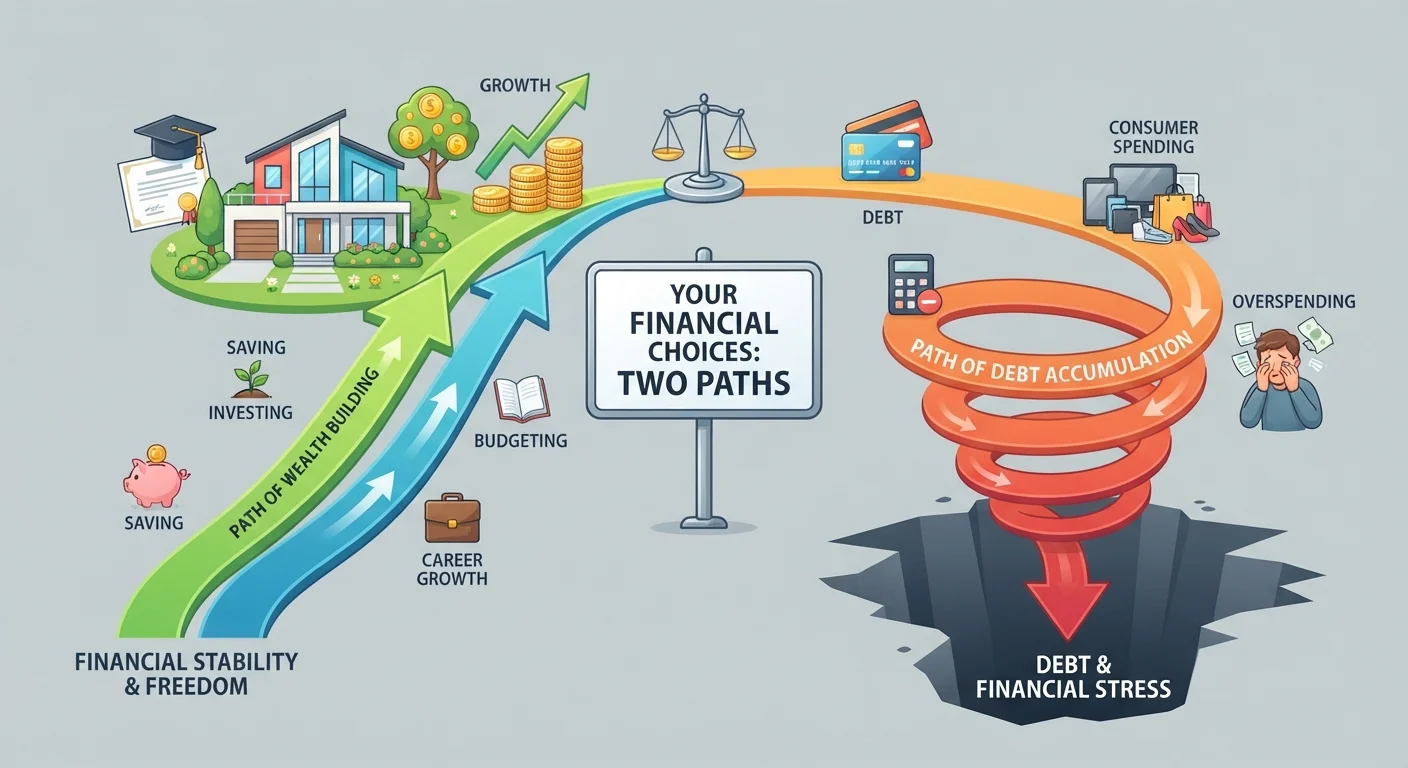
- Good debt typically finances assets that appreciate or increase your income potential over time.
- Bad debt usually funds consumption or depreciating purchases, often at high interest rates.
- Interest rate, purpose, and repayment terms together determine whether debt works for or against you.
- Even 'good' debt carries risk - income loss or over-borrowing can turn any loan problematic.
- Carrying some debt strategically is different from carrying debt because of financial strain.
Option A
Good Debt
Borrowing that has the potential to build long-term value or increase earning power.
Best for: People financing education, a home, or investments that are expected to appreciate or generate returns over time.
Option B
Bad Debt
Borrowing tied to depreciating assets or consumption that offers no lasting financial return.
Best for: Understanding which spending patterns quietly erode financial stability, so you can course-correct.
If you're financing a college degree or vocational training
Good Debt
Education loans can increase lifetime earning potential, though borrowing only what you need and choosing programs with clear career outcomes matters significantly.
If you're financing everyday purchases or vacations on a high-interest credit card
Bad Debt
Revolving balances on high-rate cards cost far more than the original purchase over time and provide no lasting financial return.
If you're taking out a mortgage on a home you can reasonably afford
Good Debt
Real estate historically appreciates, and mortgage interest rates are generally lower than other borrowing forms, making this a more productive use of leverage.
If you're financing a new car you don't strictly need at a high interest rate
Bad Debt
Vehicles depreciate rapidly - often losing significant value in the first few years - making high-rate auto loans a costly financial move.
If you're weighing any borrowing decision for the first time
Good Debt
Understanding debt's purpose, cost, and your repayment capacity before signing is the foundation of responsible borrowing, regardless of loan type.
What Makes Debt 'Good' or 'Bad'?
The phrase "good debt" might sound contradictory - after all, owing money rarely feels like a win. But financial educators use the term to describe borrowing that is reasonably likely to improve your financial position over time, either by building an asset, increasing your income, or both. "Bad debt," by contrast, refers to borrowing tied to consumption or rapidly depreciating items, often at steep interest rates.
The clearest way to distinguish them is to ask three questions: What am I financing? What is the interest rate? And what is my realistic ability to repay? A low-rate loan on a home that builds equity looks very different from a high-rate balance carried month to month on a retail card.
It's worth noting that these categories aren't fixed moral judgments - they're practical frameworks. The same type of debt (say, a student loan) can be well-structured or poorly structured depending on the amount borrowed, the program chosen, and the borrower's financial situation. Context always matters.
The 'Good' Label Doesn't Mean Risk-Free
Classifying a loan as 'good debt' describes its potential - not a guaranteed outcome. A mortgage can turn into a financial hardship if home values decline or income drops. Student loans can become overwhelming if borrowing significantly exceeds what the resulting career is likely to pay. Always evaluate debt relative to your specific financial situation, not just the loan category.
A Side-by-Side Look at the Key Differences
Comparing good and bad debt across concrete criteria helps clarify the concept beyond abstract definitions.
| Criterion | Good Debt | Bad Debt |
|---|---|---|
| Primary purpose | Build assets or increase income | Fund consumption or depreciating goods |
| Typical interest rate | Relatively lower (e.g., mortgages, federal student loans) | Higher to very high (e.g., credit cards, payday loans) |
| Asset value over time | Appreciates or generates returns | Depreciates rapidly or has no lasting value |
| Repayment structure | Fixed, predictable installment terms | Often revolving or short-term with compounding cost |
| Long-term financial impact | Can improve net worth if managed well | Erodes purchasing power and savings capacity |
| Risk level | Moderate - depends on repayment capacity | High - especially when balances compound |
Notice that the dividing line is rarely the type of loan itself - it's the combination of cost (interest rate), purpose (what the money funds), and terms (how the debt is structured). Secured versus unsecured credit is another important structural distinction that affects how much you'll pay and what's at stake if repayment becomes difficult.
Common Examples of Each Type
Debt often considered 'good':
- Mortgages - Financing a home you can afford provides shelter and, historically, long-term appreciation. Rates are generally lower than most other consumer borrowing.
- Student loans - When borrowed in measured amounts for programs with strong job outcomes, education debt can increase lifetime earnings. Overborrowing for degrees with weak market demand shifts the calculation.
- Small business loans - Borrowing to start or grow a business with a viable plan is a calculated bet on your own income-generating capacity.
Debt often considered 'bad':
- High-interest credit card balances - Carrying revolving balances on cards with double-digit APRs means paying significantly more than the original purchase price. See how credit cards compare to personal loans as borrowing tools.
- Payday loans - Short-term, extremely high-rate loans often trap borrowers in cycles of re-borrowing.
- Financing depreciating consumer goods - Borrowing at high rates to buy electronics, furniture, or vehicles you don't need compounds cost on top of rapid value loss.
20%+
Typical APR on credit card balances
The Federal Reserve has reported average credit card interest rates frequently exceeding 20% APR in recent years, making carried balances costly very quickly.
~6-7%
Federal student loan rates (undergraduate)
U.S. federal undergraduate student loan rates have generally ranged between 4% and 7% in recent years, significantly lower than most consumer credit products.
400%+
Effective APR on many payday loans
The Consumer Financial Protection Bureau (CFPB) has noted that payday loans can carry annualized rates exceeding 400%, making them among the most expensive forms of consumer debt.
Why 'Good' Debt Can Still Go Wrong
The good/bad framework is useful, but it can give a false sense of safety. Even a mortgage or student loan becomes a financial burden if you borrow more than your income can support, if your income situation changes, or if the underlying asset doesn't perform as expected.
Over-leveraging is the most common pitfall. Taking on a mortgage that stretches your budget to the limit, or financing a degree at a cost that far outpaces its likely salary return, transforms what looks like productive debt into a source of genuine financial stress. The principle holds: the purpose of borrowing matters, but so does the scale relative to your income and financial cushion.
If you're already managing multiple debts, understanding how to prioritize repayment is as important as categorizing them. Strategies like the debt avalanche and debt snowball methods offer structured approaches to paying down what you owe - and even managing debt on a limited income is achievable with the right framework. For those carrying multiple high-rate balances, debt consolidation may be worth understanding as well.
This article provides general financial education and is not personalized financial, investment, or legal advice. For guidance specific to your situation, consider consulting a licensed financial professional.