

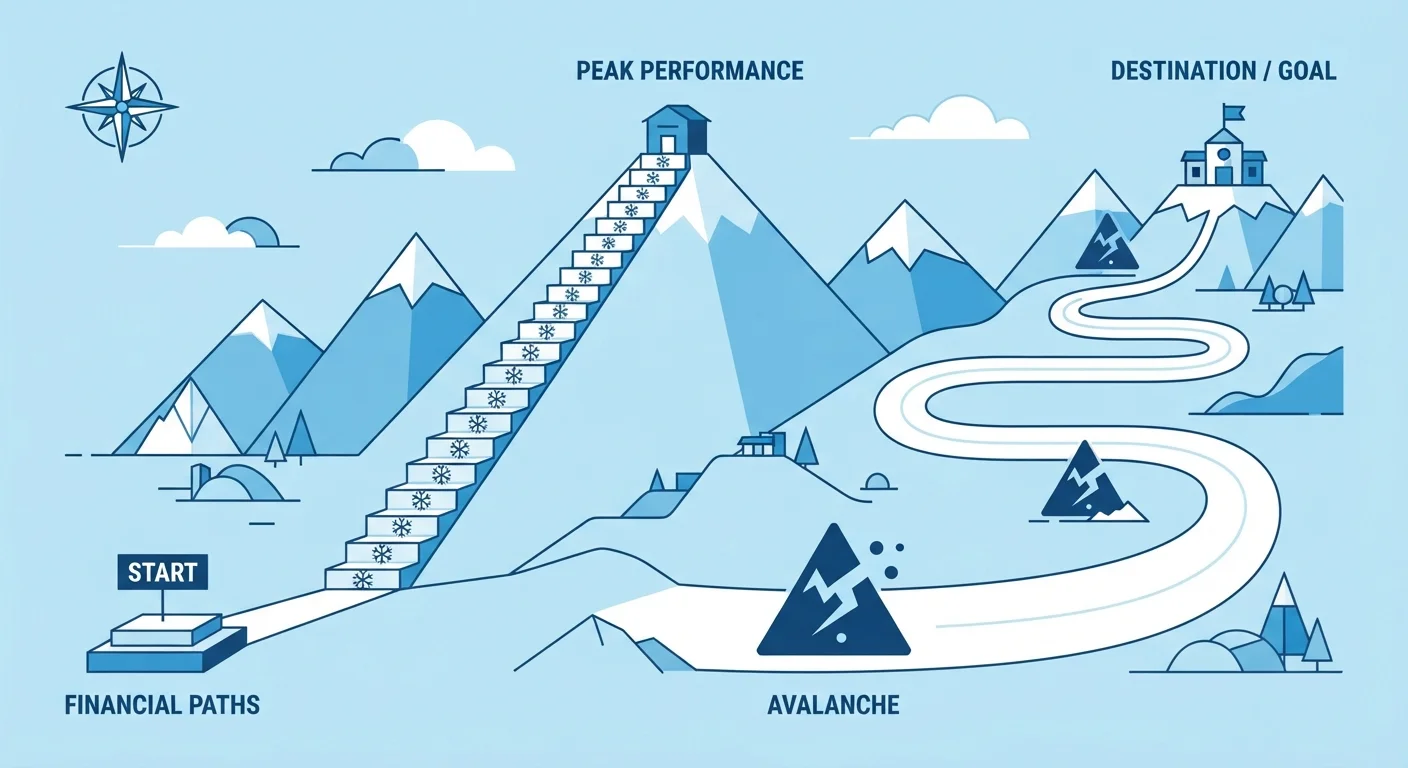
Key Takeaways
- The debt avalanche targets your highest-interest balance first, minimizing total interest paid over time.
- The debt snowball pays off your smallest balance first, generating early wins that sustain motivation.
- Research suggests behavior and consistency matter as much as math when choosing a repayment method.
- Either strategy requires directing any extra money beyond minimum payments toward one target debt at a time.
- Your choice should reflect both your financial situation and your personal track record with follow-through.
Option A
Debt Avalanche
The mathematically optimal approach to eliminating debt.
Best for: Borrowers who are motivated by minimizing total interest paid and can stay disciplined without frequent quick wins.
Option B
Debt Snowball
The psychologically rewarding path to becoming debt-free.
Best for: Borrowers who need early momentum and visible progress to stay committed to a long-term repayment plan.
If you want to pay the least interest possible
Debt Avalanche
By attacking the highest-rate debt first, the avalanche method reduces the total amount of interest that accrues across all your balances over time.
If you've struggled to stick with repayment plans before
Debt Snowball
Eliminating smaller balances quickly creates visible progress that reinforces the habit of paying extra, helping you stay on track longer.
If your debts carry similar interest rates
Debt Snowball
When rates are close together, the interest savings from the avalanche are minimal, so the motivational benefit of the snowball becomes the deciding factor.
If you carry a large high-interest balance like credit card debt
Debt Avalanche
A significantly higher rate on one debt means it is quietly compounding fast; targeting it first prevents a growing interest burden from undermining your overall plan.
How Each Method Works
Both strategies share a common foundation: you make minimum payments on every debt each month, then direct all additional available funds toward one designated target account. The difference is how you choose that target.
Debt Avalanche: You rank your debts by interest rate, highest to lowest. Your extra money goes toward the highest-rate balance until it is paid off, then you roll that payment into the next-highest-rate debt, and so on. The name reflects how momentum builds as each eliminated payment cascades forward.
Debt Snowball: You rank your debts by outstanding balance, smallest to largest. Your extra money eliminates the smallest balance first, regardless of its interest rate. Once that account is cleared, you apply its former payment to the next-smallest balance. The cleared accounts accumulate like a growing snowball.
Both methods work best when there is a consistent surplus available each month beyond minimums. If that surplus is thin right now, our guide to managing debt on a tight income outlines how to build that margin first.
| Criterion | Debt Avalanche | Debt Snowball |
|---|---|---|
| Target selection | Highest interest rate first | Smallest balance first |
| Total interest paid | Lower (mathematically optimal) | Typically higher |
| Time to first payoff | Potentially longer | Faster first win |
| Motivational style | Numbers-driven, long-view | Progress-driven, milestone-based |
| Best rate environment | Wide spread between rates | Similar rates across debts |
| Complexity | Requires tracking APRs | Easy to rank and visualize |
The Real Cost Difference
The avalanche method is mathematically superior in nearly every scenario. By neutralizing high-rate debt before it compounds further, you reduce the total interest you pay across all accounts. The actual dollar difference depends on your specific balances and rates, but it can be significant - particularly if you carry high-rate revolving credit alongside lower-rate installment loans.
The snowball method typically results in paying more interest overall, because lower-balance debts often carry lower rates and would have accrued less interest anyway. However, the gap narrows when balances are similarly sized or when interest rates across your debts are close together.
~$1,000+
Potential interest savings with avalanche vs. snowball
The difference varies widely by balance size and rate spread, but financial educators commonly illustrate scenarios where the avalanche saves hundreds to thousands of dollars.
~80%
Of Americans carrying some form of consumer debt
Federal Reserve and Experian consumer credit data consistently show the large majority of U.S. households carry at least one form of non-mortgage debt.
What both strategies cannot solve alone is an underlying cash-flow problem. If your total debt load feels unmanageable, it may be worth understanding whether debt consolidation changes the math in your favor - though that approach comes with its own trade-offs.
The Behavioral Factor
Research in behavioral economics consistently finds that people do not always act in their mathematical best interest - and debt repayment is no exception. A plan you abandon after four months costs far more than a slightly less optimal plan you stick with for three years.
The snowball method exploits a well-documented psychological principle: small, early wins reinforce the habit of continuing. Clearing a $400 store card balance after two months provides concrete proof that the plan works, which makes it easier to commit to the next target. For many borrowers, that behavioral reinforcement is worth a modest increase in total interest paid.
The avalanche method suits borrowers who track numbers closely, find motivation in spreadsheet projections, and are less reliant on immediate tangible rewards. If you have already demonstrated the discipline to maintain a consistent savings habit, the avalanche approach may align naturally with how you already think about money. See how saving philosophies compare for a related perspective on behavioral versus mathematical approaches to personal finance.
Understanding how different forms of debt - such as credit cards versus personal loans - behave can also sharpen your strategy. Our explainer on credit cards and personal loans walks through the key differences in how each affects your repayment path and credit profile.
This article is for general informational and educational purposes only and does not constitute personalized financial advice. Consult a qualified financial professional for guidance tailored to your specific circumstances.