

Key Takeaways
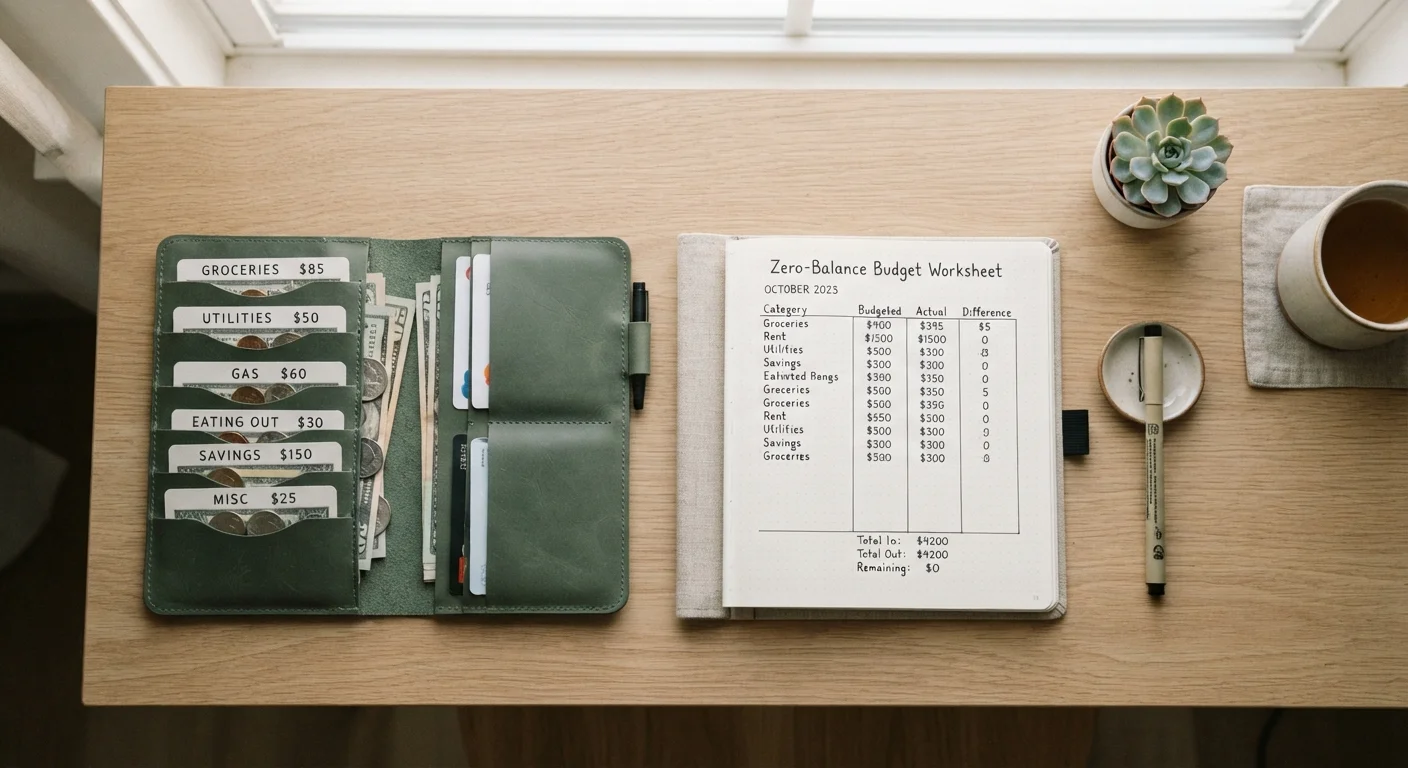
- Zero-based budgeting assigns every dollar of income a specific purpose until the budget reaches zero.
- Envelope budgeting physically or digitally separates cash into spending categories so you cannot exceed each limit.
- Both methods require intentional planning but differ in how they enforce spending boundaries.
- Your lifestyle, income type, and relationship with money should guide which system you choose.
- Combining elements of both approaches is a valid strategy for many households.
Option A
Zero-Based Budgeting
The meticulous, every-dollar-has-a-job approach.
Best for: People who want complete control over every spending category and are comfortable working with digital tools or detailed spreadsheets.
Option B
Envelope Budgeting
The tactile, cash-in-hand system for natural spenders.
Best for: People who overspend on discretionary categories and need a physical or visual spending limit to stay on track.
If you have variable income or complex finances
Zero-Based Budgeting
Zero-based budgeting's flexibility lets you reallocate categories each month based on what you actually earn, making it easier to adapt to income swings.
If you consistently overspend on groceries, dining, or entertainment
Envelope Budgeting
Hard category limits - whether in cash or a digital envelope app - remove the temptation to justify overspending after the fact.
If you prefer digital tools and detailed financial tracking
Zero-Based Budgeting
Zero-based budgeting integrates naturally with spreadsheets and budgeting apps, giving you a bird's-eye view of every financial decision each month.
If you are new to budgeting and want a simple starting point
Envelope Budgeting
The envelope system is intuitive - when the money is gone, it's gone - which builds spending awareness fast without requiring financial expertise.
If you want one system that covers both spending and saving goals
Zero-Based Budgeting
By treating savings as a named budget line item, zero-based budgeting makes saving non-negotiable rather than an afterthought.
How Each Method Works
Understanding what each system actually does - mechanically - makes the comparison much clearer.
Zero-based budgeting (ZBB) starts with your total monthly income and requires you to assign every dollar to a category until the difference between income and expenses reaches zero. That doesn't mean spending everything; savings, investments, and debt payments count as assigned categories. The goal is that no dollar sits unplanned. You rebuild this budget from scratch each month, which means irregular expenses get addressed rather than forgotten.
Envelope budgeting divides your spending money into discrete buckets - traditionally physical cash envelopes labeled by category (groceries, gas, dining out, etc.). You fund each envelope at the start of the period, and when that envelope is empty, spending in that category stops. Digital versions replicate this with sub-accounts or budgeting apps, but the core mechanic is identical: a hard, pre-set limit per category.
If you've never built a formal budget before, see our step-by-step guide to building your first monthly budget before choosing a system - the groundwork is the same regardless of which method you pick.
| Criterion | Zero-Based Budgeting | Envelope Budgeting |
|---|---|---|
| Core mechanic | Assign every dollar a job until balance = zero | Pre-load fixed cash into spending category envelopes |
| Spending enforcement | Self-enforced; relies on discipline to stay in category | Structurally enforced; empty envelope = spending stops |
| Best for income type | Variable or irregular income | Steady, predictable income |
| Setup complexity | Moderate - monthly rebuild required | Low - fund envelopes and go |
| Flexibility mid-month | High - reallocate categories as needed | Low - moving envelope funds requires deliberate choice |
| Savings integration | Built-in as a named category | Requires a dedicated savings envelope |
| Digital tool availability | Wide - many apps and spreadsheets support it | Growing - digital envelope apps now widely available |
| Ideal user profile | Detail-oriented planners with multiple financial goals | Visual learners prone to discretionary overspending |
The Real Differences in Practice
On paper both systems demand intentionality. In practice, they ask very different things of you.
Zero-based budgeting requires a monthly planning session - often 30 to 60 minutes - to allocate income across categories. It rewards people who enjoy seeing their full financial picture in one place, including savings targets and debt payoff timelines. The weakness: it relies heavily on self-enforcement. Nothing stops you from moving money between categories mid-month if willpower wavers.
Envelope budgeting enforces limits structurally. Once the dining envelope is empty, the decision is already made. This is particularly effective for discretionary categories where emotional or impulse spending tends to happen. The trade-off is reduced flexibility - a large, unexpected expense in one category can disrupt the entire system if you haven't built a buffer.
Irregular spending is a common budget killer for both methods. Our article on why most budgets fall apart after week two covers how forgotten irregular expenses derail even well-intentioned plans - something both systems require you to actively plan for.
~33%
Americans with a detailed monthly budget
Gallup polling has consistently found that fewer than one in three U.S. adults maintains a detailed household budget, suggesting most people manage spending without a formal structure.
60%+
Adults living paycheck to paycheck at some point
Multiple Federal Reserve and consumer finance surveys indicate a majority of Americans have experienced periods with little to no financial cushion between paychecks.
$500-$1,000
Common shortfall for unexpected expenses
Federal Reserve research has found that a meaningful share of U.S. adults would struggle to cover an unexpected $400-$1,000 expense without borrowing - underscoring the importance of budget-linked emergency funds.
Choosing the Right Fit - and Knowing When to Adjust
Neither system is universally superior. The right choice depends on your income structure, spending habits, and what budgeting friction you can realistically sustain.
Choose zero-based budgeting if your income varies month to month, if you have multiple savings goals running in parallel, or if you find that tracking numbers gives you a sense of control rather than anxiety. It also pairs well with the 50/30/20 budgeting framework as a starting point for deciding how to allocate your categories.
Choose envelope budgeting if you've tried tracking-only methods and kept overspending, if you respond better to tangible limits than abstract numbers, or if your budget is relatively simple with a handful of key spending categories.
Many households find that a hybrid works well: zero-based planning for savings and fixed expenses, envelope-style limits for discretionary categories like food and entertainment. If your current method is producing stress without results, that's a sign the structure - not your discipline - may need rethinking. Our guide on signals that your budget needs a reset can help you diagnose what's actually going wrong.
This article is for general informational and educational purposes only and does not constitute personalised financial advice. Consider speaking with a qualified financial professional about your specific situation.