

Key Takeaways
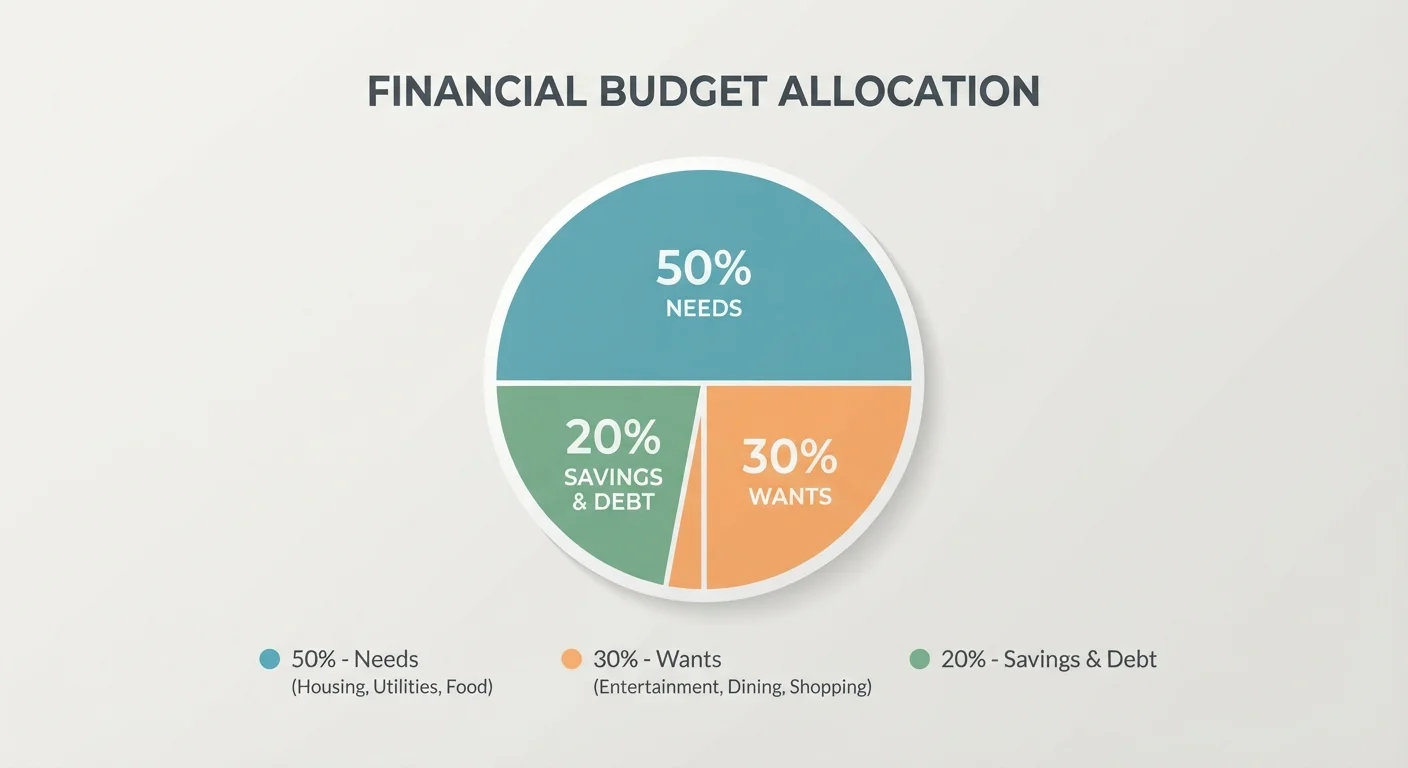
- The 50/30/20 rule divides after-tax income into needs, wants, and savings or debt repayment.
- Needs include housing, food, utilities, and minimum debt payments - not every recurring expense.
- The 20% savings bucket covers emergency funds, retirement contributions, and extra debt payments.
- The framework works best for those with stable, predictable incomes.
- Most people will need to adjust the percentages to fit their actual cost of living.
- It's a starting framework, not a guarantee of financial outcomes - consulting a financial professional is advisable for complex situations.
The 50/30/20 Rule
The 50/30/20 rule is a personal budgeting framework that divides your after-tax income into three broad categories: 50% toward needs, 30% toward wants, and 20% toward savings or debt repayment. It's designed to give people a simple, flexible structure for managing money without requiring detailed expense tracking. The approach is intended as a starting point, not a rigid prescription.
The framework is commonly attributed to U.S. Senator Elizabeth Warren and her daughter Amelia Warren Tyagi, who outlined it in their 2005 book 'All Your Worth: The Ultimate Lifetime Money Plan.' It uses after-tax (take-home) income as the baseline, not gross income.
How the Three Buckets Work
The 50/30/20 rule organizes your monthly after-tax income into three spending categories. Understanding what belongs in each bucket is more important than memorizing the percentages themselves.
50% - Needs
This half of your income covers the essentials: rent or mortgage payments, groceries, utilities, health insurance premiums, transportation costs required for work, and minimum required payments on debts. The key test is whether you could function without the expense. If going without would seriously compromise your housing, health, or employment, it's likely a need.
A common mistake is treating every recurring bill as a need. A streaming service, gym membership, or premium phone plan may feel essential, but they typically fall into the wants category.
30% - Wants
Wants are discretionary expenses that improve quality of life but aren't strictly necessary. Dining out, entertainment, travel, hobbies, clothing beyond basic needs, and subscription services all belong here. This bucket isn't a reward - it's an honest acknowledgment that sustainable budgets include spending on things people enjoy.
20% - Savings and Debt Repayment
The final fifth covers financial progress: building an emergency fund, contributing to a retirement account such as a 401(k) or IRA, and paying down debt faster than the minimum required. Which of these takes priority depends on your individual situation - factors like high-interest debt, employer matching contributions, and whether you have a cash cushion all matter.
If you're just starting out, our first monthly budget guide walks through how to categorize your actual expenses step by step.
Start With a Single Month of Real Data
Before applying any percentage targets, pull three months of bank and credit card statements and categorize each expense as a need, want, or savings contribution. Seeing your actual split first makes the 50/30/20 targets feel grounded rather than arbitrary. Most people are surprised by how much the wants category has crept up over time.
Where the Rule Works Well - and Where It Struggles
The 50/30/20 framework is deliberately broad. That simplicity is both its strength and its limitation.
Strengths
- Low barrier to entry: You don't need budgeting software or spreadsheets to apply it. Three numbers are easy to remember.
- Flexibility: It sets targets, not rules. You can spend your wants money on whatever you choose.
- Built-in savings habit: Allocating 20% from the start treats savings as a fixed commitment, not an afterthought.
Limitations
- High cost-of-living areas: In cities where rent consumes 40-50% of take-home pay, the math simply doesn't work without adjusting the percentages.
- Irregular income: Freelancers and gig workers often can't apply fixed percentages to a fluctuating paycheck. The irregular income budgeting strategies article covers practical alternatives.
- Significant debt loads: If minimum payments alone consume a large share of income, the 50% needs bucket may be overrun before you've accounted for food or utilities.
The rule works best as a diagnostic tool. Run your numbers against the 50/30/20 split once to see where your spending actually lands. The gaps often reveal more than the percentages themselves.
The Rule Uses After-Tax Income
A common source of confusion is applying the 50/30/20 percentages to your gross salary rather than your take-home pay. Always use the amount that actually reaches your bank account after federal and state taxes, Social Security, and Medicare withholding. Pre-tax retirement contributions (such as a traditional 401(k)) add a layer of nuance - some financial educators count the employer match as part of the 20% savings bucket even if it's withheld before taxes.
Adjusting the Framework to Your Situation
Think of the 50/30/20 rule as a template, not a mandate. Many financial educators suggest treating the percentages as targets to work toward rather than thresholds you must hit immediately.
57%
Americans with less than $1,000 in savings
A GOBankingRates survey found that a majority of Americans report having very limited liquid savings, underscoring the importance of the 20% savings allocation.
30%+
Income spent on housing by renters
The U.S. Census Bureau reports that roughly half of all renters are 'cost-burdened,' spending more than 30% of gross income on housing - often compressing what the 50/30/20 framework allows.
20%
Recommended savings and debt repayment share
Financial planners broadly endorse directing at least 20% of after-tax income to savings and accelerated debt repayment as a foundation for long-term financial stability.
Common Modifications
- High-debt situation
- Temporarily shift 5-10% from wants into debt repayment until high-interest balances are reduced. The wants bucket can expand once that pressure eases.
- Aggressive savings goal
- Some people prefer a 50/20/30 inversion - capping wants at 20% and directing 30% to savings and investments. This can accelerate goals like a home down payment or early retirement.
- Early career or low income
- If needs legitimately exceed 50%, focus first on bringing that figure down over time - whether through increased income, reduced housing costs, or refinancing debt - rather than squeezing wants to near zero and burning out.
Regularly reviewing your budget against your actual numbers is essential. A monthly budget audit checklist can help you spot where your allocations are drifting and realign them before habits solidify.
For those whose budgets feel structurally broken despite their best efforts, signs your budget needs a reset outlines when the problem may be the framework itself, not your willpower.
Once your savings rate is stable, the 20% bucket can also serve as a foundation for early investing decisions. Understanding investing basics can help you make the most of what you've set aside.
This article is for general informational and educational purposes only and does not constitute personalized financial advice. Consult a qualified financial professional before making decisions about your specific financial situation.