

Key Takeaways
- Pay-yourself-first treats saving as a fixed expense, transferring money before discretionary spending begins.
- Save-what's-left relies on spending discipline throughout the month, with saving from any remaining balance.
- Research consistently shows automated, priority-first saving leads to higher average savings rates.
- Save-what's-left can work for people with highly variable income or tight cash-flow constraints.
- Both methods can be combined or adjusted as your financial situation changes over time.
- Consulting a qualified financial adviser can help you tailor either approach to your specific goals.
Our Verdict
Pay-yourself-first has a stronger track record for building consistent savings because it removes the decision from the end of the month - when willpower and cash are both typically depleted. Save-what's-left is not inherently flawed, but it demands a level of daily spending discipline that most people find difficult to sustain. For the majority of savers, automating a transfer on payday is the more reliable path to growing wealth over time.
| Best for | Recommended |
|---|---|
| Those who want a reliable, low-effort saving habit | Pay-Yourself-First |
| Freelancers or workers with irregular income needing spending flexibility | Save-What's-Left |
| People already budgeting carefully with surplus at month's end | Save-What's-Left |
| Those building an emergency fund or investing for retirement | Pay-Yourself-First |
The Core Idea Behind Each Approach
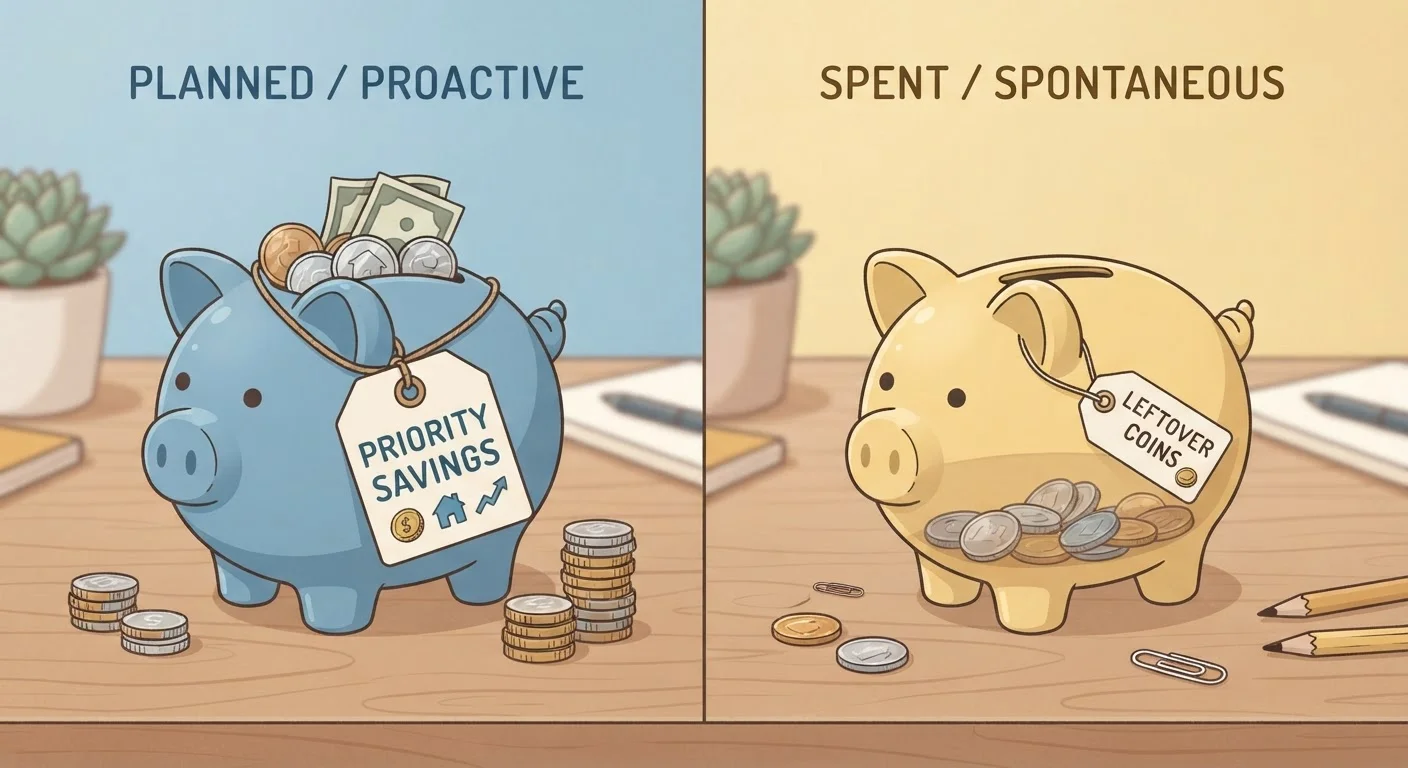
Pay-yourself-first is exactly what it sounds like: the moment income arrives, a predetermined amount moves into savings - before rent, groceries, or any other expense. What remains is what you live on. The saving decision is made once, automated, and then largely forgotten.
Save-what's-left works in reverse. You cover your expenses, pay your bills, and handle daily spending throughout the month. If a balance remains at the end, it goes to savings. The appeal is flexibility; the risk is that discretionary spending tends to expand to fill available space.
Neither method is morally superior, but they operate on very different psychological premises. Pay-yourself-first treats saving as non-negotiable. Save-what's-left treats it as conditional. That distinction has real consequences over time. For a broader look at how structure shapes spending decisions, see Zero-Based Budgeting vs. Envelope Budgeting.
How Pay-Yourself-First Works in Practice
The mechanics are straightforward. On payday, an automatic transfer moves a set amount - often a percentage of gross income - to a savings account, retirement plan, or other goal-specific account. The transfer happens before you see the money in your checking account, which is precisely the point.
Common vehicles for this approach include:
- Employer-sponsored retirement plans (e.g., 401(k)): Contributions come directly from payroll before you receive your check.
- Automatic transfers to a high-yield savings account: Scheduled to coincide with each direct deposit.
- Sinking funds: Dedicated sub-accounts for specific goals like a car repair fund or a vacation.
The behavioral science here is well-documented: automating a financial behavior reduces the mental load of executing it and removes the temptation to spend the money instead. It also leverages what researchers call status quo bias - once a system is in place, people tend to leave it running.
Start Small, Then Scale Up
Starting with a figure you can genuinely afford - even 5% of take-home pay - is more durable than setting an ambitious target and abandoning it. You can increase the percentage incrementally as your income grows or fixed expenses drop. Small, consistent contributions compound meaningfully over time.
Starting with a figure you can genuinely afford - even 5% of take-home pay - is more valuable than aiming for an ambitious number and abandoning it. You can increase the percentage incrementally as your income grows or expenses drop.
How Save-What's-Left Works in Practice
This approach requires no automation setup, no predetermined percentage, and no upfront commitment. You pay bills, manage variable expenses, and at the end of your budget period - typically the month - transfer whatever remains to savings.
Save-what's-left can be a reasonable fit when income is irregular. A freelancer whose monthly earnings fluctuate by several hundred dollars may not be able to commit to a fixed transfer without risking overdraft. In that context, saving a variable amount based on actual results is a practical compromise.
The structural weakness is predictable: expenses tend to grow into available income. Without a firm ceiling on discretionary spending, many people find the "leftover" amount to be consistently small - or zero. Research from behavioral economics has long suggested that people generally underestimate future expenses and overestimate future discipline.
For those who use this method, pairing it with intentional spending cutbacks can meaningfully increase the amount left to save at month's end.
| Pay-Yourself-First | Save-What's-Left | |
|---|---|---|
| When saving happens | Immediately on payday | After all monthly expenses |
| Consistency of savings | High - fixed, automated amount | Variable - depends on spending |
| Behavioral challenge | Setting the right amount upfront | Resisting spending throughout month |
| Works well for irregular income | Less so - requires predictable cash flow | Yes - amount adapts monthly |
| Setup effort | One-time automation required | No setup needed |
| Long-term savings rate | Typically higher | Typically lower |
| Best suited to | Salaried employees, goal-driven savers | Freelancers, flexible budgeters |
Combining the Two - and Knowing When to Switch
These approaches are not mutually exclusive. A common hybrid: automate a conservative fixed transfer on payday, then sweep any remaining surplus at month's end into savings or toward a emergency fund. This preserves the reliability of pay-yourself-first while capturing additional savings when spending runs lean.
Life transitions - a new job, a pay cut, or a major expense like a medical bill - may prompt a temporary switch. If your cash flow tightens, reducing the automatic transfer is preferable to canceling it entirely. Even a nominal automated saving maintains the habit and keeps the account growing, however slowly.
Whichever approach you use, the habits that separate consistent savers from occasional ones tend to share one trait: the saving decision is made in advance, not in the moment. For personal guidance on how much to save and where to direct it, consult a licensed financial adviser who can account for your specific income, debts, and goals.
This article is for general informational and educational purposes only and does not constitute personalized financial or investment advice. Please consult a qualified financial professional before making decisions about your savings strategy.