

Key Takeaways
- Keeping detailed maintenance records protects your home's resale value and supports insurance claims.
- Records should include receipts, warranties, inspection reports, and contractor contact information.
- Both physical binders and digital folders are effective - consistency matters more than the format.
- Well-documented upkeep history can speed up home sales and mortgage refinancing processes.
- Organized records help you stay on schedule with routine maintenance and catch recurring problems early.
Why Maintenance Records Are Worth the Effort
Most homeowners fix something, pay the bill, and file the receipt - somewhere. When it's time to sell the house, file an insurance claim, or figure out why the same pipe keeps leaking, that paperwork is nowhere to be found. A simple, consistent documentation habit prevents that frustration and has real financial payoff.
Home buyers and their agents routinely ask for proof of upkeep during a sale. Being able to hand over a complete service history - roof replacement, HVAC tune-ups, pest inspections - signals that the property has been responsibly maintained. It can also support your asking price. On the insurance side, documented evidence of routine maintenance can strengthen a claim and help establish that damage wasn't caused by neglect.
For ongoing upkeep, pairing your records with a structured schedule pays dividends. See our month-by-month maintenance calendar to connect your documentation habit to concrete tasks throughout the year.
Record every repair and service call within 48 hours of completion.
Memory fades quickly, and details like the exact model number replaced or the contractor who did the work become hard to reconstruct later. Timely logging keeps records accurate and complete.
Store warranty documents with their registration confirmation and expiration date clearly noted.
Many homeowners lose warranty coverage simply because they can't locate the original paperwork or don't realize a product is still covered. A noted expiration date makes it easy to file a claim before the window closes.
Keep copies of all permits and final inspection approvals for any permitted work.
Permitted renovations can be difficult to prove without documentation, and unpermitted improvements may need to be disclosed or remediated during a home sale. Permit records also confirm that work met local code at the time of completion.
Log contractor names, license numbers, and contact details alongside each job record.
If a repair fails or a warranty claim requires proof of professional installation, you need to know exactly who did the work. Contractor license numbers can also be verified with your state licensing board if a dispute arises.
Create a simple home profile document listing the age and model of major systems.
Knowing when your roof, HVAC, water heater, and appliances were installed helps you plan for eventual replacement costs and prioritize maintenance budgets. It also gives any emergency repair technician a head start.
What to Keep in Your Home Records File
Not every scrap of paper deserves permanent storage, but certain categories of documents should be preserved for the life of your ownership - and ideally handed to the next owner.
~$4,000
Average cost of a major home repair incident
Home repair and improvement research consistently finds that unexpected major repairs - such as roof failure or HVAC replacement - cost homeowners several thousand dollars on average, underscoring the value of documented upkeep.
70%+
Of home buyers who request maintenance documentation
Real estate industry surveys indicate that a substantial majority of buyers or their agents request evidence of repairs and servicing history as part of due diligence during a home purchase.
- Repair and service receipts: Date, vendor, work performed, and cost. Include both contractor invoices and major DIY supply purchases.
- Warranties and manuals: Appliances, roofing, windows, HVAC equipment, and water heaters often carry warranties ranging from one to twenty-five years. Keep the original documents and note expiration dates.
- Inspection reports: Home inspections, pest inspections, radon tests, and septic evaluations. These establish the baseline condition of systems at a point in time.
- Permits and certificates of occupancy: Any permitted work - additions, electrical upgrades, deck construction - should be documented with the permit number and final approval. Unpermitted work can complicate a sale or refinance.
- Contractor contact information: When a repair needs to be redone or a warranty claim filed, knowing exactly who did the work saves time.
- Utility and energy records: A running log of energy bills helps identify spikes that may signal insulation problems, failing HVAC equipment, or air leaks.
If your home has safety devices such as smoke detectors and CO alarms, document their installation dates and test logs too. Our safety device maintenance guide explains what records those devices specifically require.
Building a Filing System That You'll Actually Use
The best filing system is one you maintain consistently. Choose a format that fits your habits - a physical binder, a dedicated digital folder, or a combination of both.
Scan Documents Right Away
Don't let receipts pile up in a drawer - paper fades and gets lost. Spend two minutes scanning or photographing each invoice immediately after a job is done, then email it to yourself or upload it to your home folder. This one habit eliminates most filing backlog before it starts.
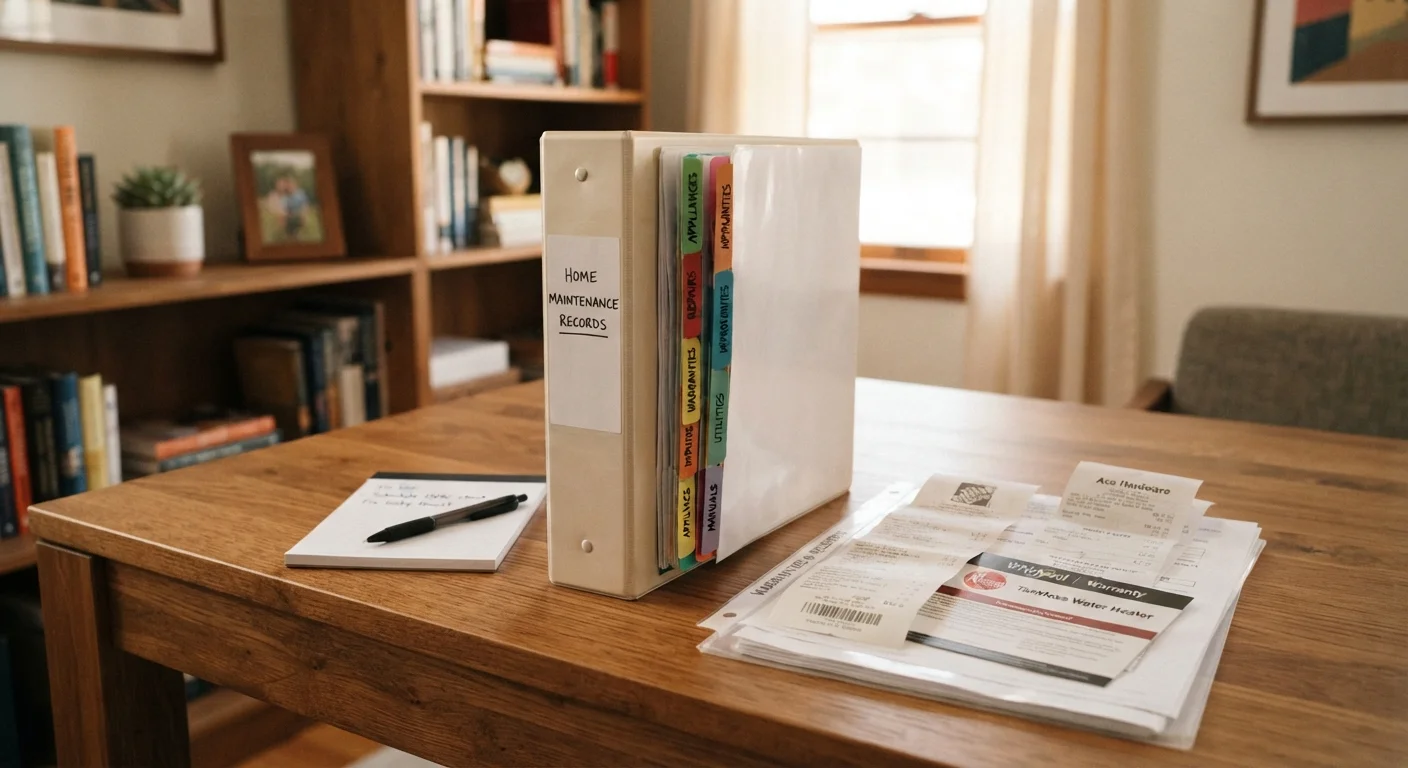
Physical binder approach: Use a three-ring binder with labeled dividers by category: HVAC, Plumbing, Electrical, Roof, Appliances, Permits, Insurance. Store receipts in sheet protectors. Keep the binder in the same place - a filing cabinet, a kitchen drawer, a home office shelf - so it's always accessible.
Digital folder approach: Create a top-level folder titled with your address. Use subfolders matching the same categories above. Scan or photograph receipts immediately after a job is complete. Store digital copies in a cloud service so they survive a hard drive failure or house fire.
Hybrid method: Keep originals in a physical binder and scan everything into a mirrored digital folder. This provides redundancy without significant extra effort.
Whatever system you choose, set a recurring reminder - quarterly works well - to file any documents that have accumulated since your last session. A routine upkeep overview can help newer homeowners identify which systems generate the most paperwork to plan for.
When a repair involves judgment calls about scope or complexity, documentation also helps you track decisions. For guidance on which jobs to hand off entirely, see our article on when to call a professional.