

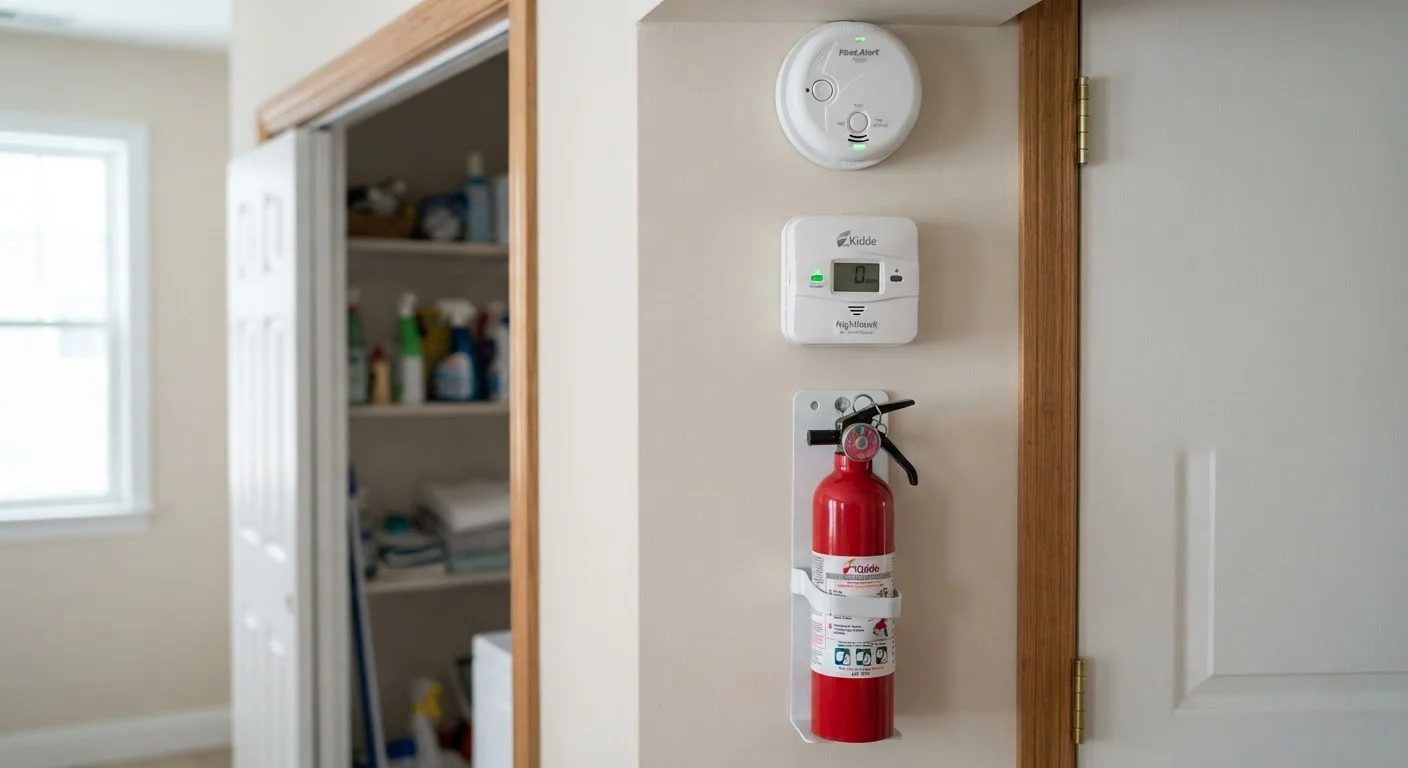
Key Takeaways
- Smoke detectors and CO alarms should be tested monthly and replaced every 7-10 years depending on type.
- Carbon monoxide is odorless and invisible - a functioning CO alarm is your only reliable warning.
- Fire extinguishers need annual visual inspection and professional service every six years.
- Proper placement of each device is just as important as regular testing.
- Logging your inspection dates helps you stay on schedule and supports insurance documentation.
What you will need
Why Life-Safety Device Maintenance Can't Be Skipped
Smoke detectors, carbon monoxide (CO) alarms, and fire extinguishers are passive fixtures until the moment they're desperately needed. That gap between installation and emergency is exactly where maintenance matters. A smoke detector with a dead battery or a CO alarm past its sensor lifespan offers zero protection - even though it looks perfectly fine on the wall.
According to the National Fire Protection Association (NFPA), roughly three of every five home fire deaths occur in properties with no working smoke alarms. The most common reason? Missing or dead batteries, or sensors that have aged past their reliable lifespan. The same logic applies to CO alarms: carbon monoxide is colorless and odorless, so a non-functioning alarm gives no warning whatsoever.
This guide walks you through the complete maintenance routine for all three device types, including what to check, how often, and when to replace. For a broader look at home upkeep habits, see our guide for first-time homeowners.
What you will need
Placement: Getting the Foundation Right
Even a perfectly maintained device will underperform if it's in the wrong location. Use these NFPA-aligned placement standards as your baseline - always verify local code requirements with your municipality, since some jurisdictions have stricter rules.
Smoke Detectors
- Install on every level of your home, including the basement.
- Place inside every bedroom and outside each sleeping area.
- Mount on the ceiling or high on a wall (within 12 inches of the ceiling).
- Keep at least 10 feet from cooking appliances to reduce nuisance alarms.
Carbon Monoxide Alarms
- Install on every level of the home and outside each sleeping area.
- CO is roughly the same density as air, so mid-wall or ceiling placement both work.
- Keep them away from fuel-burning appliances - CO alarm placement is about coverage, not proximity to the source.
Fire Extinguishers
- Mount one in the kitchen, ideally near the exit - not directly over the stove.
- Add one in the garage and any workshop or utility area.
- Mount at a height accessible to all adults in the household (handle typically at 3.5-5 feet).
9-Volt or AA Replacement Batteries
Power non-sealed smoke and CO alarms; required for annual battery replacement.
Compressed Air Can or Soft Vacuum Brush
Clears dust and debris from detector vents during semi-annual cleaning.
Step Stool or Ladder
Provides safe access to ceiling-mounted smoke detectors and CO alarms.
Maintenance Log (Notebook or Digital Spreadsheet)
Records test dates, battery replacements, and inspection results for all safety devices.
Screwdriver
May be needed to remove and remount detector mounting brackets during cleaning or replacement.
Your Step-by-Step Maintenance Routine
Consistency is the key. Tying your safety checks to recognizable calendar anchors - like daylight saving time changes or the start of each season - helps turn maintenance from an afterthought into a habit. Keep a log of your inspection dates; this protects you during insurance claims and helps you track replacement timelines. Our article on home maintenance records explains a straightforward filing system for exactly this kind of documentation.
Test every smoke detector monthly
Press and hold the test button on each smoke detector until the alarm sounds - this typically takes 2-5 seconds. A loud, clear alarm indicates the siren and basic electronics are working. If the alarm sounds weak or does not sound at all, replace the battery first, then retest. If it still fails, replace the unit.
Test every CO alarm monthly
Press the test button on your CO alarm and hold it for several seconds. A functioning alarm will beep in a pattern (typically four beeps, a pause, four beeps). Refer to your device's manual for the exact test sequence, since patterns vary by manufacturer. If the unit chirps but doesn't complete a full test cycle, replace the battery and try again.
Replace batteries at least once a year
Even if your detectors are functioning, replace batteries in all non-sealed units on a set annual schedule. A common approach is to swap batteries when clocks change in the fall. For units with sealed, 10-year lithium batteries, battery replacement is not necessary - but you should still perform monthly tests and replace the entire unit at end of life.
Clean detectors every six months
Dust, insects, and airborne debris can accumulate inside smoke detector chambers and interfere with sensor accuracy. Using a can of compressed air or a soft vacuum brush attachment, gently clean the vents and interior slots of each detector. Do not use liquid cleaners or spray anything directly into the unit.
Visually inspect your fire extinguisher monthly
Check that the pressure gauge needle sits in the green zone. Confirm the safety pin and tamper seal are intact. Look for visible damage such as dents, rust, or a cracked hose. Verify the unit is mounted securely in its bracket and accessible without obstruction. Note any concerns in your maintenance log.
Schedule professional fire extinguisher service
Every six years, have your extinguisher inspected and serviced by a certified fire protection professional - this involves internal examination, proper recharging if needed, and documentation. Every 12 years, hydrostatic (pressure) testing is required on rechargeable units. Keep the service tags attached to the extinguisher and log the dates.
Knowing When to Replace Each Device
Maintenance extends device life, but every safety device has a hard expiration point beyond which testing and battery swaps are not enough.
Smoke Detectors
Most ionization and photoelectric smoke detectors have a rated lifespan of 10 years from the manufacture date (printed on the back of the unit). After that, the sensing chamber degrades and reliability drops significantly - regardless of how well the unit was maintained.
CO Alarms
Most CO alarms have a lifespan of 5-7 years, though some newer models reach 10 years. The electrochemical sensor inside gradually loses sensitivity over time. Check the manufacture date on the label, and replace according to the manufacturer's specified interval.
Fire Extinguishers
A properly maintained extinguisher does not expire in the same way, but it does require a professional inspection every six years and hydrostatic testing (pressure testing) every 12 years. Disposable extinguishers - common in many homes - cannot be recharged and should be replaced after any use or after 12 years.
Never Ignore an Intermittent Chirp
A chirping smoke detector or CO alarm is not just an annoyance - it's a diagnostic alert. A repeating single chirp usually signals a low battery; a different chirp pattern may indicate end-of-life sensor failure. Consult your device manual to identify the pattern. Silencing or removing the battery without addressing the underlying issue leaves your household unprotected.
When in doubt about any device's age, check the manufacture date stamped or printed on the unit. If you can't find it, replace the device - the cost of a new alarm is trivial compared to the risk of relying on an unknown-age sensor.