

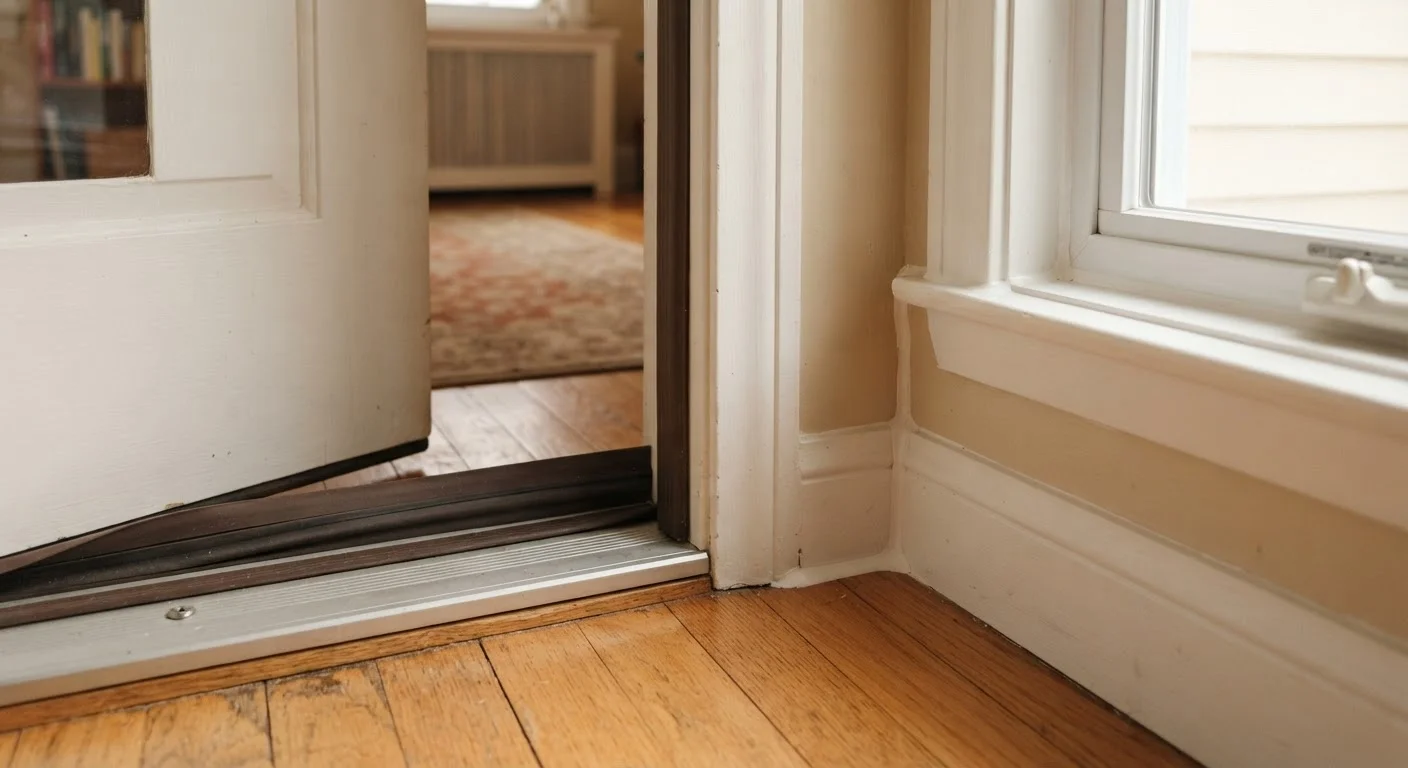
Key Takeaways
- Caulk works on stationary gaps; weatherstripping handles moving parts like doors and operable windows.
- Using the wrong product leads to premature failure - caulk cracks when applied to moving joints.
- Many homes need both products working together to fully eliminate drafts.
- Weatherstripping typically needs replacement every few years; caulk can last a decade when applied correctly.
- Proper surface prep is the single biggest factor in how long either seal lasts.
Option A
Caulk
The permanent, rigid seal for stationary gaps.
Best for: Best for sealing fixed joints between non-moving surfaces like window frames, baseboards, and exterior siding.
Option B
Weatherstripping
The flexible, compressible seal for moving parts.
Best for: Best for sealing the perimeter of doors and operable windows that open, close, and flex with temperature changes.
If you're sealing around a fixed window frame or exterior trim
Caulk
Fixed joints don't move, so caulk's rigid bond creates a durable, long-lasting air and moisture barrier without breaking down.
If you're stopping drafts around an exterior door or casement window
Weatherstripping
Doors and operable windows flex and compress with every use; weatherstripping is designed to absorb that movement without tearing.
If your home has both drafty doors and gaps around fixed trim
Both
A complete air-sealing strategy almost always requires caulk on stationary surfaces and weatherstripping on moving edges - they complement each other.
If you're preparing for a cold season on a tight budget
Weatherstripping
Door and window perimeter gaps are typically the largest single sources of air infiltration and can be addressed with inexpensive foam or felt tape.
Understanding the Core Difference
Both caulk and weatherstripping exist to stop unwanted air movement - but they're engineered for entirely different conditions. Applying the wrong one doesn't just fail to fix the problem; it often makes future repairs harder.
Caulk is a flexible sealant that cures into a semi-rigid bead. It bonds to two stationary surfaces and fills the gap between them permanently. Common applications include the joint between a window frame and exterior siding, the seam where interior trim meets drywall, or the gap where a bathtub meets tile. Because caulk relies on adhesion to both surfaces, it breaks down quickly when one surface moves repeatedly relative to the other - which is exactly what happens every time you open a door.
Weatherstripping is a compressible material installed along the edges of movable building components - the sides, top, and bottom of doors, or the sashes of double-hung windows. When the door closes, the weatherstripping compresses to fill the gap. When the door opens, it expands back to its original shape. That repeated compression cycle is what it's designed to handle; it's why a foam backer or pile strip in a door jamb outlasts caulk in that location by years.
Think of it this way: if the gap moves, use weatherstripping. If it stays still, use caulk. That single rule resolves most decisions before you even open a package.
Where Each Product Belongs
Knowing the rule is one thing; applying it to real spots around your home is another. Here's a practical breakdown of common locations.
| Criterion | Caulk | Weatherstripping |
|---|---|---|
| Best surface type | Fixed, stationary joints | Moving parts (doors, operable windows) |
| Typical lifespan | 7-15 years when properly applied | 2-10 years depending on material type |
| DIY difficulty | Low - caulk gun, prep, and patience | Low - measure, cut, press or screw |
| Fails when... | Applied over moving joints or damp surfaces | Compressed permanently or surface is oily |
| Common materials | Silicone, latex, polyurethane | Foam tape, V-strip, rubber, pile, felt |
| Works on exterior? | Yes - use paintable or silicone type | Yes - especially door perimeters |
Caulk locations: exterior window frames (where the frame meets the wall), interior window and door casing (where trim meets drywall), gaps between baseboards and flooring, penetrations around pipes or wires entering exterior walls, and any fixed joint in a bathroom or kitchen. For high-moisture zones, the choice of caulk type matters significantly - see our article on why caulk fails in high-moisture areas for guidance on silicone versus latex formulations.
Weatherstripping locations: the full perimeter of exterior door frames (head jamb, side jambs, and threshold), sliding glass doors, garage doors, and the meeting rails of double-hung or casement windows. Door sweeps - which seal the gap between the bottom of the door and the threshold - are a specialized form of weatherstripping and are often the single biggest source of drafts in older homes.
Skipping either fix isn't just uncomfortable. Persistent air leaks contribute to moisture infiltration, higher energy bills, and the kind of deferred damage described in our overview of the hidden costs of skipping small repairs.
Application and Longevity
Both products are DIY-friendly, but each has its own prep requirements that determine how long the seal holds.
Surface Prep Is Non-Negotiable
The most common reason both caulk and weatherstripping fail prematurely isn't the product - it's skipped surface preparation. Caulk won't bond to dusty, oily, or damp surfaces, and self-adhesive weatherstripping won't stick to painted jambs that haven't been wiped clean. Taking five extra minutes to clean and dry the application area before you start is the single most reliable way to extend the life of either fix.
Applying caulk correctly: Clean the joint thoroughly - remove old caulk, dirt, and any loose paint. The surface must be dry; most caulks won't adhere to damp substrates. Cut the tube tip at a 45-degree angle for a clean bead, and tool (smooth) the bead immediately with a wet finger or caulk tool before it skins over. A properly applied bead on a prepped surface can last 10 years or more. A bead applied over old, failing caulk or a damp surface may crack within a single season.
Installing weatherstripping: Measure the full perimeter of the door or window before cutting. Most foam tape and V-strip products are self-adhesive, but the adhesion depends entirely on a clean, dry surface - wipe the jamb with rubbing alcohol before pressing the strip into place. Door sweeps typically require four screws into the door face; make sure the sweep contacts the threshold lightly when the door is closed, without dragging so hard it resists opening. Expect to replace foam compression strips every 2-4 years with regular use; metal or rubber door sweeps last considerably longer.
If your home has significant insulation gaps beyond the window and door perimeter, weatherstripping and caulk only go so far. Pairing air sealing with proper insulation is the next step - our comparison of spray foam vs. fiberglass batt insulation covers how those two approaches differ in cost and effectiveness.