

Key Takeaways
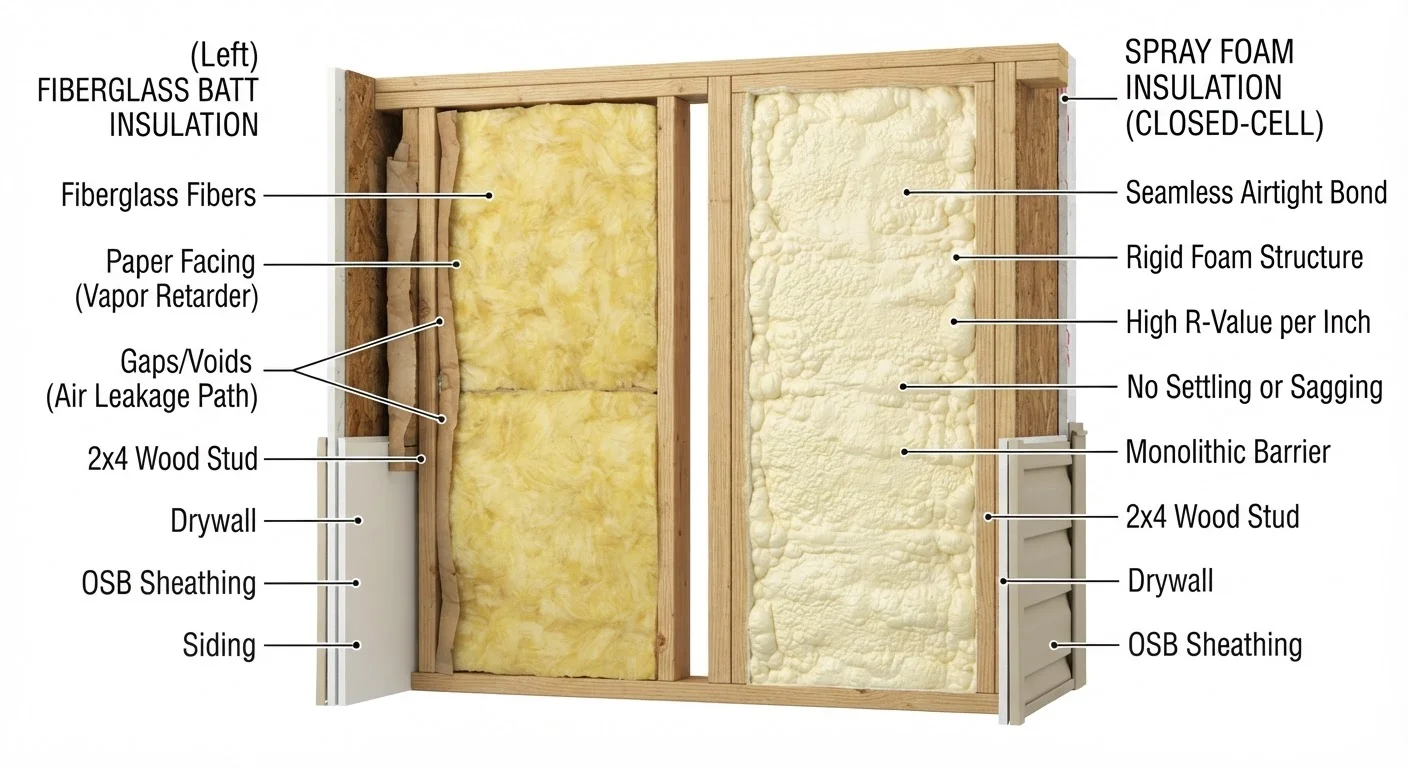
- Spray foam provides superior air sealing and higher R-value per inch compared to fiberglass batt.
- Fiberglass batt is significantly less expensive and can be installed by most DIYers without special equipment.
- Spray foam, especially closed-cell, also acts as a vapor barrier, adding moisture protection fiberglass alone cannot match.
- Fiberglass batt loses effectiveness quickly when air moves through gaps or is installed improperly.
- Open-cell spray foam is more affordable than closed-cell but offers lower R-value and less moisture resistance.
- Licensed professionals are generally required for spray foam installation due to chemical hazards and equipment demands.
Option A
Spray Foam Insulation
The air-sealing, high-performance option for tight building envelopes.
Best for: Homeowners prioritizing maximum air sealing, moisture control, and long-term energy performance in hard-to-reach or irregularly shaped cavities.
Option B
Fiberglass Batt Insulation
The widely available, budget-friendly choice for standard framed cavities.
Best for: DIYers tackling straightforward wall, floor, or attic projects with standard stud spacing and a modest budget.
If you want a weekend DIY project with manageable costs
Fiberglass Batt Insulation
Fiberglass batt requires no special equipment or chemical handling and installs easily in standard framed cavities with basic safety gear.
If air sealing and long-term energy efficiency are your top priorities
Spray Foam Insulation
Spray foam expands to fill gaps and cracks that batts simply cannot reach, delivering a tighter building envelope and reducing energy loss significantly.
If you're insulating a finished wall or irregularly shaped space
Spray Foam Insulation
Spray foam conforms to any shape and can be injected into existing cavities without major demolition, making it practical where batts are impossible to fit.
If you're working on a large attic or crawl space with open joist bays
Fiberglass Batt Insulation
Standard joist spacing in attics and crawl spaces is ideal for pre-cut batts, keeping material and labor costs low on larger surface areas.
If moisture intrusion or a humid climate is a concern
Spray Foam Insulation
Closed-cell spray foam acts as both insulation and a vapor retarder, resisting moisture migration in ways that fiberglass alone cannot provide.
How Each Material Works
Both insulation types slow the movement of heat through walls, ceilings, and floors - but they accomplish this through fundamentally different mechanisms.
Fiberglass batt insulation consists of woven glass fibers that trap pockets of still air. That trapped air is the actual insulator. Batts come in pre-cut widths sized for standard 16-inch and 24-inch stud spacing, and are rated by R-value - a measure of thermal resistance. Typical 3.5-inch batts for 2×4 walls deliver around R-11 to R-15. The critical weakness: fiberglass does nothing to stop air movement. If air flows through gaps around the batt, its effective R-value drops dramatically.
Spray foam insulation starts as a liquid mixture applied with a spray gun. Within seconds it expands and cures into a solid foam. Open-cell foam is softer and vapor-permeable, reaching roughly R-3.5 to R-3.7 per inch. Closed-cell foam is denser, rigid, and vapor-resistant, achieving R-6 to R-7 per inch - among the highest available for residential use. Crucially, both types bond directly to surrounding surfaces, sealing air gaps as they cure. See our guide to R-values and what they actually mean for a deeper breakdown of thermal performance numbers.
Cost, Installation, and DIY Feasibility
Cost is one of the starkest differences between these two materials.
Fiberglass batt is among the most affordable insulation materials available. It requires no special tools beyond a utility knife, straightedge, and basic protective gear (gloves, eye protection, and a respirator mask). Most homeowners with a free weekend can insulate an attic floor or unfinished basement walls without professional help. For large open areas like attic floors, batts remain a cost-effective workhorse.
Spray foam costs considerably more - often several times the price of fiberglass per square foot, especially for closed-cell formulations. Professional-grade spray foam requires specialized two-component equipment, and the chemical off-gassing during application poses real health hazards. For these reasons, spray foam installation is generally a job for licensed insulation contractors, not DIYers. Small canned spray foam (available at hardware stores) is safe for sealing gaps around pipes and windows, but it isn't a substitute for full-cavity application. Always ensure adequate ventilation and follow all manufacturer safety instructions when using any spray foam product.
| Criterion | Spray Foam | Fiberglass Batt |
|---|---|---|
| R-value per inch | R-3.5 to R-7 (open/closed cell) | R-3.1 to R-4.3 |
| Air sealing | Excellent - bonds and seals gaps | None - air passes through freely |
| Vapor resistance | High (closed-cell); low (open-cell) | None on its own |
| Upfront cost | High | Low |
| DIY feasibility | Not recommended (full application) | Yes, for standard cavities |
| Best application | Irregular cavities, finished walls, rim joists | Open stud bays, attic floors, crawl spaces |
| Moisture performance when wet | Resists water (closed-cell) | Loses R-value; mold risk if stays wet |
For complementary air-sealing work around windows, doors, and utility penetrations, see our article on caulking vs. weatherstripping for draft control.
Moisture Control and Long-Term Performance
Moisture management is where the two materials diverge most significantly for homeowners in humid or mixed-climate regions.
Fiberglass batt is not a vapor barrier and does not stop moisture-laden air from passing through wall cavities. When fiberglass gets wet - whether from condensation, a plumbing leak, or humid air - it loses R-value and can harbor mold if it stays damp. Proper installation requires pairing batts with an appropriate vapor retarder (typically plastic sheeting on the warm side of the wall in cold climates) and ensuring the surrounding framing is air-sealed separately.
Closed-cell spray foam, by contrast, is classified as a Class II vapor retarder when applied at sufficient thickness (typically 2 inches or more). It resists liquid water and slows vapor transmission, providing a degree of built-in moisture protection. Open-cell foam is vapor-permeable and does not offer this benefit.
Vapor Barriers and Local Building Codes
Whether you need a separate vapor retarder alongside your insulation depends on your climate zone and local building codes. In cold climates, vapor retarders typically go on the interior (warm) side of insulation; in hot-humid climates, requirements may differ. Closed-cell spray foam at sufficient thickness can sometimes serve as the vapor retarder itself - but always verify with your local building department before skipping a separate barrier. Permitted insulation work in many jurisdictions requires an inspection.
Long-term, both materials retain their thermal properties well when properly installed and kept dry. Fiberglass does not settle significantly in walls (though loose-fill fiberglass in attics can settle over time), and cured spray foam maintains its shape and R-value for the life of the building. For a full picture of how insulation choices affect attic performance specifically, visit our attic insulation overview for homeowners.
R-6 to R-7
Per-inch R-value of closed-cell spray foam
The U.S. Department of Energy notes closed-cell spray foam is among the highest R-value-per-inch insulation materials available for residential use.
25-40%
Share of home energy loss from air leakage
According to the U.S. Department of Energy, air leakage through gaps and cracks can account for a substantial portion of heating and cooling energy loss in typical homes.
R-11 to R-15
Typical R-value of 3.5-inch fiberglass batt
Standard unfaced fiberglass batts for 2×4 wall cavities fall within this range under ideal, gap-free installation conditions.