

Key Takeaways
- Processing exists on a spectrum - canned beans and frozen vegetables are processed but still nutritionally valuable.
- Ultra-processed foods, not all processed foods, are most associated with adverse health outcomes in research.
- Whole foods generally deliver more fiber, vitamins, and phytonutrients intact.
- Reading beyond front-of-package claims gives a clearer picture of what you're actually eating.
- Dietary patterns over time matter more than any single food choice.
Option A
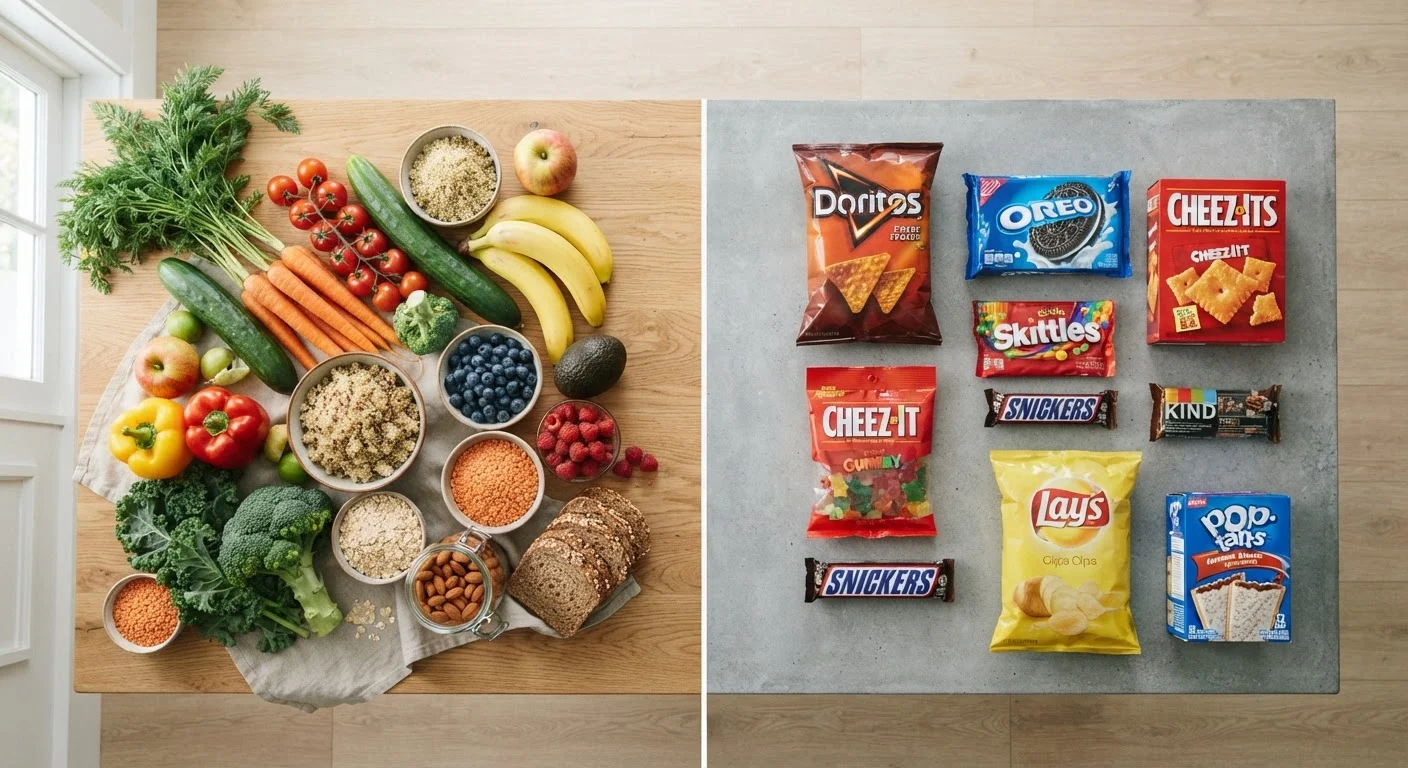
Whole Foods
Foods as close to their natural state as possible.
Best for: People looking to maximize nutrient density, fiber, and naturally occurring micronutrients in their diet.
Option B
Processed Foods
A broad spectrum - from minimally altered to heavily reformulated.
Best for: Everyday convenience needs, with quality varying widely depending on the degree and type of processing involved.
If you want to maximize fiber and micronutrient intake
Whole Foods
Whole foods retain naturally occurring fiber, vitamins, minerals, and phytonutrients that processing can partially or fully remove.
If convenience and shelf life are practical priorities
Processed Foods
Minimally processed options like canned legumes, frozen vegetables, and plain yogurt offer genuine nutritional value alongside convenience.
If you're trying to reduce added sugar and sodium
Whole Foods
Whole foods contain little to no added salt, sugar, or preservatives - ingredients that accumulate quickly in heavily processed products.
If you're navigating a tight food budget or limited access
Processed Foods
Minimally processed staples such as canned fish, dried legumes, and frozen produce offer nutrient density at accessible price points.
What 'Processed' Actually Means
Nearly every food you eat has been processed in some way - washed, cut, cooked, frozen, or fermented. The word itself is not a synonym for unhealthy. What matters is the degree of processing and what gets added or removed in the process.
Nutrition researchers commonly use a framework called NOVA, developed at the University of São Paulo, which classifies foods into four groups: unprocessed or minimally processed foods (fresh fruit, plain meats, eggs), processed culinary ingredients (oils, flour, salt), processed foods (canned tomatoes, cheese, cured fish), and ultra-processed foods (packaged snack cakes, carbonated soft drinks, reconstituted meat products). Most health concerns in the research literature are concentrated in that fourth category - ultra-processed foods - not processed foods as a whole.
Understanding this spectrum is essential before drawing any conclusions about what belongs in a healthful eating pattern. For more on how labeling language can obscure this nuance, see our guide on nutrition labels, health claims, and marketing.
Whole Foods: Nutritional Strengths and Honest Caveats
Whole foods - fruits, vegetables, legumes, whole grains, nuts, seeds, and minimally processed animal products - deliver nutrients in their most intact form. Fiber, which supports gut health and satiety, is often significantly reduced or absent in heavily processed alternatives. Phytonutrients (naturally occurring plant compounds linked to various health benefits in observational research) are similarly bound up in the structure of whole plant foods in ways that processing disrupts.
That said, "whole food" is not an automatic nutritional guarantee. Coconut oil is minimally processed but high in saturated fat. Red and processed meats are often categorized as whole or minimally processed foods yet appear in research literature with specific caveats around frequency of consumption. Context, quantity, and overall dietary pattern all matter.
Eating a variety of foods is one of the most consistently supported principles in nutrition science - and whole foods, by their natural diversity, make that variety easier to achieve.
| Criterion | Whole Foods | Processed Foods |
|---|---|---|
| Definition | Unaltered or minimally altered from natural state | Altered by physical, chemical, or industrial methods |
| Fiber content | Generally high and intact | Often reduced; absent in ultra-processed products |
| Added sugar & sodium | Little to none naturally | Varies widely; often high in ultra-processed foods |
| Nutrient density | High for vitamins, minerals, phytonutrients | Varies; some are fortified, many are lower overall |
| Shelf life & convenience | Often shorter shelf life; more prep required | Longer shelf life; quick and accessible |
| Cost accessibility | Varies; fresh produce can be expensive | Minimally processed staples often very affordable |
| Health research association | Generally favorable in dietary pattern research | Mixed; ultra-processed category has the most concern |
Where Ultra-Processing Becomes a Health Concern
Research - including large prospective cohort studies published in journals such as The BMJ and JAMA Internal Medicine - has associated high consumption of ultra-processed foods with increased risk of cardiovascular disease, type 2 diabetes, and all-cause mortality. Researchers hypothesize several mechanisms: high levels of added sugar and sodium, low fiber content, displacement of more nutritious foods, and the effects of additives such as emulsifiers and artificial colorings (though direct causality from additives remains an area of active investigation).
The issue of added sugar vs. natural sugar is particularly relevant here - ultra-processed foods are among the leading sources of added sugar in American diets, according to data from the National Health and Nutrition Examination Survey (NHANES).
57%
Of U.S. caloric intake from ultra-processed foods
A study published in BMJ Open (Martínez Steele et al.) estimated that ultra-processed foods account for more than half of daily calories in the average American diet.
~10%
Added sugar contribution from ultra-processed foods
NHANES data indicates ultra-processed foods contribute disproportionately to added sugar intake, far exceeding their share in minimally processed categories.
It's worth noting that much of the research is observational, meaning it identifies associations rather than proving direct causation. But the consistency and size of the associations across multiple populations give nutrition scientists reason for concern.
Making Practical Sense of the Spectrum
Rather than categorizing every food as simply "good" or "bad," a more useful approach is to ask: how much has this food been altered, and what was added or removed? Plain frozen spinach and a bag of ultra-processed cheese-flavored snacks are both "processed" - but they sit at entirely opposite ends of the spectrum.
Some practical signposts worth knowing:
- Short ingredient lists that include recognizable whole-food ingredients tend to indicate less processing.
- High fiber content relative to total carbohydrates often signals that intact food structure is preserved.
- Added sodium and sugar accumulate quickly in packaged foods; the nutrition label is more reliable than front-of-package claims.
If you're curious about how plant-based versus animal protein sources fit into this picture, processing level is one of the relevant factors there too - a whole lentil and a highly refined soy protein isolate are not nutritionally equivalent.
For a structured way to reflect on your current eating habits, our everyday eating patterns checklist offers a judgment-free starting point.
This article provides general nutrition education and is not a substitute for personalized advice from a registered dietitian or qualified healthcare professional. Individual dietary needs vary; consult a professional before making significant changes to your eating pattern.