

Key Takeaways
- No single food provides all the nutrients the human body requires to function well.
- Different food groups contribute distinct compounds - vitamins, minerals, fiber, and phytonutrients - that work together.
- Research consistently links greater dietary variety with healthier gut microbiome composition.
- Eating a wide range of foods can help reduce reliance on any one source, lowering nutritional gaps.
- Variety doesn't require exotic ingredients - rotating common everyday foods achieves meaningful diversity.
Why No Single Food Is Enough
Nutrition science is built on a foundational insight: the human body requires more than 40 distinct micronutrients to sustain normal physiological function, and no single food delivers all of them in adequate amounts. Vitamins, minerals, essential fatty acids, amino acids, and dietary fiber each come from different sources - and different foods supply them in varying forms and concentrations.
This isn't just a theoretical point. The Dietary Guidelines for Americans, published jointly by the U.S. Department of Agriculture and the Department of Health and Human Services, consistently emphasize variety across food groups precisely because nutritional needs can't be met by narrowing intake to a handful of favorites. As the guidelines note, nutrient-dense foods from all groups work together rather than independently.
It's also worth separating this idea from common misconceptions. Eating a variety of foods isn't the same as eating large amounts or following any particular dietary pattern - it's about ensuring that the range of compounds your body draws on is actually present in what you eat. For a closer look at persistent misunderstandings around nutrition, see common nutrition myths and what the evidence says.
What Different Food Groups Actually Contribute
Understanding variety means understanding what different categories of food bring to the table - literally and biochemically.
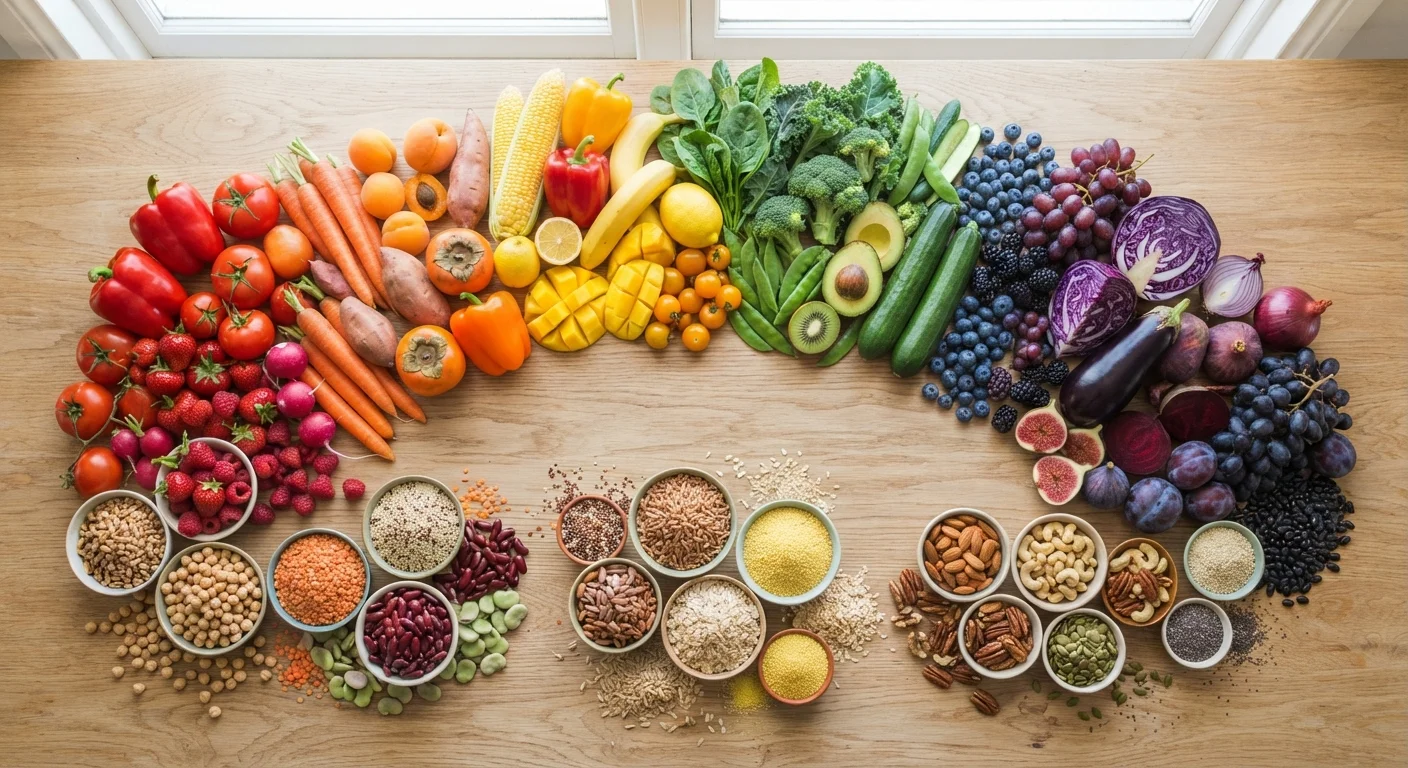
- Vegetables and fruits supply vitamins C, A, and K, potassium, folate, and a broad class of compounds called phytonutrients (plant-derived chemicals that research suggests play roles in cellular health). Different colors generally signal different phytonutrient profiles - which is part of why eating across the color spectrum matters.
- Whole grains contribute B vitamins, magnesium, iron, and dietary fiber. The fiber component is significant: most Americans fall well short of recommended intake levels. For a detailed look, see why fiber matters and where to find it.
- Legumes, nuts, and seeds provide protein, healthy fats, zinc, and additional fiber. They also contribute compounds that differ meaningfully from animal-based protein sources - a distinction explored in depth in our piece on plant-based vs. animal protein.
- Dairy and fortified alternatives are primary sources of calcium and vitamin D for many Americans.
- Lean proteins - whether from fish, poultry, eggs, or plant sources - deliver essential amino acids the body cannot synthesize on its own.
~40+
Essential nutrients required for normal human function
According to the National Institutes of Health, the body requires more than 40 essential nutrients that must come from food because the body cannot synthesize them in sufficient quantities.
Only 1 in 10
Americans eating enough fruits and vegetables
The CDC reports that only about 1 in 10 U.S. adults meets federal recommendations for daily fruit and vegetable intake, a core indicator of dietary variety.
30+
Plant types weekly associated with higher gut diversity
Research published in mSystems found that individuals who ate 30 or more different plant foods per week showed greater gut microbiome diversity than those eating 10 or fewer.
These aren't interchangeable categories. Swapping all vegetables for more protein, or eliminating grains entirely, shifts the nutritional profile in ways that can leave specific gaps over time - even when total calorie intake looks adequate.
The Gut Microbiome Connection
One of the more compelling areas of recent nutrition research involves the gut microbiome - the vast community of microorganisms living in the digestive tract. Studies published in journals including Nature and Cell Host & Microbe have found that greater dietary variety, particularly from plant-based sources, is associated with greater microbial diversity in the gut.
This matters because microbial diversity is increasingly linked by researchers to immune function, inflammatory response, and metabolic health, though the science in this area is still evolving and causality remains difficult to establish definitively. What is well-supported is that different gut bacteria prefer different substrates - meaning that a narrow diet tends to support a narrower microbial community.
“The data suggest that the diversity of the diet is one of the strongest predictors of gut microbiome diversity - and that microbiome diversity, in turn, is associated with a range of health-relevant outcomes. Feeding a variety of microbes requires a variety of foods.”
— Tim Spector, Professor of Genetic Epidemiology, King's College London, and author of research on the gut microbiome and diet
Different fiber types - soluble, insoluble, and resistant starch - ferment differently in the colon and feed different bacterial species. Eating a range of vegetables, legumes, and grains is one practical way to supply that diversity. For a broader look at how nutrients interact in this way, our article on food synergy and how nutrients enhance each other provides useful context.
Practical Ways to Build More Variety
The concept of dietary variety can sound abstract, but in practice it translates to a set of straightforward habits. The goal isn't to overhaul everything at once - it's to gradually widen the range of foods that appear regularly in your meals.
Rotate your protein sources across the week rather than defaulting to the same one daily.
Different protein sources - fish, legumes, eggs, poultry - deliver different amino acid profiles, micronutrients, and accompanying fats. Rotating them ensures a broader nutritional input without requiring dramatic changes.
Add one unfamiliar vegetable or fruit to your grocery cart each week.
Habit and convenience tend to narrow produce choices to a small set of favorites. Introducing new items incrementally expands phytonutrient and fiber variety without overwhelming meal planning.
Eat across at least three distinct color categories of vegetables and fruits each day.
Pigment compounds in plants - carotenoids in orange and red vegetables, flavonoids in purple and blue foods, chlorophyll-related compounds in greens - reflect genuinely different phytochemical profiles. Color is an accessible proxy for variety.
Include at least one legume-containing meal per week if legumes aren't already a regular part of your diet.
Legumes - beans, lentils, chickpeas, peas - are among the most nutrient-dense foods available, contributing protein, soluble fiber, iron, folate, and resistant starch simultaneously. They also tend to be underrepresented in typical American eating patterns.
Choose whole grain versions of staple foods where feasible, rather than always opting for refined grain products.
Refining grains removes the bran and germ, stripping out fiber, B vitamins, and minerals. Swapping some refined grain servings for whole grain versions expands the micronutrient and fiber profile of the overall diet.
It's also useful to think about variety at the level of the week, not just each individual meal. A single lunch doesn't need to cover every food group; a week of eating can and should. For a structured way to audit your current patterns, a practical checklist for evaluating your everyday eating patterns offers a non-judgmental framework.
Understanding the difference between minimally processed and heavily processed foods also informs variety in a meaningful way - see whole foods vs. processed foods for that distinction. And if you want to understand what genuine balance looks like across these groups, what eating a balanced diet actually means breaks it down clearly.
This article provides general nutrition information for educational purposes and is not a substitute for personalized advice from a registered dietitian or qualified healthcare provider. If you have specific dietary needs, medical conditions, or concerns, please consult a qualified professional.