

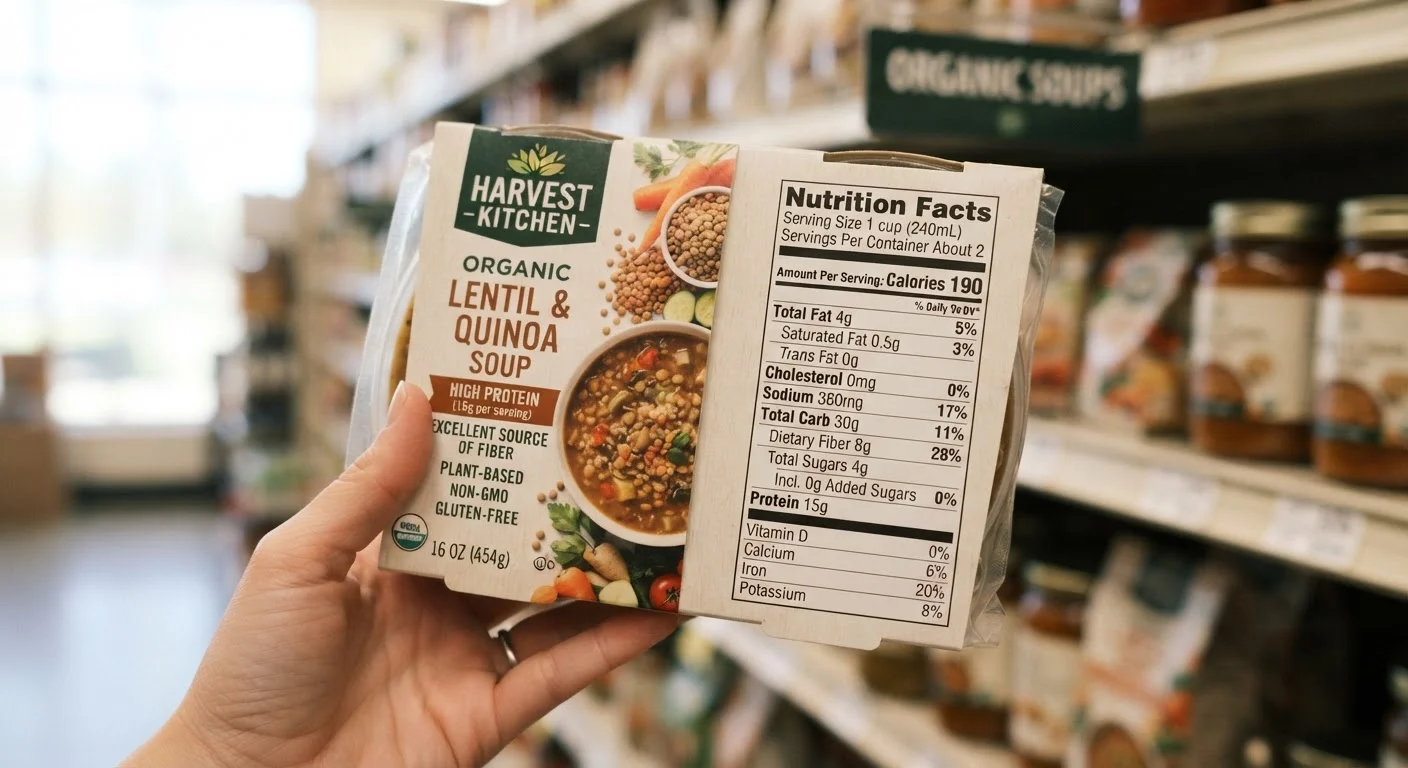
Two Very Different Languages on the Same Package
Every packaged food speaks in two distinct voices. The front of the package is marketing territory - bold claims, vibrant colors, and words chosen to influence your shopping cart. The back or side panel, home to the Nutrition Facts label, is federally regulated territory governed by the U.S. Food and Drug Administration (FDA). Understanding which is which is one of the most practical nutrition skills you can develop.
The Nutrition Facts panel tells you the measurable composition of a food: calories, macronutrients, sodium, vitamins, and more, all standardized by law. Front-of-package claims, by contrast, range from tightly regulated (such as specific nutrient content claims) to almost entirely unregulated (such as the word "natural"). Knowing the difference helps you decode the package rather than be decoded by it. For a deeper walkthrough of the Nutrition Facts panel itself, see Reading a Nutrition Facts Label Without Getting Lost.
What Front-of-Package Claims Actually Mean
The FDA defines specific criteria for nutrient content claims - precise, legally binding thresholds a product must meet before using certain language. Here is what some of the most common claims require:
- "Low fat" - 3 grams of total fat or less per serving.
- "Reduced fat" or "Reduced sodium" - at least 25% less of that nutrient compared to the standard version of the product.
- "Light" (or "Lite")" - either one-third fewer calories or 50% less fat than the reference food, with specific conditions.
- "High in" / "Excellent source of" - 20% or more of the Daily Value for that nutrient per serving.
- "Good source of" - 10-19% of the Daily Value per serving.
- "Calorie-free" - fewer than 5 calories per serving.
These claims are regulated, but they can still mislead in context. A "low-fat" food may be high in added sugar. A "reduced-sodium" product may still contain substantial salt if the original was very high. Always cross-reference the Nutrition Facts panel rather than stopping at the front label. Understanding what carbs, protein, and fat actually do helps put these numbers in perspective.
Unregulated and Lightly Regulated Terms to Watch
Several popular marketing terms have little or no enforceable definition under federal food labeling law:
- "Natural" - The FDA has not established a formal definition for this term on food labels. In practice, it is used inconsistently across products and cannot be taken as a meaningful quality indicator.
- "Clean" - Entirely a marketing construct with no regulatory definition.
- "Superfood" - Not a recognized regulatory or scientific category. While some nutrient-dense foods earn the label informally, no food must meet any standard to be called one.
- "Fortified" or "Enriched" - These do have defined meanings: fortified foods have nutrients added that were not originally present; enriched foods have nutrients restored that were lost during processing. These terms carry regulatory weight, though they do not make a food inherently healthful overall.
Overreliance on front-of-package health framing is a pattern that can quietly undermine an otherwise thoughtful diet - a topic explored further in Habits That Quietly Undermine an Otherwise Decent Diet. It is also worth noting that the line between "processed" and "whole" is more nuanced than marketing suggests - see Whole Foods vs. Processed Foods for context.
Health Claims vs. Structure/Function Claims
Beyond nutrient content claims, two additional categories appear on packaging and are easy to confuse:
Health claims describe a relationship between a food, food component, or dietary supplement and a disease or health condition. The FDA authorizes these claims based on scientific evidence. An example: "Diets low in saturated fat and cholesterol may reduce the risk of heart disease." Authorized health claims must meet a significant scientific agreement standard.
Structure/function claims describe how a nutrient or ingredient affects normal body structure or function - for example, "calcium builds strong bones" or "fiber maintains digestive health." These claims do not require FDA pre-approval and are far more broadly applied, especially on dietary supplements. Manufacturers must have substantiation for these claims, but the bar is lower than for authorized health claims, and the FDA does not vet them before they appear on packaging.
Recognizing which category a claim falls into tells you how much regulatory scrutiny stands behind it. Authorized health claims carry more evidentiary weight; structure/function claims require healthy skepticism. For a broader look at where nutrition science is solid and where myths persist, Nutrition Myths Americans Still Believe is a useful companion read.
This article is for general informational purposes only and is not medical or dietary advice. Consult a qualified healthcare provider or registered dietitian for guidance specific to your health needs.