

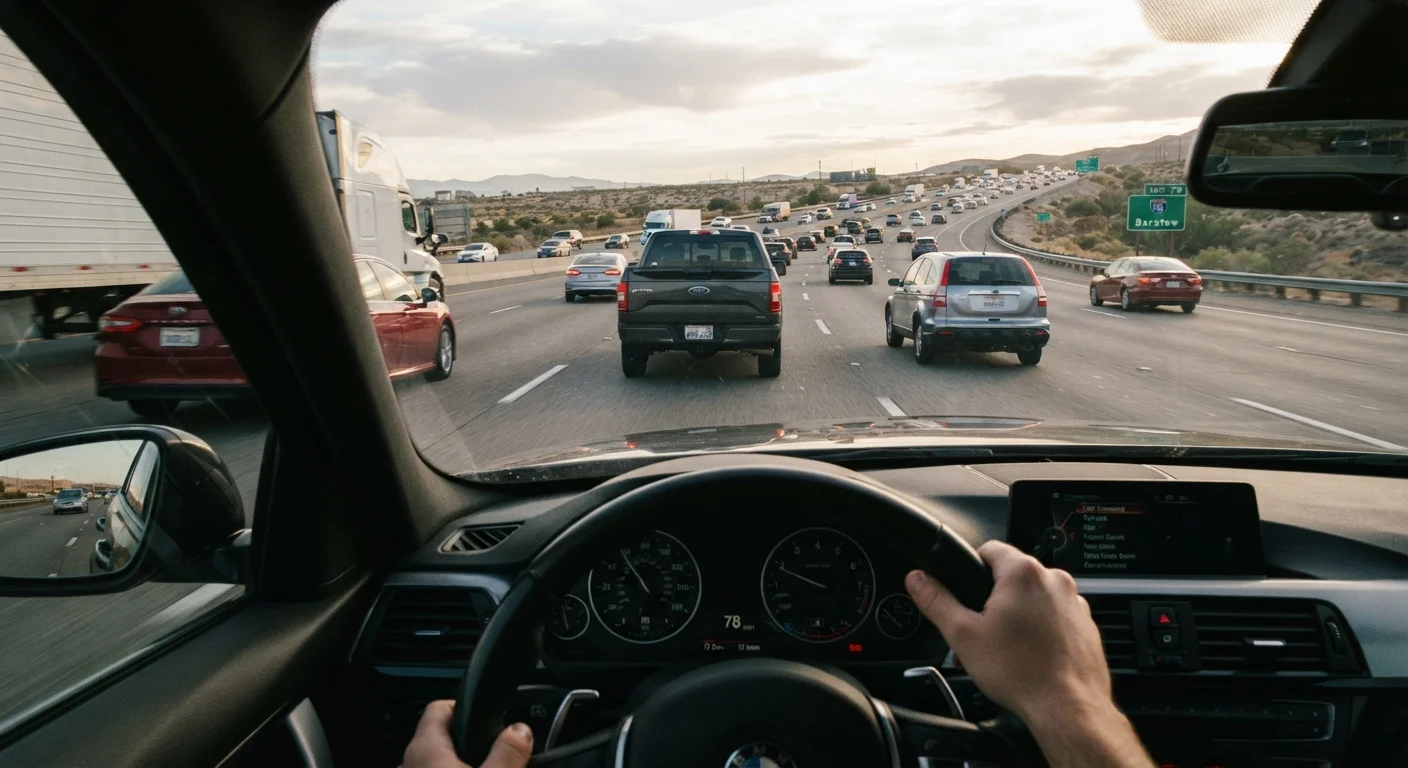
Key Takeaways
- Tailgating eliminates the stopping distance needed to avoid rear-end collisions, regardless of speed.
- Pacing traffic means matching the prevailing flow, not driving dangerously close to the vehicle ahead.
- A following gap of at least two to three seconds is the baseline - more in poor weather or at high speeds.
- Pacing traffic can sometimes be safer than standing out as the slowest or fastest vehicle on the road.
- Tailgating is a leading cause of rear-end crashes, the most common collision type on U.S. roads.
- Understanding the difference between these two behaviors helps drivers make more deliberate, confident choices.
Option A
Tailgating
The high-risk habit that eliminates your safety margin.
Best for: No legitimate use case - tailgating is an unsafe behavior that reduces reaction time and increases rear-end collision risk.
Option B
Pacing Traffic
Matching surrounding flow to navigate congested roads smoothly.
Best for: Dense highway traffic where matching the dominant speed reduces friction, lane changes, and overall collision exposure.
If you're driving on a busy highway with heavy, consistent traffic flow
Pacing Traffic
Matching the dominant speed reduces the speed differential between you and surrounding vehicles, limiting lane-change conflicts and overall exposure to side-impact risk.
If you feel pressured by a vehicle behind you to close your following gap
Pacing Traffic
Maintain your safe following distance and, where possible, move to a less congested lane. Never reduce your gap to the car ahead in response to pressure from behind.
If you're in stop-and-go traffic and trying to keep pace with the car directly ahead
Pacing Traffic
Focus on the vehicle two or three cars ahead to anticipate slowdowns earlier, keeping a cushion that prevents you from becoming a tailgater during sudden stops.
If you're late and trying to push through slower traffic by following closely
Neither - create a proper gap
Tailgating to force progress is one of the most dangerous habits on the road and is a primary driver of rear-end crashes. No time savings justifies the risk.
Defining the Two Behaviors
Tailgating and pacing traffic are frequently lumped together in driving conversations, but they describe fundamentally different behaviors with very different risk profiles. Getting them confused can lead drivers to misjudge their own habits - or dismiss legitimate concerns about following distance.
Tailgating means following another vehicle so closely that you would be unable to stop in time if that driver braked suddenly. It eliminates the stopping buffer that is your primary line of defense against rear-end collisions. At 60 mph, a vehicle travels approximately 88 feet per second. Factor in perception time, reaction time, and actual braking distance, and the physics become unforgiving very quickly. For a deeper look at how following distance actually works in practice, see our article on following distance myths that put drivers at real risk.
Pacing traffic is a separate concept: it means adjusting your speed to match the prevailing flow of vehicles around you, not necessarily the posted speed limit. Pacing does not require you to close the gap to the car ahead - a driver can pace traffic perfectly while maintaining a safe two-to-three-second following distance or more.
Where the Safety Risks Actually Live
Rear-end collisions are consistently among the most common crash types on American roads. According to the National Highway Traffic Safety Administration (NHTSA), rear-end crashes account for roughly one-third of all U.S. traffic crashes each year. Tailgating is a primary contributing factor. When there is no following gap, there is no margin for error - any unexpected braking, road debris, or pedestrian creates an unavoidable impact.
| Criterion | Tailgating | Pacing Traffic |
|---|---|---|
| Definition | Following too closely to stop safely | Matching the prevailing speed of surrounding vehicles |
| Following gap | Insufficient - often under one second | Can maintain any safe following gap |
| Primary crash risk | Rear-end collision with vehicle ahead | Speed differential conflicts if pacing too slowly |
| Driver intent | Often pressure-based or inattentive | Deliberate adaptation to traffic conditions |
| Legal standing | Illegal in all U.S. states | Generally lawful within posted speed limits |
| Weather adjustment | Makes wet/icy roads even more dangerous | Should include increased following gap in poor conditions |
Pacing traffic, by contrast, carries a different and more nuanced risk calculation. Driving significantly slower than surrounding traffic can actually increase collision exposure by creating large speed differentials - situations where faster-moving vehicles must brake hard or change lanes abruptly to avoid you. This is why traffic engineers and safety researchers generally note that it is the difference in speed between vehicles, not absolute speed alone, that contributes to many highway incidents.
This does not make speeding acceptable. It means that staying far below the flow of traffic - particularly on multi-lane highways - introduces its own set of risks that drivers often underestimate.
~33%
Share of U.S. crashes that are rear-end collisions
According to NHTSA data, rear-end crashes consistently represent approximately one-third of all reported traffic collisions annually.
88 ft/sec
Distance traveled per second at 60 mph
At highway speeds, even a one-second reaction delay means nearly 90 feet of travel before braking begins - illustrating why gap matters.
2-4 sec
Recommended following gap range
Safety organizations generally recommend a minimum two-second gap in ideal conditions, extending to four or more seconds in rain or reduced visibility.
The Two-Second Rule - and When It Isn't Enough
The two-second following rule is a widely taught baseline: choose a fixed object ahead, watch when the vehicle in front passes it, and count two full seconds before you pass the same point. If you reach it sooner, you're too close. This is a practical minimum under good conditions - dry roads, alert driver, daylight.
In rain, snow, or fog, stopping distances increase substantially. Most safety guidance recommends extending your following gap to four seconds or more in wet conditions, and even further in ice or snow. At highway speeds above 65 mph, building additional buffer is also advisable, since the gap closes faster than many drivers intuitively appreciate. If you're new to highway driving or preparing a teen driver, the concepts around merging and maintaining space also apply - our overview of highway on-ramp etiquette addresses some of the same spatial awareness skills.
Regardless of how smoothly traffic is flowing around you, the following gap between your vehicle and the one directly ahead remains your personal responsibility. Pacing the speed of traffic does not reduce that obligation.
How to Handle Pressure and Aggressive Drivers
One of the most common scenarios that blurs the line between tailgating and pacing occurs when another driver is following you closely. Many drivers respond by either speeding up - effectively pacing an unsafe driver - or braking, which escalates the hazard. Neither is optimal.
The safer response is to signal and move to a less congested lane when one is available, allowing the aggressive driver to pass. If you're already in the right lane with no room to move, maintaining your speed steadily - without hard braking - and creating a slightly larger gap to the vehicle ahead gives you more options if you need to stop suddenly. Avoid retaliatory braking or speed matching that keeps an aggressive driver directly behind you longer than necessary.
Aggressive tailgating is classified as a form of aggressive driving in many states and can carry fines or points against a license. Understanding how road behaviors affect safety in specific contexts - like school zone rules and violations - reinforces that context matters significantly to risk level. Helping new or younger drivers understand following distance early is one of the highest-return safety conversations available, as outlined in our guide on safe driving with new teen drivers.
Speed Limits Still Apply When Pacing
Pacing traffic does not justify exceeding the posted speed limit. If the prevailing flow of traffic is moving above the limit, drivers are still legally responsible for their own speed. Pacing is a situational awareness strategy - not a defense for speeding. When traffic flows above the limit, the safest approach is to drive as close to the limit as conditions allow while maintaining awareness of vehicles around you.