

| Typical school zone speed limit | 15-25 mph (Varies by state and local ordinance) |
| Fine multiplier for speeding in school zones | 2x-3x standard fine (Varies by state) |
| Enforcement method increasingly in use | Automated speed cameras (Deployed in multiple U.S. states) |
| School bus stop-arm violation | Illegal in all 50 states (American School Bus Council) |
| Zone activation method | Flashing amber lights or posted hours (State-dependent) |
What Makes a School Zone Different
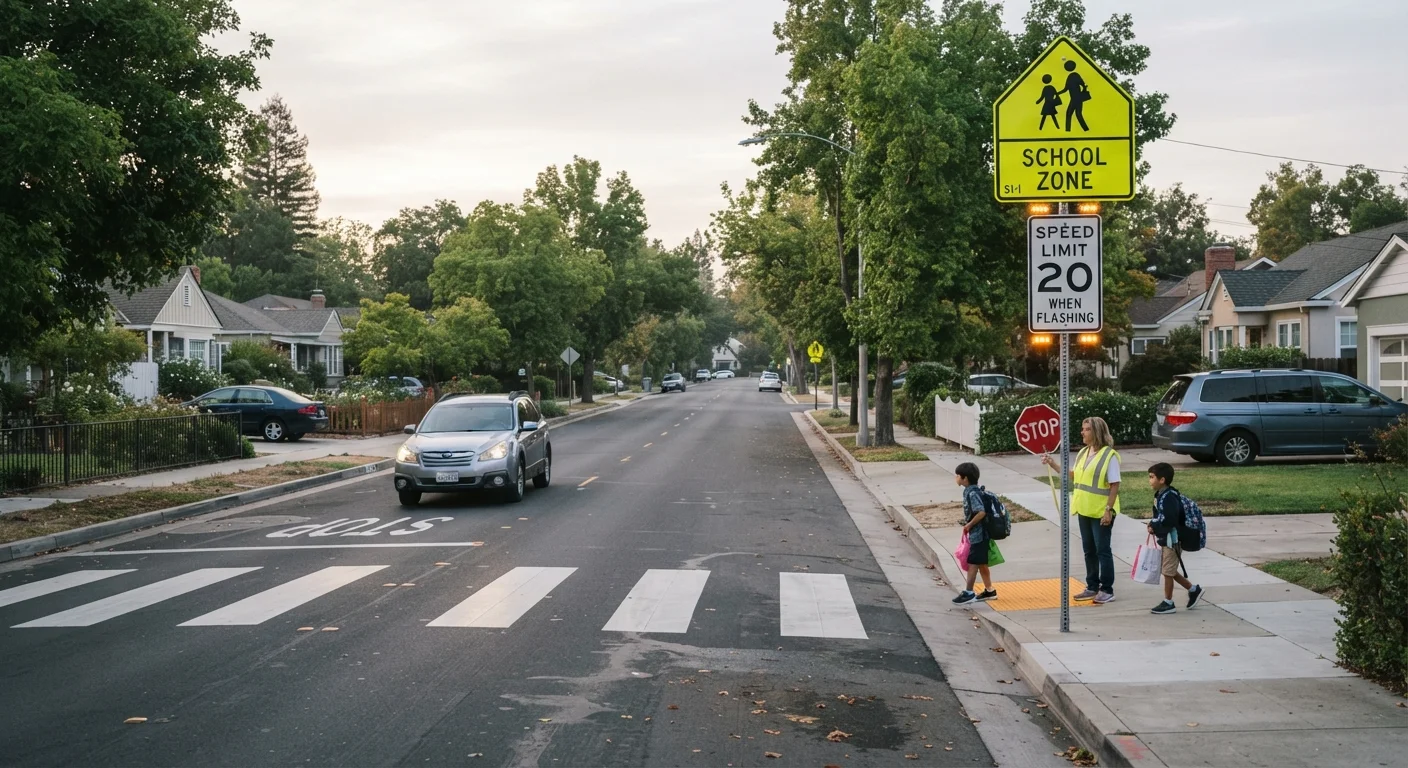
A school zone is a designated stretch of road near an active school where special traffic laws apply - typically reduced speed limits, crosswalk protections, and no-passing rules. These areas are engineered around a simple and important reality: children are unpredictable pedestrians. They may dart into traffic, misjudge vehicle speeds, or cross outside marked crosswalks.
| Typical school zone speed limit | 15-25 mph (Varies by state and local ordinance) |
| Fine multiplier for speeding in school zones | 2x-3x standard fine (Varies by state) |
| Enforcement method increasingly in use | Automated speed cameras (Deployed in multiple U.S. states) |
| School bus stop-arm violation | Illegal in all 50 states (American School Bus Council) |
| Zone activation method | Flashing amber lights or posted hours (State-dependent) |
Most school zones are marked by posted signs and, in many states, by flashing amber lights that signal when the reduced speed limit is in effect. That activation window generally corresponds to arrival and dismissal times, though the exact hours vary by jurisdiction. Drivers often assume the zone rules don't apply when school is not in session - but in most states, when the flashing lights are active, the law applies regardless of whether children are visibly present.
Speed Limits and Enforcement
School zone speed limits in the United States typically range from 15 to 25 mph, depending on the state and local ordinance. Some jurisdictions post a static reduced limit that applies at all times; others use a time-activated limit that only applies during school hours. Both approaches carry real legal weight.
Speeding in a school zone is one of the most heavily penalized moving violations in most states. Fines are frequently doubled or even tripled compared to the same infraction on a standard roadway. Many jurisdictions have also deployed automated speed cameras in school zones, meaning violations can be issued without a police officer being present. The camera doesn't distinguish between a driver who is five miles over the limit and one who didn't notice the flashing lights.
Camera Enforcement Doesn't Require a Police Presence
Automated speed cameras in school zones can issue violations based on recorded vehicle speed alone. Penalties are typically mailed to the registered vehicle owner. Some states also use license plate readers to flag vehicles that illegally pass school buses. Assuming you won't be caught without a patrol car nearby is a common and costly mistake.
Stopping distances matter enormously at lower speeds. A vehicle traveling at 25 mph requires significantly less distance to stop than one traveling at 35 mph - a gap that can mean the difference between a near-miss and a tragedy. Maintaining a safe following distance through school zones is as important as the speed itself. See our guide on following distance myths for the real numbers behind stopping distances.
Common Violations Drivers Should Recognize
Understanding the most frequent school zone infractions helps drivers self-correct before law enforcement - or worse, an injury - does it for them.
- Failing to stop for crossing guards or flaggers. A crossing guard's signal carries the same legal authority as a traffic signal in most states. Failing to stop is a serious violation.
- Passing a stopped school bus. When a school bus extends its stop arm and activates flashing red lights, all traffic in both directions must stop on most roads. Passing is illegal and one of the most dangerous violations a driver can commit.
- Rolling through crosswalks. Pedestrians in a marked crosswalk have the right of way. Edging forward while a child is crossing - even slowly - is a violation.
- Cell phone use. Handheld device use is prohibited in school zones in a growing number of states, often with stiffer penalties than standard distracted driving fines.
- Ignoring flashing lights. Some drivers treat the flashing amber signals as advisory rather than mandatory. In most jurisdictions, they are legally binding.
If you're navigating unfamiliar school pickup areas with a teen driver, the guidance on driving with new teen drivers covers how to model safe habits in high-pedestrian zones.
State Variations and What to Watch For
School zone laws are set at the state level, which means enforcement details vary. Some states require the reduced speed limit only when children are present; others require it whenever the lights flash, period. A handful of states apply school zone rules year-round; others suspend them during summer break.
School zone
A designated section of roadway near a school where special traffic regulations - including reduced speed limits and pedestrian protections - are legally enforced during specified periods.
Stop arm
The extendable red sign that deploys from the side of a school bus to signal that children are boarding or exiting. Traffic in most states must stop whenever the stop arm is out and red lights are flashing.
Flashing beacon
An amber warning light mounted on a school zone sign that activates during school arrival and dismissal windows, signaling that the reduced speed limit is in effect.
Crossing guard
A trained individual - often a school employee or volunteer - authorized to direct traffic and pedestrians at school crossings. Their signals carry legal authority equivalent to official traffic controls in most states.
Right of way (pedestrian)
The legal priority given to pedestrians in a marked crosswalk, requiring drivers to yield and not proceed until the crossing is clear.
Because rules differ, the safest approach is to treat school zone signage as an active instruction regardless of your assumptions about the time of year or day. When you see the zone markers, slow down, stay off your phone, watch for pedestrians at and between crosswalks, and allow extra following distance. If you're unfamiliar with an area's setup, add margin - slow down a little more than the sign requires. For additional context on how speed decisions play out quickly in complex environments, our article on misreading yellow lights explains how drivers misjudge timing under pressure.