

Key Takeaways
- Nighttime driving fatalities are disproportionately high compared to daytime miles driven.
- Your eyes switch to a less precise visual system after dark, reducing detail and depth perception.
- Glare from oncoming headlights causes temporary vision disruption that can last several seconds.
- Reaction time slows at night due to a combination of reduced visibility and natural fatigue cycles.
- Simple adjustments - speed, following distance, headlight maintenance - significantly improve night safety.
- Even drivers with good daytime vision can experience meaningful limitations after dark.
Nighttime Driving Vision
Nighttime driving vision refers to how the human visual system adapts - and struggles - when operating a vehicle in low-light conditions. Unlike daylight driving, where sharp central vision dominates, nighttime conditions shift reliance to less precise peripheral vision and slower neural processing. The result is longer reaction times, reduced depth perception, and narrowed visual fields, even for drivers with healthy eyes.
The shift from cone-based (photopic) vision to rod-based (scotopic) vision in low light is responsible for most nighttime visual limitations. Rods are highly sensitive to light but cannot detect color or fine detail, which explains why hazards at night appear later and less clearly than they would in daylight.
The Real Science Behind Night Vision
Most drivers assume that poor nighttime visibility is simply a lighting problem - fix the headlights, see better. In reality, much of what makes night driving difficult originates inside the eye itself.
In daylight, your eyes rely on cones - photoreceptor cells clustered in the center of the retina that deliver sharp, color-accurate detail. After dark, cones become nearly ineffective, and your visual system hands control to rods, which are scattered across the peripheral retina. Rods are extraordinarily sensitive to low light - they can detect a single photon - but they offer no color information and cannot resolve fine detail. This is why a hazard you'd instantly recognize in daylight can appear as a vague shape at night until you're dangerously close to it.
This transition also affects where you see best. In daylight, looking directly at something gives you the sharpest image. At night, the opposite can be true: looking slightly to the side of a dim object - a technique called off-center viewing - places it on the rod-rich peripheral retina and can make it appear clearer. This is a counterintuitive skill experienced night drivers and pilots learn to apply deliberately.
~50%
Of traffic fatalities occur at night
According to the National Safety Council, roughly half of all traffic deaths happen at night despite significantly lower traffic volumes after dark.
3x
Higher nighttime fatal crash rate per mile
Research from the AAA Foundation for Traffic Safety indicates the fatal crash rate per mile driven is approximately three times higher at night than during daylight hours.
160-200 ft
Typical low-beam headlight range
Standard low-beam headlights illuminate roughly 160 to 200 feet ahead, while a vehicle traveling at 60 mph requires around 240 feet to stop - creating a structural visibility deficit.
Glare, Adaptation, and the Hidden Time Gap
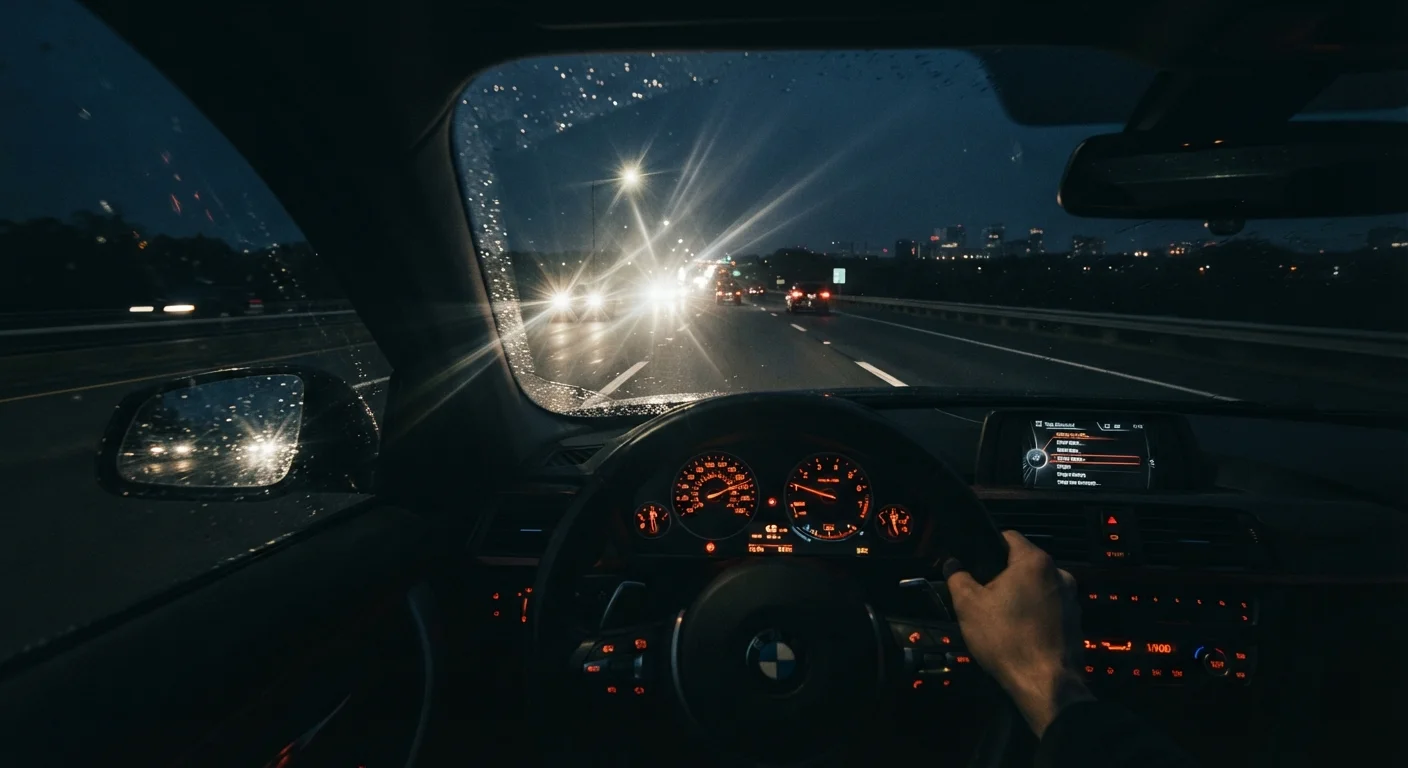
Glare from oncoming headlights is more than an annoyance - it is a genuine, measurable safety hazard. There are two distinct types. Discomfort glare is the irritating brightness that makes you want to look away. Disability glare is more dangerous: it temporarily blinds you by overwhelming the retina, causing a veil of light that washes out everything in your field of view.
After exposure to bright oncoming lights, the eye needs time to re-adapt to the dark. During that recovery window - which can span several seconds - your effective vision is severely degraded. At 60 mph, a car travels 88 feet per second. Even three seconds of compromised vision means covering a quarter of a football field with unreliable sight.
A practical response: when facing oncoming headlights, shift your gaze to the right edge of your lane or the painted white fog line. This avoids direct glare exposure while still providing enough visual information to hold your lane. Also, be cautious about your own high beams - they create the same problem for drivers approaching you. Our guide on managing blind spots and mirror positioning covers related visibility strategies worth reviewing before any nighttime drive.
Look Right to Beat Glare
When oncoming headlights are blinding, shift your focus to the right edge of your lane or the white fog line rather than looking directly at the approaching light source. This keeps you on course while reducing the disability glare effect on your retina. Avoid the instinct to stare at the light or over-correct your steering away from it.
Reaction Time, Fatigue, and Overdriving Your Headlights
Two compounding problems make nighttime driving riskier than reduced visibility alone suggests: slower reaction time and the concept of overdriving your headlights.
Reaction time - the interval between spotting a hazard and physically responding - averages roughly 1.5 seconds for an alert driver. At night, fatigue (which peaks in the early morning hours due to circadian rhythms), reduced stimulation, and the cognitive effort of interpreting low-contrast scenes all push that figure higher. A driver who is tired and dealing with limited visibility may take two to three seconds or more to react - enough time to close the gap to a stopped vehicle on a dark highway.
Overdriving headlights means traveling at a speed where your stopping distance exceeds your headlight range. Standard low beams illuminate roughly 160-200 feet ahead. A vehicle traveling at 60 mph requires approximately 240 feet to stop under typical conditions - well beyond what most headlights reveal. Reducing speed at night, particularly on unlit roads, is one of the simplest and most effective safety adjustments available to any driver. See our broader article on safe driving habits on long road trips for complementary guidance on fatigue and sustained alertness.
Headlight condition matters too. Yellowed or foggy headlight lenses - extremely common on older vehicles - can reduce light output dramatically. Before any significant nighttime drive, a quick exterior check of your lights is worthwhile. Our pre-trip walk-around checklist covers exactly what to inspect. And if weather compounds low-light conditions, adjusting your habits for rain, fog, or snow applies even more urgently after dark.
A driver on a rural two-lane highway encounters a slow-moving farm vehicle with minimal rear lighting. Despite having functional headlights, the driver doesn't see the hazard until they are well within unsafe stopping distance.
An older driver notices they increasingly avoid nighttime highway driving after finding oncoming headlights cause prolonged visual disruption that wasn't an issue a decade ago.
A driver cleans the interior of their windshield before an evening road trip and notices the reduction in glare and light scatter from oncoming cars is immediately noticeable.
After switching from low to high beams on an unlit country road, a driver spots a deer at the roadside far enough ahead to slow safely - a hazard that would have been invisible at low-beam range.
Practical Adjustments That Actually Help
Understanding the physiology of night vision translates directly into actionable habits. None of these require special equipment - just deliberate awareness.
- Increase following distance. Give yourself more space to react. A three-second following gap in daylight should extend to four or five seconds at night.
- Reduce speed on unlit roads. Slower speeds shrink the gap between your stopping distance and your headlight range, eliminating the overdrive problem.
- Keep your windshield clean. Interior film on glass scatters light and amplifies glare significantly. A clean windshield can meaningfully reduce discomfort from oncoming lights.
- Dim your instrument cluster. Bright dashboard lights degrade your eye's dark adaptation. Most modern vehicles allow you to reduce cluster brightness - use it.
- Schedule regular eye exams. Night vision limitations that develop gradually - from cataracts, uncorrected astigmatism, or natural aging - may go unnoticed until an eye care professional measures them.
Nighttime driving confidence comes not from ignoring the limitations your eyes face after dark, but from understanding them well enough to compensate. The road presents different demands after sunset - and informed drivers handle them far more safely.