

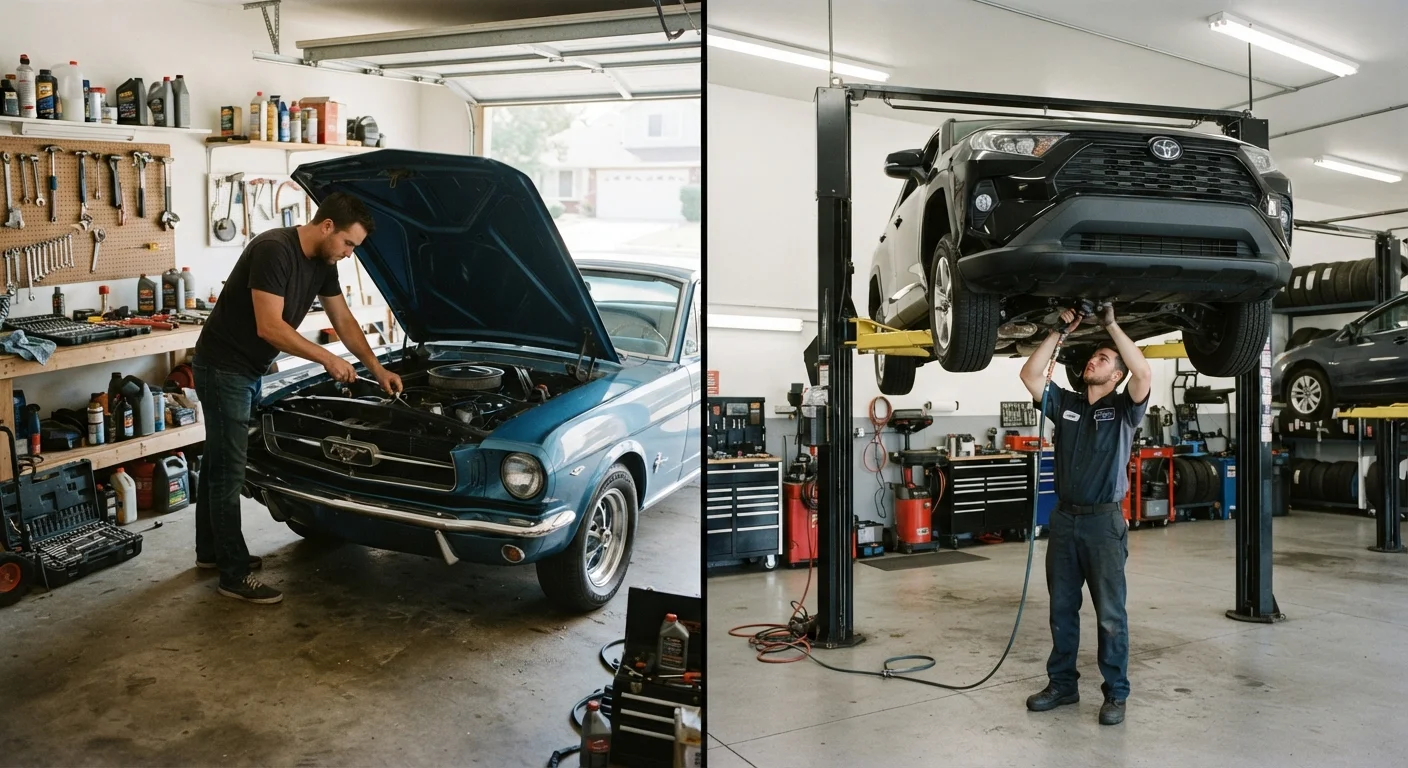
Key Takeaways
- Simple tasks like air filter swaps and wiper replacements are realistic DIY projects for most drivers.
- Brake systems, suspension components, and anything involving fuel or high-voltage systems require a qualified mechanic.
- DIY can save money on labor, but mistakes on complex jobs can cost significantly more to fix.
- Your owner's manual defines the maintenance schedule your vehicle was actually engineered for - consult it first.
- The right choice depends on your skill level, available tools, and the safety stakes of the specific job.
Our Verdict
DIY maintenance makes sense for straightforward, low-risk tasks where the cost of a mistake is manageable and basic tools suffice. Professional service is the wiser call for anything involving safety systems, specialized equipment, or work that requires diagnostic expertise. Most drivers will benefit from a hybrid approach - handling simple upkeep themselves while trusting trained mechanics with jobs that genuinely demand it.
| Best for | Recommended |
|---|---|
| Drivers comfortable with basic tools and simple procedures | DIY maintenance for routine, low-risk tasks |
| Anyone dealing with brakes, suspension, or electrical faults | Professional mechanic service |
| Those working within strict time or cost constraints | DIY for simple jobs; shop for anything requiring specialized tools |
| New or inexperienced vehicle owners | Professional mechanic, with gradual DIY skill-building over time |
Why This Decision Actually Matters
Car ownership comes with an ongoing maintenance obligation - and every driver eventually faces the same question: handle it yourself or pay someone else? Neither answer is universally right. The honest framework depends on the task, your capabilities, and what's at stake if something goes wrong.
For a solid foundation on what routine upkeep actually involves, see our plain-English maintenance primer - it covers every essential task without assuming prior mechanical knowledge. The bigger picture of why staying current on maintenance pays off long-term is explored in this look at routine maintenance's long-term payoff.
Tasks That Are Genuinely DIY-Friendly
Several common maintenance items require no special equipment, carry low safety risk, and follow straightforward procedures most drivers can learn in under an hour.
- Engine air filter replacement: Usually a matter of unclipping a housing, swapping the filter, and reattaching - no tools required on most vehicles.
- Cabin air filter replacement: Typically accessible behind the glove box or under the dashboard. Your owner's manual will show the exact location and replacement interval.
- Windshield wiper blades: Blades attach with simple clips; replacement takes minutes and blades are widely available.
- Checking and topping fluid levels: Engine oil, coolant, brake fluid, and washer fluid all have clearly marked reservoirs. Monitoring levels is easy; adding fluid is straightforward when using the correct type specified by the manufacturer.
- Battery terminal cleaning: Corrosion buildup on terminals can be safely cleaned with a wire brush and basic safety precautions.
Start Small to Build Confidence
If you're new to DIY maintenance, begin with a single straightforward task - such as an air filter swap - before moving on to anything more involved. Consulting your owner's manual before starting any job will clarify the correct parts, fluids, and procedures your vehicle specifically requires. Building a small kit of quality basic tools gradually is more practical than buying everything upfront.
These tasks also serve as useful entry points for drivers building mechanical familiarity over time. Small wins with basic jobs build the confidence and judgment to recognize when a problem is beyond DIY scope.
When the Job Belongs in a Shop
Other maintenance and repair tasks involve safety-critical systems, specialized diagnostic tools, or procedures where an error can escalate into a much larger - and more expensive - problem.
| DIY Maintenance | Professional Mechanic | |
|---|---|---|
| Typical cost | Parts cost only; no labor charge | Parts plus labor; higher total outlay |
| Tool requirements | Basic hand tools for simple tasks | Specialized equipment available in-shop |
| Suitable task types | Filters, fluids, wiper blades, battery terminals | Brakes, suspension, timing, diagnostics, fuel systems |
| Safety risk if done incorrectly | Low for routine tasks | Higher stakes for safety-critical systems |
| Diagnostic capability | Limited without professional scan tools | Full diagnostic access and interpretation |
| Time investment | Variable; learning curve for first attempts | Faster with experience and proper equipment |
| Warranty implications | Possible risk on under-warranty vehicles | Certified work typically preserves warranty |
- Brake system work: Pad replacement is often cited as a borderline DIY task, but brake bleeding, caliper replacement, and rotor resurfacing involve precision that directly affects stopping performance. Errors here have serious safety consequences.
- Suspension and steering components: Worn ball joints, tie rods, and struts affect handling and tire wear. Proper diagnosis and installation require a lift, torque specifications, and often a wheel alignment afterward.
- Timing belt or chain service: This job is labor-intensive, sequence-sensitive, and catastrophic if done incorrectly - engine damage is a real risk on interference engines.
- Check engine light diagnosis: Reading a fault code with a basic scanner tells you a code, not a cause. Accurate diagnosis often requires a professional-grade scan tool and the expertise to interpret live data.
- Fuel system and high-voltage hybrid/EV components: These systems carry risks that make professional service non-negotiable for safety reasons.
The Real Cost Comparison
DIY saves on labor - and labor typically accounts for a significant portion of a shop bill. But the cost calculation isn't purely about the hourly rate you avoid paying. Consider:
- Tool investment: Some jobs require tools you may not own and won't use often. A torque wrench, jack stands, or specialty sockets can add up quickly for a one-off job.
- Cost of mistakes: An improperly installed component may cause further damage or require a shop to redo the work - often at higher cost than the original job would have been.
- Warranty considerations: Some manufacturers' warranties specify that certain work be performed by certified technicians. Verify before proceeding with DIY on a vehicle still under warranty.
For a broader view of what maintenance spending typically looks like over a vehicle's life, our article on car maintenance costs over time provides useful context. Understanding the difference in oil types - a common DIY question - is also covered in our guide to synthetic vs. conventional motor oil.
A Practical Framework for Deciding
Before starting any maintenance task yourself, run through these questions honestly:
- Is this task explicitly covered in my owner's manual? If the manual describes a procedure with clear steps and no special tools, it's often intended for owner access.
- What happens if I make a mistake? If the answer involves a safety risk - to yourself or others on the road - that's a strong signal to defer to a professional.
- Do I have the right tools and a safe working environment? A stable, level surface, proper jack stands (never rely solely on a floor jack), and adequate lighting are the baseline.
- Has a diagnostic already identified the problem clearly? DIY repair works best when the diagnosis is already confirmed. Guessing at causes and replacing parts speculatively is rarely cost-effective.
The goal isn't to avoid all professional service - it's to be an informed vehicle owner who knows the limits of each approach. That judgment, more than any specific skill, is what protects both your car and your budget.