

Key Takeaways
- Your owner's manual contains the factory-specified maintenance schedule designed for your exact engine and drivetrain.
- Generic service interval advice often differs significantly from what your manufacturer actually recommends.
- The manual explains warning lights, fluid specifications, tire pressures, and towing limits in plain terms.
- Most owner's manuals are also available as free PDF downloads from the manufacturer's website.
- Reading even a few key sections can prevent costly mistakes and unnecessary service upsells.
What you will need
Why Most Drivers Never Open It
The owner's manual is the most authoritative document that comes with your vehicle - written by the engineers who designed it - yet surveys consistently show the majority of drivers have never read past the first few pages. It sits in the glove box, buried under registration papers and old napkins, consulted only in a crisis.
Part of the problem is perception. Many drivers assume the manual is dense, technical, and written for mechanics rather than everyday people. In reality, most modern manuals are organized logically, use plain language, and include a detailed index. A quick scan of the table of contents reveals sections on everything from warning lights to cargo capacity - information that's directly useful, right now, regardless of mechanical experience.
The other issue is that outside advice fills the vacuum. Quick-lube shops, well-meaning coworkers, and internet forums become the default source for maintenance intervals. That advice is often generic - built around average assumptions, not your specific engine, climate designation, or drivetrain configuration. Your manual, by contrast, was written for exactly your vehicle. See our guide on oil change intervals for a real-world example of how generic advice can diverge from manufacturer guidance.
What You'll Actually Find Inside
Before working through the steps below, it helps to understand the manual's structure. Most are divided into several major sections:
- Instruments and controls - how every button, switch, and dashboard symbol works
- Maintenance and service - the official schedule for oil changes, filters, spark plugs, belts, and more
- Technical specifications - fluid types, tire pressure ranges, towing capacity, fuel grade requirements
- Emergency information - what to do if a warning light activates, how to change a tire, roadside procedures
The maintenance schedule section alone is worth the read. It typically separates intervals by mileage and time (whichever comes first), and many manuals now include two tracks: normal driving conditions and severe driving conditions. Severe conditions - which include frequent short trips, towing, dusty environments, or extreme temperatures - apply to more drivers than most people realize. Our plain-English maintenance primer explains each of these service tasks in practical detail once you know what your manual specifies.
No Manual? No Problem.
If your vehicle came without a physical manual - as is often the case with used cars - most manufacturers host free, searchable PDFs on their official websites. Searching "[your vehicle year, make, model] owner's manual PDF" typically surfaces the official source quickly. Third-party sites may host older editions, but always cross-check against the manufacturer's version for accuracy.
How to Read and Use Your Manual Effectively
What you will need
Locate or download your owner's manual
Check your glove box first. If the manual is missing - common with used vehicles - search the manufacturer's official website using your vehicle's year, make, and model. Most automakers provide free PDF downloads. You can also search for your vehicle's VIN (found on the driver's side dashboard or door jamb) to pull the exact edition for your build.
Find the maintenance schedule section
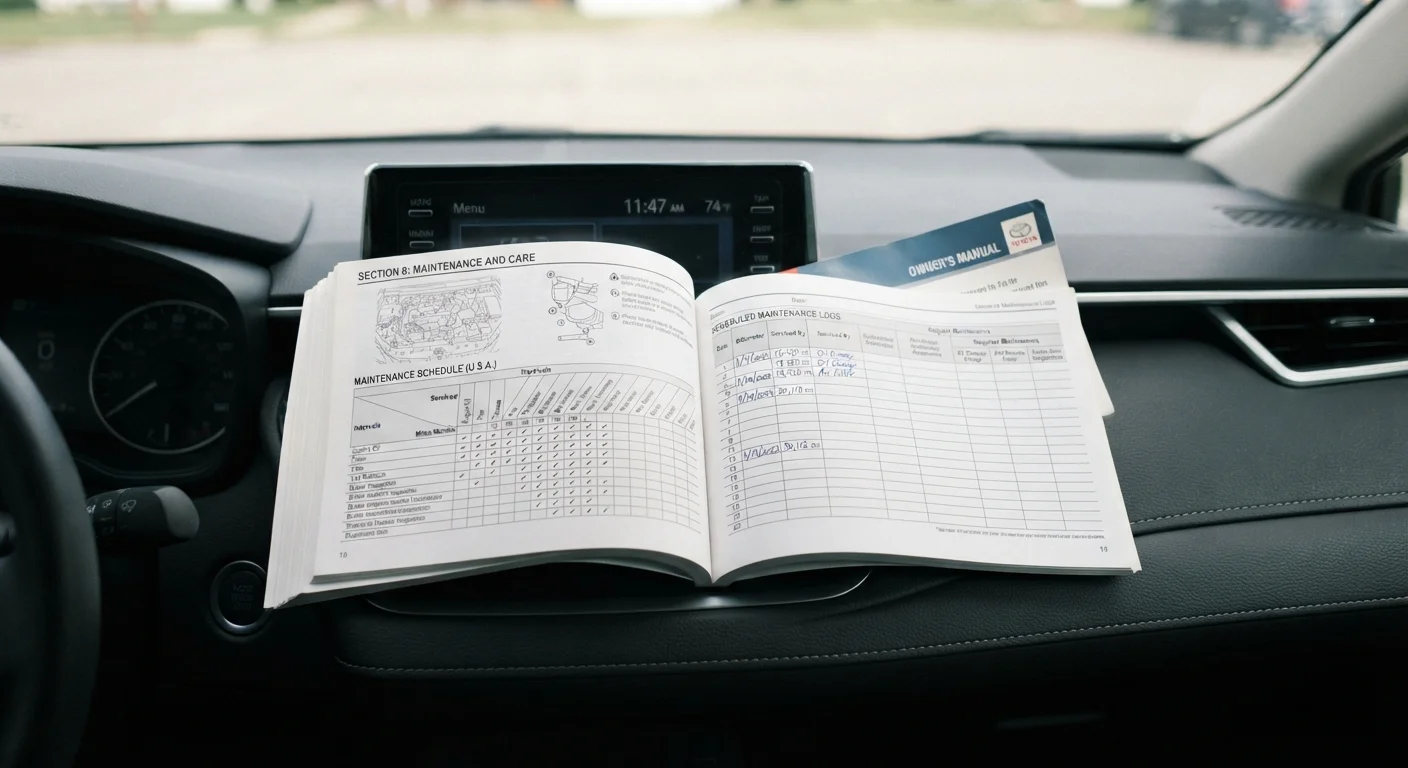
Use the table of contents or index to navigate directly to the maintenance and service section. This is typically labeled "Scheduled Maintenance," "Service Schedule," or similar. Look for the mileage-based table - it lists every service item (oil, filters, fluids, belts, spark plugs) alongside the interval at which each is due. Note whether your driving habits qualify as "severe" service conditions, as defined by the manual.
Identify your fluid specifications
Locate the technical specifications section and note the exact oil viscosity grade (such as 5W-30 or 0W-20), coolant type, brake fluid specification, and transmission fluid type your vehicle requires. These aren't interchangeable - using the wrong fluid type can cause component damage over time. Write these down or photograph the page for reference at service appointments. For a deeper look at what each fluid does, see our guide to fluid checks.
Check tire pressure recommendations
The recommended tire pressure for your vehicle is listed in the manual and also printed on a sticker inside the driver's door jamb. Note that this figure - expressed in PSI - applies to cold tires (measured before driving). The pressure printed on the tire sidewall is the maximum the tire can hold, not the target pressure for your vehicle. These two numbers are often different, and using the wrong one affects handling, fuel efficiency, and tire wear.
Review the warning light reference guide
Most manuals include a dedicated section illustrating every dashboard warning symbol and its meaning. Read through this section so you can recognize a critical alert (such as low oil pressure or overheating) versus an advisory notice (such as a service reminder or door-ajar indicator) before one appears while driving. Knowing the difference helps you make a calm, informed decision rather than guessing under pressure. For a comprehensive breakdown, our warning lights guide walks through each symbol in detail.
Note towing, payload, and fuel requirements
If you ever haul a trailer, carry heavy loads, or are unsure about fuel grade, the specifications section provides the manufacturer's defined limits. Exceeding towing or payload capacity puts stress on the drivetrain, suspension, and brakes in ways that may not be immediately obvious. The required fuel grade (regular, mid-grade, or premium) is also specified here - using a lower grade than required can affect engine performance and, in some engines, may cause long-term issues.
Once you've worked through these steps, you'll have a clear picture of what your vehicle actually needs - and when. Pair this knowledge with the long-term payoff of routine maintenance to understand why following the manufacturer's schedule consistently matters over the life of your vehicle.
For vehicles already past the 100,000-mile mark, maintenance habits for high-mileage vehicles builds on this foundation with guidance specific to older cars.