

Key Takeaways
- The advertised monthly rate rarely reflects what you'll actually pay once fees and equipment charges are added.
- Equipment rental fees alone can add $10-$20 per month, totaling hundreds of dollars over a two-year contract.
- Promotional pricing often expires after 12 months, causing monthly bills to jump significantly.
- Data overage charges can add unpredictable costs, particularly on plans with hard data caps.
- Reading the full terms of service before signing up is essential to calculating true long-term cost.
True Cost of Home Internet
The true cost of home internet is the total amount you actually pay for connectivity over time - not just the advertised monthly rate. It includes one-time fees like installation and equipment setup, recurring charges like router rental, and variable costs like data overage fees or price increases after a promotional period ends.
Providers are required to disclose certain fees under FCC broadband label rules, but consumers must still read beyond the headline price to understand the full financial picture of a service contract.
Why the Advertised Rate Is Just the Starting Point
Internet providers lead with a monthly rate in their advertising - and that number is almost never what you'll pay. The headline price is typically a promotional rate that applies for the first 12 months, excludes equipment fees, and doesn't reflect taxes or regulatory surcharges added at billing. Understanding what's bundled into - and excluded from - that number is the foundation of comparing plans accurately.
To understand what kind of plan you're actually signing up for, it helps to first understand the connection type itself. Our guide to home internet connection types explains how fiber, cable, DSL, and satellite differ in both performance and typical pricing structure.
Once you know the technology, the next step is dissecting the bill into its actual components.
The Hidden Fees That Drive Up Your Monthly Bill
Several recurring charges routinely appear on internet bills that aren't reflected in advertised rates:
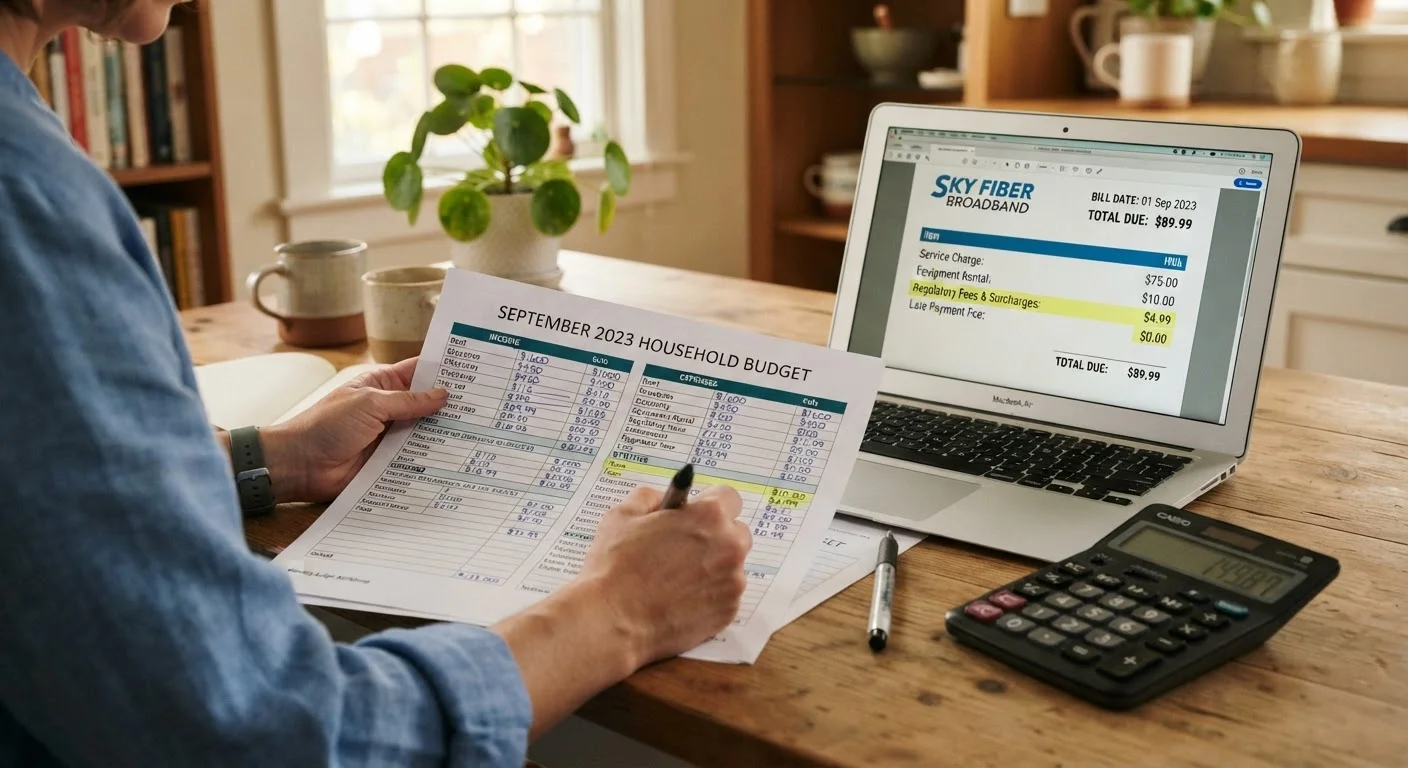
- Equipment rental fees: Most providers charge $10-$20 per month to rent a modem or gateway device. Over a 24-month contract, that's $240-$480 on top of your base plan cost.
- Router rental: Some providers bundle Wi-Fi router rental separately, adding another $5-$15 per month.
- Taxes and regulatory fees: Federal Universal Service Fund (USF) contributions, state and local taxes, and various regulatory surcharges typically add $3-$10 to monthly bills.
- Service or network fees: Some providers add a "network enhancement" or "service" fee that isn't part of the advertised plan price.
Buying your own compatible modem and router eliminates rental fees entirely. While the upfront cost can range from $80 to $200 or more depending on the equipment, this investment typically pays off within 12 to 18 months for most households.
$10-$20/mo
Typical monthly equipment rental fee
Equipment rental fees are one of the most consistent hidden costs on residential internet bills, often adding $240-$480 over a standard two-year contract period.
12 months
Typical promotional pricing window
Most promotional internet rates are valid for the first 12 months of service, after which the standard rate - often $20-$40 higher - takes effect.
$50-$150
Common professional installation fee range
Installation fees vary by provider and location; some waive them during promotions, while others charge this as a standard one-time cost at setup.
One-Time and Setup Costs to Factor In
Before the first bill even arrives, you may face upfront costs that affect the true price of getting connected:
- Installation fees: Professional installation, where a technician comes to your home and sets up the connection, can range from $50 to $150. Some providers waive this fee during promotions or for self-installation setups.
- Activation fees: A one-time charge, sometimes $10-$35, for activating service on a new account.
- Early termination fees (ETFs): If you switch providers before a contract ends, ETFs can run $10-$15 per remaining month on the contract - adding up to $180 or more on an 18-month remaining term.
Spreading one-time costs across a contract period helps clarify true monthly cost. A $100 installation fee on a 24-month contract adds roughly $4.17 to your effective monthly rate.
Ask for the All-In Monthly Price
Before agreeing to a plan, ask the provider to itemize every recurring charge - including equipment, taxes, and regulatory fees - at the standard (post-promotional) rate. Request this in writing or via a provider-issued quote. This gives you a reliable baseline for cost comparison rather than relying on the advertised headline number.
Promotional Pricing and Rate Increases
Promotional rates are nearly universal in residential internet marketing, and the rate jump when they expire can be substantial. A plan advertised at $49.99 per month may revert to $74.99 or higher after 12 months - a 50% increase. Over a two-year window, the average monthly cost of that plan is closer to $62 than $50.
Always ask the provider for the standard (post-promotional) rate before signing up, and use that figure - not the promotional one - when comparing options. Some providers offer price-lock guarantees for a fixed term; others reserve the right to increase rates with 30 days' notice. The details are in the fine print. Our article on how to read an ISP's terms of service shows exactly where to find these clauses and what they mean in practice.
“The price you see advertised is the price the provider wants you to remember. The price you pay is determined by what you agreed to in the contract.”
— Consumer Financial Protection Bureau, U.S. federal consumer protection agency
Data Caps and Overage Charges
Not all plans offer unlimited data. DSL and satellite plans in particular often impose monthly data caps - commonly ranging from 150 GB to 1.2 TB. Exceeding those limits can trigger either overage fees (often $10-$15 per additional 50 GB block) or severe speed throttling for the remainder of the billing cycle.
Households with multiple users streaming video, gaming online, or working from home can consume data faster than expected. See our breakdown of how devices and activities consume bandwidth to estimate whether a capped plan fits your usage.
For households in areas with limited options, understanding these limits before signing up is especially important. Our guide to rural internet options covers what to realistically expect from plans in lower-competition markets, where caps are more common.
FCC Broadband Labels Improve Transparency
The FCC now requires many broadband providers to display standardized labels disclosing monthly price, data allowances, overage fees, and contract terms at the point of sale. While these labels are a step toward transparency, they don't replace careful review of the full service agreement before signing.
Calculating Your Real Monthly Cost
A simple formula brings the true cost into focus. For any plan you're considering, add together:
- The standard (post-promotional) monthly rate
- Equipment rental fees (or the amortized cost of owned equipment)
- Estimated taxes and regulatory fees
- One-time fees divided by contract length (in months)
Compare that number across plans rather than the advertised rate. Two plans priced the same on paper can differ by $20 or more per month once all costs are included. This approach mirrors how analysts think about any subscription service - and it's the same logic that applies to comparing costs in areas like auto ownership. Our piece on total cost of ownership explores that same principle in a different context.
Armed with the full cost picture, you're in a much stronger position to evaluate what a plan is actually worth - and to ask providers the right questions before you commit.