

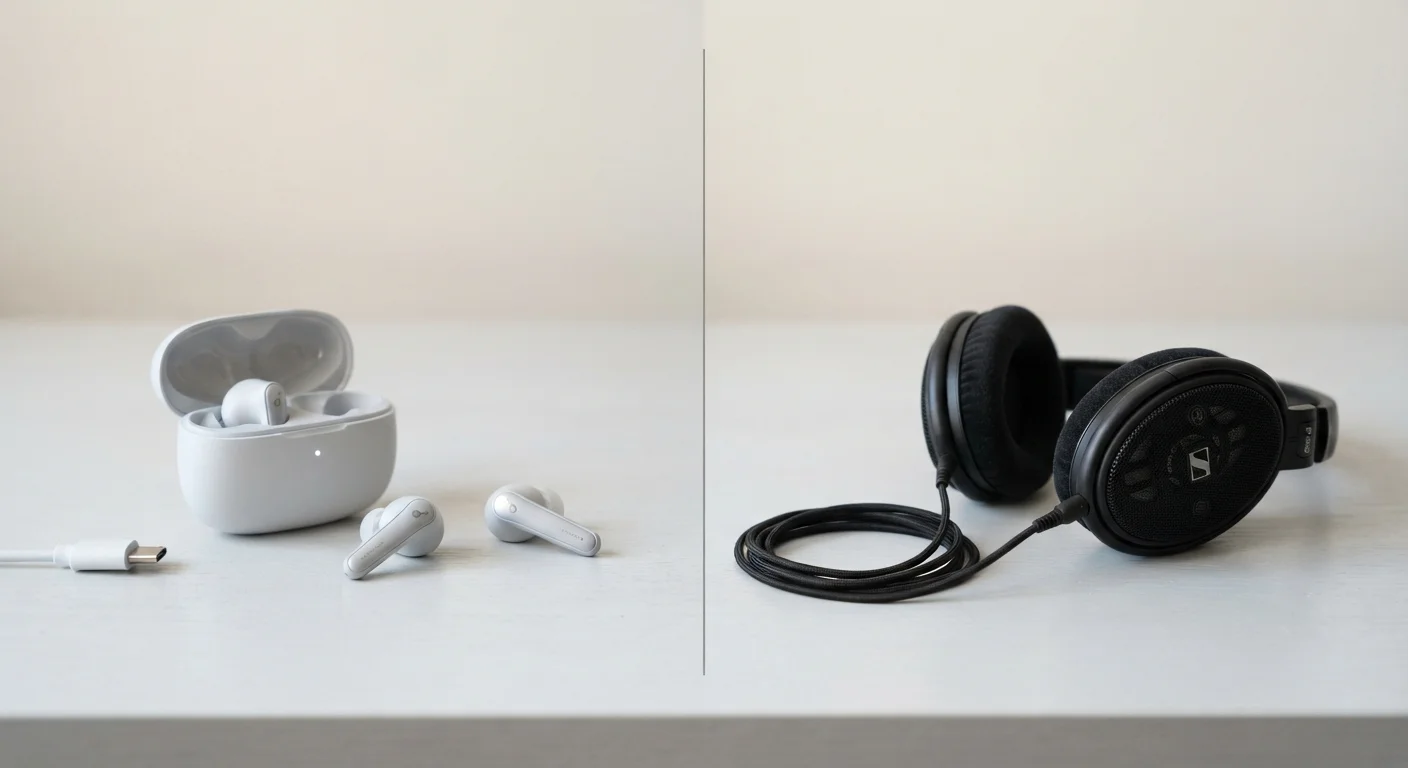
Key Takeaways
- Wireless earbuds introduce audio compression and measurable latency that wired headphones avoid entirely.
- Wired headphones have no battery to charge, giving them a significant reliability advantage for long sessions.
- Bluetooth codecs like aptX and AAC close the audio quality gap but don't fully eliminate it.
- Active Noise Cancellation is now common in both wireless and wired options, but wireless implementations vary more widely.
- Your specific use case - mobility, studio work, gaming, or casual listening - should drive the decision.
Option A
Wireless Earbuds
The cable-free, portable everyday companion.
Best for: Commuters, exercisers, and anyone who values freedom of movement and convenience over absolute audio fidelity.
Option B
Wired Headphones
The reliable, no-compromise audio workhorse.
Best for: Audiophiles, studio listeners, and users who need consistent, low-latency sound without managing battery life.
If you commute, exercise, or need hands-free mobility
Wireless Earbuds
No cable snagging and freedom of movement make wireless earbuds the practical choice for active, on-the-go use.
If you prioritize consistent, uncompressed audio quality
Wired Headphones
Wired connections transmit an analog signal without Bluetooth compression, preserving more of the original audio detail.
If you play games or watch video where sync matters
Wired Headphones
Wired headphones have near-zero latency, eliminating the audio delay that can make dialogue and sound effects feel out of sync wirelessly.
If you want to avoid charging yet another device
Wired Headphones
Wired headphones draw no battery power from a separate source, so there's nothing to run out mid-flight or mid-meeting.
If you use multiple devices and switch between them frequently
Wireless Earbuds
Multipoint Bluetooth pairing lets many wireless earbuds stay connected to two devices at once, making switching seamless.
What Actually Changes When You Remove the Cable
Cutting the cord does more than eliminate a physical wire. It changes the entire signal path your audio travels - and that has real consequences for sound quality, timing, and reliability.
With wired headphones, audio travels as an analog electrical signal from a headphone jack or DAC (digital-to-analog converter) directly to the driver in each ear cup. The signal is continuous and lossless within its path. With wireless earbuds, audio is first compressed using a Bluetooth codec, transmitted over radio frequency, received by a small chip inside the earbud, decoded, converted from digital to analog, then played back. Each of those steps introduces processing overhead. Understanding how Bluetooth works as a transmission protocol is useful here - see our breakdown of short-range wireless technologies for the technical detail.
The compression step is the most consequential. Standard Bluetooth SBC codec strips away audio data to fit within the transmission bandwidth. Higher-quality codecs - AAC, aptX, aptX HD, and Sony's LDAC - reduce that loss considerably, but they require both the source device and the earbuds to support the same codec. Mismatched devices fall back to SBC regardless of what either device is capable of on its own.
Latency: The Hidden Difference Most Listeners Notice
Audio latency - the delay between a sound being produced and reaching your ears - is negligible with wired headphones, typically under 5 milliseconds. With wireless earbuds, Bluetooth latency generally ranges from around 40 milliseconds to over 200 milliseconds depending on the codec and device. For music listening, this rarely matters. For video or gaming, it absolutely does.
When audio lags behind video by more than roughly 20-30 milliseconds, the human brain begins to detect the mismatch. Dialogue appears to drift from lip movements. Game sound effects arrive a beat too late. Some devices compensate with software-level synchronization, but this relies on the device, the streaming app, and the earbuds all cooperating correctly - which isn't guaranteed.
| Criterion | Wireless Earbuds | Wired Headphones |
|---|---|---|
| Signal path | Bluetooth transmission with codec compression | Direct analog electrical signal |
| Audio latency | 40-200+ ms depending on codec | Under 5 ms |
| Battery requirement | Yes - earbuds and case must be charged | None required |
| Cable interference | No cable, no microphonics | Cable can cause rustling noise |
| Portability | Highly portable, pocket-sized case | Bulkier, less pocketable |
| Driver size potential | Limited by small earbud housing | Larger drivers possible in over-ear designs |
| Long-term durability | Battery degrades over 1-3 years | Can last a decade with cable care |
For professional studio monitoring or precise audio editing, wired headphones remain the standard for this reason alone. The deterministic, consistent signal path removes a variable that wireless cannot yet fully eliminate.
Battery Life, Charging, and the Reliability Question
Wired headphones have exactly zero battery considerations. They work as long as the cable and source device do. Wireless earbuds carry two batteries - one in each bud - plus a third in the charging case, and all three degrade with charge cycles over time.
500
Typical charge cycles before notable battery degradation
Lithium-ion cells in consumer earbuds commonly retain around 80% capacity after approximately 500 full charge cycles.
40-200ms
Typical Bluetooth audio latency range
Latency varies significantly by codec; standard SBC often exceeds 100ms, while low-latency codecs can approach 40ms.
5-10 hrs
Average wireless earbud playback per charge
Most current wireless earbuds offer 5 to 10 hours per charge, with cases extending total capacity to 24-36 hours.
Typical wireless earbuds today offer between 5 and 10 hours of playback per charge, with the case extending total use to 24-36 hours before needing a power outlet. That's sufficient for most daily use, but it introduces a new responsibility: remembering to charge. A wired headphone never dies in the middle of a flight.
Battery degradation is also a long-term factor. Lithium-ion cells in earbuds typically retain around 80% of original capacity after 500 charge cycles - roughly two years of daily use. After that, battery life shortens noticeably, and replacing the batteries in small earbuds is often impractical or costly. Wired headphones, by contrast, can last a decade or more with basic cable care. This connects to a broader conversation about the tradeoffs of always-powered personal devices covered in our article on always-on device tradeoffs.
Fit, Form, and Practical Everyday Differences
Wireless earbuds are typically smaller, lighter, and designed for in-ear or true wireless fit. Many are water-resistant, making them viable for workouts. The absence of a cable means no microphonics - the rustling noise wired cables produce when they rub against clothing, which is a common irritation in daily use.
Wired headphones span a wider physical range, from compact on-ear models to full-size over-ear designs. Over-ear wired headphones often have larger drivers - the internal speaker element - which can move more air and produce more nuanced bass and soundstage. Audiophiles typically prefer open-back wired over-ear headphones for their natural, spacious sound, though this design provides little isolation in noisy environments.
Active Noise Cancellation (ANC) is now available in both categories, using microphones to capture ambient sound and generate an opposing signal that cancels it out. Wireless implementations vary considerably in effectiveness, while wired headphones with ANC require a separate power source - usually an internal battery - which closes some of the battery-dependence gap between the two types.
The decision ultimately maps to context. For commuters and active users, wireless earbuds solve real daily problems. For home listening, studio work, or uninterrupted long sessions, wired headphones remove variables that wireless cannot. Neither format is objectively superior - they're optimized for different lives.
This article is for general informational purposes only. Product specifications and technology standards evolve; verify current codec support and device compatibility before purchasing.