

Key Takeaways
- Always-on devices listen, sense, or transmit data continuously, even when you're not actively using them.
- The convenience benefits are real, but so are the privacy, security, and energy tradeoffs.
- Most devices allow users to limit data collection through settings, without fully disabling core functions.
- Understanding how these devices work helps you make deliberate choices rather than accepting defaults.
Instant response without manual activation
Always-on devices eliminate the friction of unlocking, launching an app, or pressing a button. Smart speakers respond to voice in under a second precisely because they're already listening.
Continuous health and safety monitoring
Wearables that track heart rate, blood oxygen, or sleep patterns can only provide useful data because they never stop measuring. Some devices have flagged irregular rhythms that users were unaware of.
Home automation that adapts to your patterns
Smart thermostats, lights, and security systems use persistent sensing to learn schedules and respond to real conditions - not just programmed timers.
Hands-free accessibility for more users
For people with mobility limitations or disabilities, always-on voice control can be genuinely transformative, removing reliance on physical interfaces entirely.
Ambient audio captured beyond your intent
Wake-word detection is imperfect. Smart speakers can activate on similar-sounding phrases and may record brief audio clips that are stored on manufacturer servers, sometimes reviewed by human contractors.
Continuous data transmission to third parties
Many devices send usage data, behavioral patterns, or sensor readings to cloud servers by default. Depending on the manufacturer's data-sharing agreements, that data may reach advertising or analytics partners.
Increased household energy consumption
A device drawing even a few watts continuously adds up over a year. Households with multiple always-on devices can see a measurable increase in electricity use compared to devices that power down fully.
Expanded attack surface for security vulnerabilities
Every internet-connected device that's always online represents a potential entry point for network intrusions. Devices with infrequent firmware updates are particularly vulnerable over time.
Erosion of privacy expectations at home
Cameras, microphones, and motion sensors inside the home shift the baseline expectation of private space - a concern that becomes more significant in shared living situations or with guests.
Our Verdict
Always-on devices deliver genuine value - faster responses, health insights, and home automation - but they do so by maintaining a continuous data relationship with manufacturers, cloud servers, and sometimes third parties. The tradeoffs are manageable for most users who take time to review privacy settings and understand what their devices are actually doing. Accepting defaults without scrutiny, however, means ceding more control than most people intend.
Consumers who want the convenience of connected devices and are willing to spend a few minutes configuring privacy settings to match their comfort level.
What 'Always-On' Actually Means
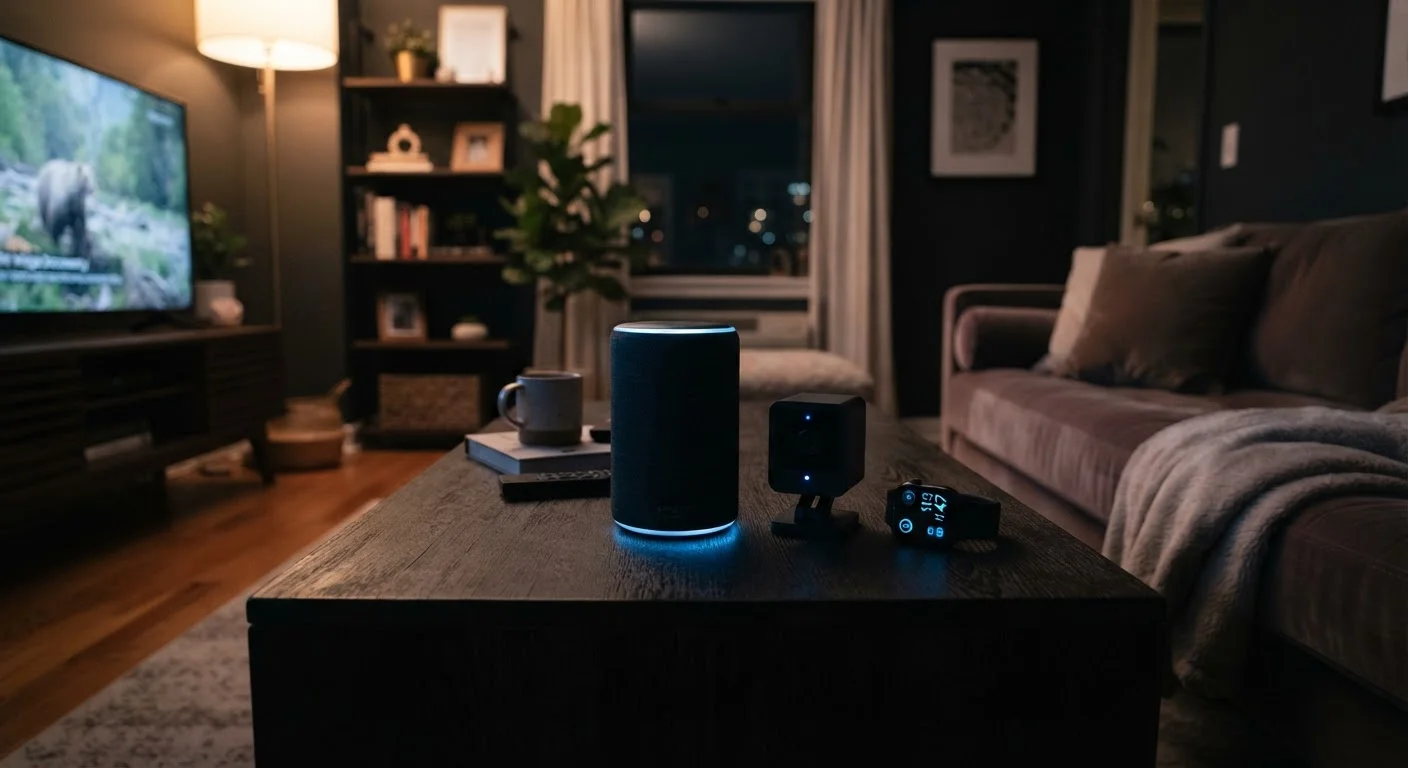
The term always-on refers to devices that maintain a persistent connection to power, the internet, or both - and remain ready to respond or record even when you're not interacting with them. Smart speakers wait for a wake word. Security cameras stream or buffer footage continuously. Fitness trackers measure heart rate, movement, and sleep around the clock.
This isn't a bug; it's the core design. Responsiveness depends on readiness. But that readiness has costs - in energy draw, data exposure, and the simple fact that these devices are always paying attention to something. For a broader look at how connected devices share your home network, see our piece on how devices consume internet bandwidth.
The Real Advantages
Always-on functionality isn't just a marketing feature - it solves real problems for real households.
Instant response without manual activation
Always-on devices eliminate the friction of unlocking, launching an app, or pressing a button. Smart speakers respond to voice in under a second precisely because they're already listening.
Continuous health and safety monitoring
Wearables that track heart rate, blood oxygen, or sleep patterns can only provide useful data because they never stop measuring. Some devices have flagged irregular rhythms that users were unaware of.
Home automation that adapts to your patterns
Smart thermostats, lights, and security systems use persistent sensing to learn schedules and respond to real conditions - not just programmed timers.
Hands-free accessibility for more users
For people with mobility limitations or disabilities, always-on voice control can be genuinely transformative, removing reliance on physical interfaces entirely.
Smart speakers that respond instantly, thermostats that adapt to your schedule without manual input, and wearables that detect irregular heart rhythms all depend on continuous operation. If you're curious about what fitness trackers are actually capturing, our guide on what fitness trackers measure breaks down the sensors and their accuracy.
For households that have invested in smart home ecosystems, always-on capability is often what makes automation feel seamless rather than clunky. Our introduction to smart home devices explains how these systems fit together for new owners.
The Real Disadvantages
The same features that make always-on devices useful also introduce tradeoffs that deserve honest examination.
Ambient audio captured beyond your intent
Wake-word detection is imperfect. Smart speakers can activate on similar-sounding phrases and may record brief audio clips that are stored on manufacturer servers, sometimes reviewed by human contractors.
Continuous data transmission to third parties
Many devices send usage data, behavioral patterns, or sensor readings to cloud servers by default. Depending on the manufacturer's data-sharing agreements, that data may reach advertising or analytics partners.
Increased household energy consumption
A device drawing even a few watts continuously adds up over a year. Households with multiple always-on devices can see a measurable increase in electricity use compared to devices that power down fully.
Expanded attack surface for security vulnerabilities
Every internet-connected device that's always online represents a potential entry point for network intrusions. Devices with infrequent firmware updates are particularly vulnerable over time.
Erosion of privacy expectations at home
Cameras, microphones, and motion sensors inside the home shift the baseline expectation of private space - a concern that becomes more significant in shared living situations or with guests.
Local Processing vs. Cloud Processing
Some newer always-on devices handle voice recognition or sensor analysis locally on the device chip, rather than sending data to a remote server. Local processing generally means less data leaves your home, though it can also mean reduced accuracy or fewer features. Check your device's settings or documentation to see which mode it uses - and whether you can switch between them.
Many users also underestimate how much these devices can do when configured correctly. Our article on using everyday gadgets more effectively highlights overlooked features that can improve both utility and control.
What You Can Actually Control
The good news is that most always-on devices offer more configuration options than their default settings suggest. Microphone mute switches, local-only processing modes, data-deletion tools, and granular app permissions are common - but rarely enabled out of the box.
70%+
Smart speaker owners who never changed default settings
Research from consumer advocacy organizations consistently finds that most users accept default privacy configurations without review, regardless of device type.
~1-8W
Typical idle power draw per always-on device
U.S. Department of Energy estimates suggest standby and idle power consumption from connected devices collectively accounts for a meaningful share of residential electricity use.
A practical approach: review the privacy settings of each connected device when you first set it up, not months later. Disable data-sharing options you don't need. Check whether voice recordings are stored and for how long, and whether you can opt out of human review programs that some manufacturers use to improve voice recognition.
Battery-powered always-on devices - wearables especially - also benefit from maintenance habits that extend hardware life. Our guide to caring for your gadgets covers charging and storage practices that make a measurable difference.
The goal isn't to avoid always-on technology - for many households, the convenience is worth it. The goal is to use it deliberately, with a clear sense of what you're exchanging for that seamless experience.