

Key Takeaways
- Optical heart rate sensors estimate pulse by shining LED light through your skin - accuracy varies by fit and skin tone.
- Accelerometers detect motion in three axes; step counts are calculated algorithms, not direct counts.
- Sleep stage classification relies on movement and heart rate, not brainwave readings - treat it as an estimate.
- Calorie burn estimates from wrist-based trackers carry meaningful error margins and should not be treated as precise.
- Understanding sensor limitations helps you use tracker data as a useful trend tool rather than medical-grade measurement.
The Core Sensors Inside Every Fitness Tracker
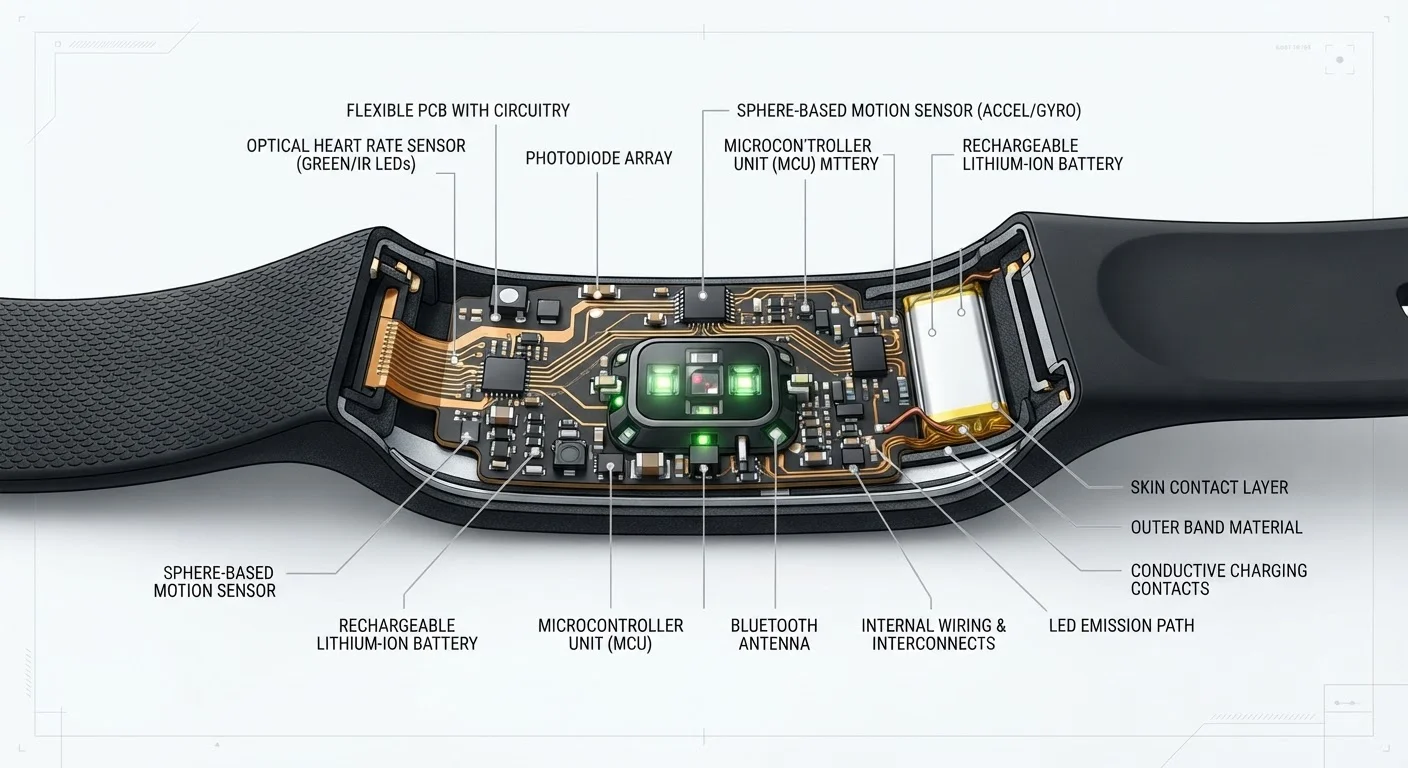
A fitness tracker is essentially a cluster of miniaturized sensors wrapped in a wristband. While the exterior looks simple, the hardware inside is doing several jobs at once. Most consumer-grade trackers contain at least three major sensor types: an accelerometer, an optical heart rate sensor (also called a photoplethysmography or PPG sensor), and a gyroscope. Higher-end models may also include GPS, skin temperature sensors, blood oxygen (SpO2) sensors, and even electrical heart sensors used to generate single-lead electrocardiogram (ECG) readings.
Each sensor is designed to measure something specific about your body or movement, and the device's processor then combines those raw signals through software algorithms to produce the metrics you see - steps, calories, heart rate zones, and sleep stages. Understanding this pipeline matters because the accuracy of every output depends on both the hardware and the algorithm interpreting it.
For a broader look at how wearables fit into the connected-device landscape, see the tradeoffs of always-on devices.
How Heart Rate Monitoring Actually Works
The green (or sometimes red and infrared) LEDs on the underside of your tracker are doing the work of heart rate measurement. This method, called photoplethysmography (PPG), works by shining light into the capillaries beneath your skin. Blood absorbs light differently depending on how much is present - and blood volume in capillaries changes with every heartbeat. A photodetector reads that fluctuating light absorption and converts it into a pulse rate estimate.
Wear your tracker snugly - not uncomfortably tight, but with no gap between the sensor array and your skin. A loose band is the single fastest way to degrade heart rate accuracy during exercise.
PPG sensors rely on consistent skin contact; gaps introduce ambient light and motion artifact that corrupt the signal, a well-documented source of error in wearable heart rate literature.
Calibrate your tracker's stride length manually by walking a known distance and comparing it against the device's estimate. Most companion apps offer a manual override that meaningfully improves distance accuracy.
Default stride length assumptions are population averages and can be off by 10-15% for individuals at the tails of height or gait distributions.
PPG is genuinely useful for resting heart rate trends and moderate-intensity exercise. However, accuracy degrades meaningfully during high-intensity or high-impact activities because wrist movement creates noise in the signal - a phenomenon called motion artifact. Loose band fit, tattoos, and darker skin tones have also been shown in published research to introduce measurement error, a limitation that device makers are actively working to address through improved sensor design and algorithms.
Some trackers also include an electrical heart sensor that measures the tiny electrical signals your heart generates, generating a simplified ECG trace. This is a fundamentally different technology from PPG and is generally more accurate for rhythm detection, though still not a substitute for clinical equipment.
Step Counting and Movement Detection
The accelerometer is the workhorse of any fitness tracker. It measures acceleration forces across three axes - forward/backward, side to side, and up/down - thousands of times per second. A gyroscope complements this by detecting rotational movement, helping the device distinguish a hand wave from a walking stride.
Crucially, your tracker does not literally count each footfall. Instead, its algorithm analyzes patterns in the acceleration data - looking for the rhythmic, repeating signal shape characteristic of a walking or running gait - and converts those patterns into a step estimate. This is why non-step arm movements like chopping vegetables or driving on a bumpy road can sometimes register as steps, and why certain activities like cycling or rowing produce fewer credited steps despite significant physical effort.
Step Count Isn't the Full Picture
Activities like swimming, weightlifting, cycling, and rowing generate significant cardiovascular and muscular effort but contribute few or no steps. Relying solely on step count to gauge daily activity can underrepresent the true workload of these exercise types. Use heart rate zones or active minutes as supplementary metrics for a more complete picture.
GPS, when present, adds a layer of positional data that helps calibrate distance and pace more accurately than accelerometer data alone. Without GPS, distance is calculated by multiplying estimated step count by a stride length value - which the device either uses as a default or learns over time from your data.
To put these metrics in context alongside common fitness concepts, fitness terminology explained covers metrics like VO2 max and RPE that trackers increasingly surface.
Sleep Tracking: What It Measures and What It Misses
Sleep tracking in consumer wearables relies on two primary inputs: movement data from the accelerometer and heart rate variability (HRV) from the PPG sensor. Periods of stillness combined with a lower, steadier heart rate are classified as sleep; variations in both are used to infer lighter sleep stages, REM, and wakefulness.
This is a meaningful distinction from clinical sleep studies (polysomnography), which measure brainwave activity (EEG), eye movement, and muscle activity simultaneously. Consumer trackers cannot access any of those signals. As a result, sleep stage classifications - particularly the separation of light sleep from deep sleep - carry substantial uncertainty and should be treated as rough estimates rather than diagnostic data.
Where consumer sleep tracking does add value is in identifying behavioral trends over time: consistent sleep timing, overall duration, and night-to-night variability. Those patterns, observed across weeks or months, can surface genuinely useful insights about sleep habits.
Accuracy Limitations You Should Know
Research comparing consumer fitness trackers against clinical-grade equipment generally finds that resting heart rate and step count are the most reliably accurate metrics, while calorie expenditure, sleep stages, and SpO2 readings carry larger error margins. A 2020 review published in the Journal of Medical Internet Research found that energy expenditure estimates from popular wrist-worn devices showed mean errors ranging from roughly 15% to over 40% depending on the device and activity type.
15-40%+
Calorie estimate error range
A 2020 review in the Journal of Medical Internet Research found energy expenditure errors of this magnitude across popular wrist-worn fitness trackers.
~3%
Typical resting heart rate error
Multiple validation studies show PPG-based resting heart rate tends to be the most accurate metric consumer trackers produce, often within a few beats per minute.
3 axes
Dimensions accelerometers measure
Tri-axial accelerometers detect acceleration in all three planes of movement, forming the foundation of step counting and activity classification algorithms.
This does not mean trackers are useless - it means the numbers are best used as relative indicators rather than absolute measurements. Seeing that you burned more calories on Tuesday than Monday has value. Treating Tuesday's specific calorie number as precise enough to guide exact dietary decisions does not. This distinction also matters when evaluating fitness progress alongside nutrition choices - reading nutrition labels accurately is a separate skill worth developing independently of tracker data.
Also worth noting: many trackers require accurate user profile inputs - height, weight, age, biological sex - to calibrate their algorithms. Outdated or inaccurate profile data compounds measurement error.
Using Your Tracker Data Wisely
The practical takeaway is to think of your fitness tracker as a trend tool with sensor-level limitations, not a medical instrument. Used that way, it can be genuinely valuable: building awareness of daily activity levels, flagging unusual resting heart rate spikes, and providing a baseline for comparing effort across time.
If a reading seems inconsistent with how you feel - an unexpectedly high or low heart rate, unusual SpO2 data - treat that as a prompt to pay attention or consult a healthcare professional, not as a diagnosis in itself. Fitness wearables are consumer wellness tools; they are not cleared for clinical diagnosis.
It is also worth auditing the data your tracker collects and stores. Most devices sync continuously to a companion app, and that data may be shared with third parties depending on the platform's privacy policy - a consideration covered more fully in our look at always-on device tradeoffs.
For context on separating useful fitness signals from noise, common exercise myths debunked is a useful companion read - many tracker-driven habits, like optimizing for calorie burn alone, run into the same misconceptions addressed there.
This article is for general informational and educational purposes only and is not intended as medical advice. Consult a qualified healthcare professional for any health-related concerns, symptoms, or before making changes to your health or exercise routine.