

Key Takeaways
- Dollar-cost averaging spreads investment purchases over time rather than committing all funds at once.
- Regular contributions automatically buy more shares when prices fall and fewer when prices rise.
- DCA reduces the emotional pressure of trying to time the market perfectly.
- The strategy works best paired with diversified, long-term holdings like index funds.
- DCA does not eliminate investment risk - markets can decline over extended periods.
- Many employer-sponsored retirement plans like 401(k)s use DCA automatically with each paycheck.
Dollar-Cost Averaging
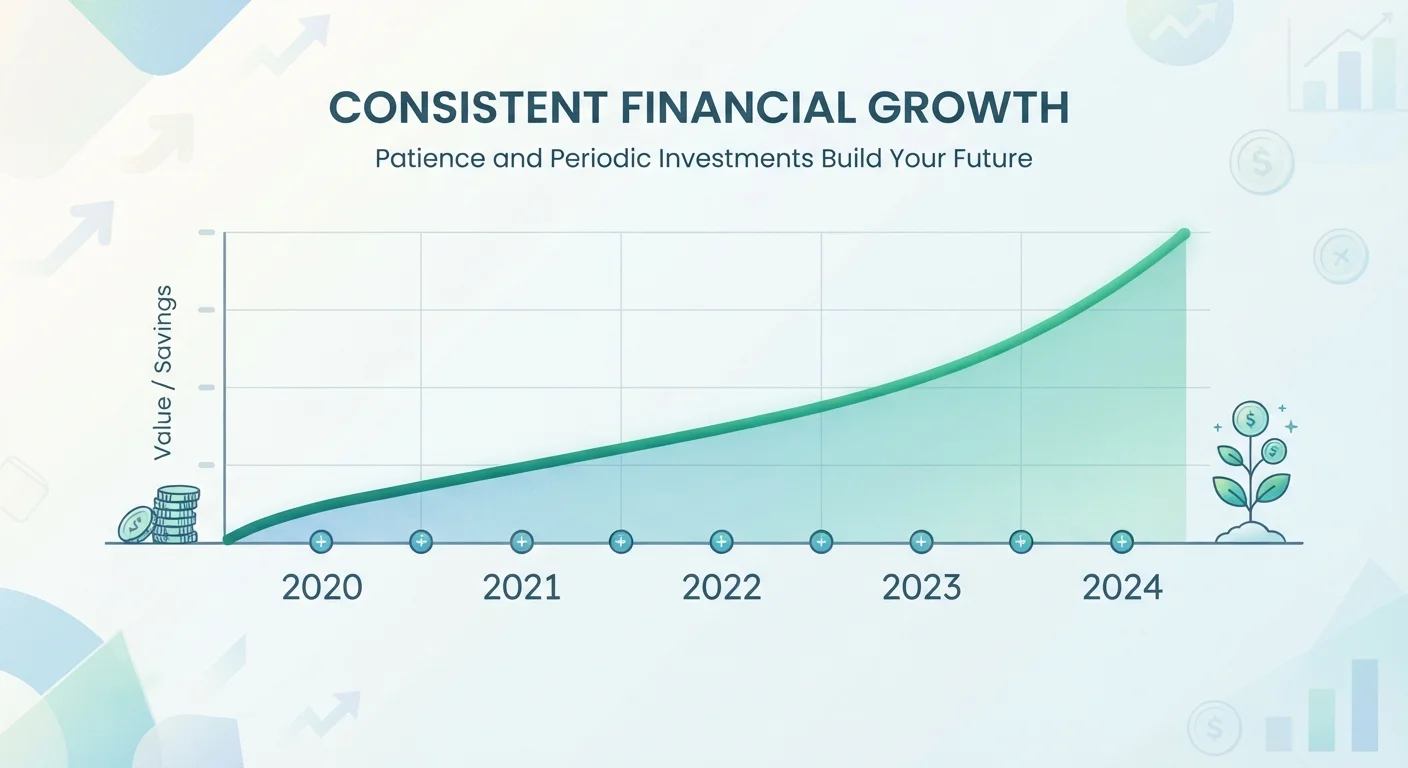
Dollar-cost averaging (DCA) is an investment strategy where you contribute a fixed dollar amount at regular intervals - such as weekly or monthly - regardless of what the market is doing. When prices are high, your fixed amount buys fewer shares; when prices are low, it buys more. Over time, this approach produces an average cost per share that may be lower than if you had invested a lump sum at the wrong moment.
DCA does not guarantee a profit or protect against losses in declining markets. It is a method for managing the timing risk of market entry, not a tool for predicting or controlling market direction.
How Dollar-Cost Averaging Works
The mechanics of dollar-cost averaging are straightforward. Instead of waiting for the "right moment" to invest a large sum, you commit to putting in the same dollar amount on a fixed schedule - every two weeks, every month, or whatever interval suits your finances.
Here is the key dynamic: because your contribution is fixed in dollar terms rather than share terms, your purchasing power shifts automatically with price. Suppose you invest $200 per month in a broad-market index fund. When the fund's share price is $50, you receive four shares. When price falls to $40 the following month, the same $200 buys five shares. You are, in effect, buying more when the market is cheaper - without having to make that judgment call yourself.
Over many cycles of market movement, this tends to produce an average cost per share that sits below the simple average of the prices you paid across that period. Investors sometimes call this "buying the dip by default."
~58%
U.S. adults who own stocks
According to Gallup polling, roughly 58% of Americans reported owning stocks, funds, or retirement accounts - many of them contributing via regular payroll deductions that mirror DCA principles.
10%
Average annual S&P 500 return (historical)
The S&P 500 has historically averaged roughly 10% annual returns before inflation over the long run, according to widely cited market data - though past performance does not guarantee future results.
1%
Annual fee impact over 30 years
A 1% annual fee difference can reduce a portfolio's final value by roughly 20-25% over a 30-year horizon, based on standard compound-growth modeling - underscoring why fee awareness matters alongside any contribution strategy.
Why Market Timing Is So Difficult
One reason DCA resonates with investors at every experience level is that it sidesteps one of the hardest problems in investing: knowing when to buy. Even professional fund managers consistently struggle to outperform a simple buy-and-hold approach when trading costs and taxes are factored in.
Market volatility - the normal, sometimes sharp swings in asset prices - is psychologically taxing. A sudden 15% drop can tempt investors to pull out entirely, locking in losses and missing the eventual recovery. DCA does not make volatility disappear, but it does reframe it. A falling market becomes an opportunity to accumulate more shares at lower prices, rather than purely a source of anxiety.
This behavioral benefit may be just as valuable as any mathematical advantage. Investors who stay in the market through downturns are far more likely to capture long-term gains than those who move in and out based on sentiment. See our guide to common investing misconceptions for more on the thought patterns that derail long-term wealth building.
Automate to Remove Emotion
Setting up an automatic transfer on payday is one of the most effective ways to maintain a DCA strategy. When contributions happen without manual action, you are less likely to skip them during volatile markets - which is precisely when skipping is most costly. Many brokerage accounts and retirement plans make automation straightforward to configure.
Where DCA Fits in a Broader Strategy
Dollar-cost averaging is a contribution method, not an investment selection strategy. Choosing where that money goes - and how to diversify - remains a separate, important decision. DCA applied to a poorly diversified or high-fee portfolio will not save you from those underlying problems.
For many investors, low-cost, broadly diversified funds are a natural complement to DCA because they avoid the need to time individual stock picks. Our explainer on index funds vs. actively managed funds covers how these vehicles work and what they typically cost.
Fees also deserve attention. Even a 1% annual expense ratio, compounding against you over decades, can significantly erode wealth. Read about fees that quietly erode investment returns to understand which charges to watch for.
As your regular contributions accumulate, your portfolio's allocation will naturally drift as some assets grow faster than others. Rebalancing your portfolio periodically ensures your asset mix stays aligned with your original goals and risk tolerance.
If you are wondering whether you can begin this approach without a large starting balance, the answer is yes. Our article on starting to invest on a tight budget outlines realistic first steps for those working with limited monthly funds.
This article is for general informational and educational purposes only and does not constitute personalized financial, investment, tax, or legal advice. Investing involves risk, including the possible loss of principal. Consult a qualified financial professional before making decisions based on your individual circumstances.