

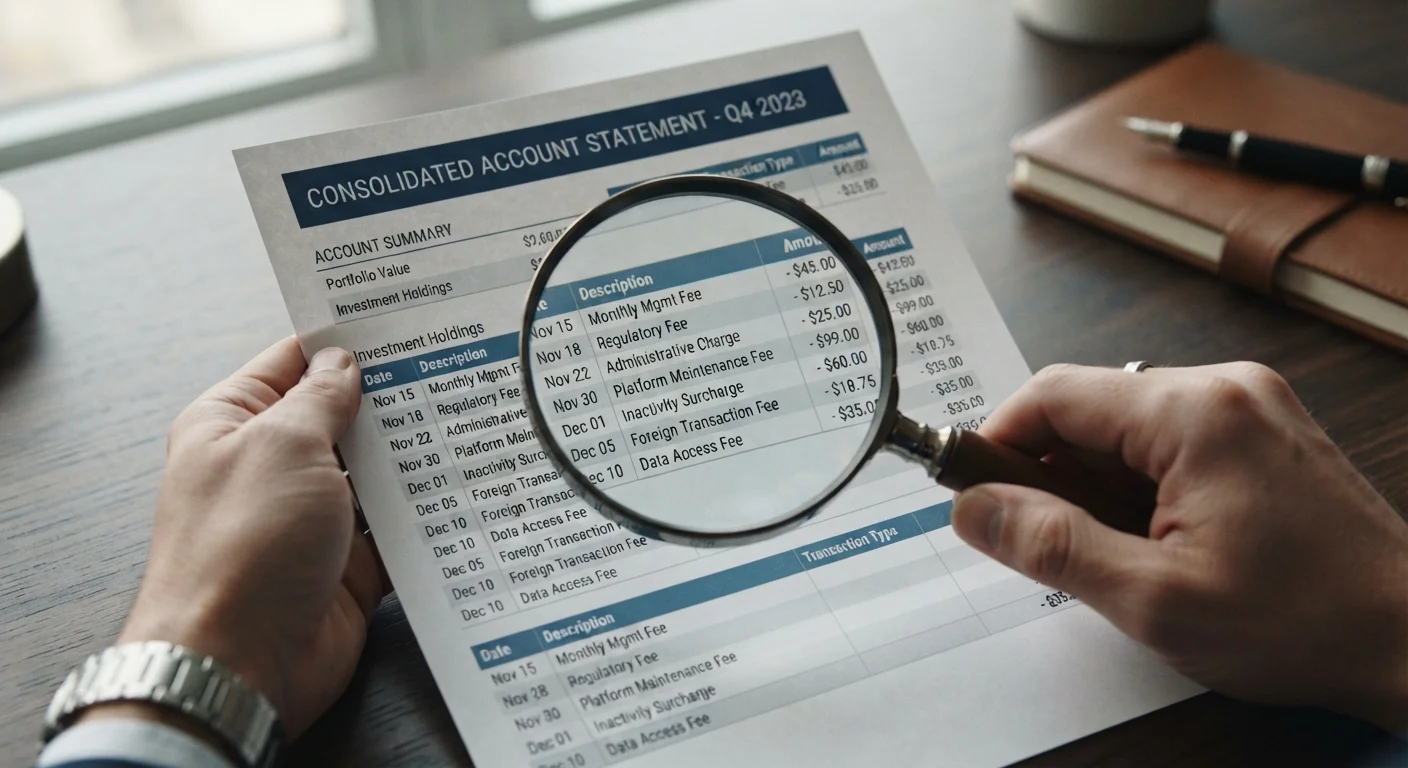
Key Takeaways
- Expense ratios, account fees, and trading costs reduce your returns every year, whether markets rise or fall.
- A 1% annual fee difference can cost tens of thousands of dollars over a multi-decade investment horizon.
- Low-cost index funds and fee-transparent platforms help investors keep more of what they earn.
- Many fees are disclosed but buried - knowing where to look is the first line of defense.
- Tax-advantaged accounts can help offset some costs, but fees still apply inside those accounts.
Why Investment Fees Matter More Than They Look
A fee of 1% per year sounds almost trivial. But because investing works through compounding - your gains generating further gains over time - fees compound against you in exactly the same way. The money deducted for fees today is money that never gets to grow tomorrow.
Consider two investors who each put $50,000 into a broad market fund for 30 years, both earning an average annual gross return of 7%. The investor paying 0.05% in annual fees ends up with roughly $370,000. The one paying 1.05% ends up with about $261,000. That 1-percentage-point difference costs over $100,000 - not because of bad investment choices, but because of fees quietly compounding in reverse.
This is why understanding the fee landscape is a foundational investing skill. Our guide to compound interest explains the mechanics in detail, and the same math that powers wealth-building also powers wealth erosion when fees enter the equation.
$100,000+
Cost of a 1% fee over 30 years
On a $50,000 investment earning 7% annually, a 1-percentage-point fee difference can reduce final value by over $100,000 due to compounding.
0.03%-1.5%
Typical expense ratio range
Broad market index ETFs often charge as little as 0.03% annually, while some actively managed funds charge 1% or more per year.
~23%
Of fund investors unaware of fees paid
Research from FINRA's Investor Education Foundation has found that a significant share of investors do not know what fees they are paying on their accounts.
Common Fee Mistakes Investors Make - and How to Avoid Them
Most fee-related losses aren't caused by obvious missteps. They result from normal, well-intentioned behaviors that simply haven't accounted for cost. Here are the most frequent errors beginners and intermediate investors make:
Ignoring the expense ratio when selecting a fund.
Why it happens: New investors often focus entirely on past performance or fund name without realizing the expense ratio is deducted from returns every single year, regardless of how the market performs.
Paying account maintenance or inactivity fees without realizing it.
Why it happens: These fees are often buried in account agreements and only become visible on a monthly statement line that's easy to scroll past.
Overtrading and accumulating unnecessary transaction costs.
Why it happens: Market volatility triggers emotional responses. Investors who react by buying and selling frequently incur more transaction costs and often lock in losses, even on platforms that advertise "commission-free" trading.
Assuming fees inside a 401(k) or IRA are low by default.
Why it happens: Investors often believe tax-advantaged status implies cost efficiency. In reality, the fund options inside employer-sponsored plans vary widely in expense ratio.
Paying a sales load without understanding what it covers.
Why it happens: Some mutual funds charge a front-end or back-end load - a sales commission of 3-5% that goes to the broker or advisor, not into your investment. Many investors don't realize they're paying this until after the fact.
"Commission-Free" Doesn't Mean Cost-Free
Many brokerages advertise zero-commission trades, but transaction costs can still appear in other forms - including wider bid-ask spreads and a practice called payment for order flow, where your trades are routed to market makers who may not offer the best execution price. Read platform disclosures carefully and understand how your broker earns revenue before assuming a trade has no cost.
If you're just getting started, our article on starting to invest on a tight budget addresses how to choose low-cost entry points from the beginning, before habits form around high-fee products.
Where to Look for Fee Disclosures
Fees are legally required to be disclosed, but they aren't always easy to find. For mutual funds and ETFs, the expense ratio appears in the fund's prospectus and on its summary fact sheet - typically expressed as an annual percentage of assets. For brokerage accounts, fee schedules are usually listed under account terms or a dedicated pricing page.
For actively managed funds, also look for a figure called the total expense ratio (TER), which may include administrative costs beyond the base management fee. Some funds also charge a 12b-1 fee - a marketing cost passed on to shareholders - which is folded into the expense ratio but worth identifying separately.
If your portfolio includes both actively managed and passive funds, our comparison of index funds vs. actively managed funds breaks down the cost and performance tradeoffs between the two approaches.
Fee awareness is also part of broader financial hygiene. Many of the same patterns - costs hidden in the fine print - appear in everyday budgeting. The hidden expenses that derail even careful budgeters article covers analogous traps outside investing.
This article is for general informational and educational purposes only and does not constitute personalized financial, investment, tax, or legal advice. Past performance does not guarantee future results. Consult a qualified financial professional before making decisions about your own investments.