

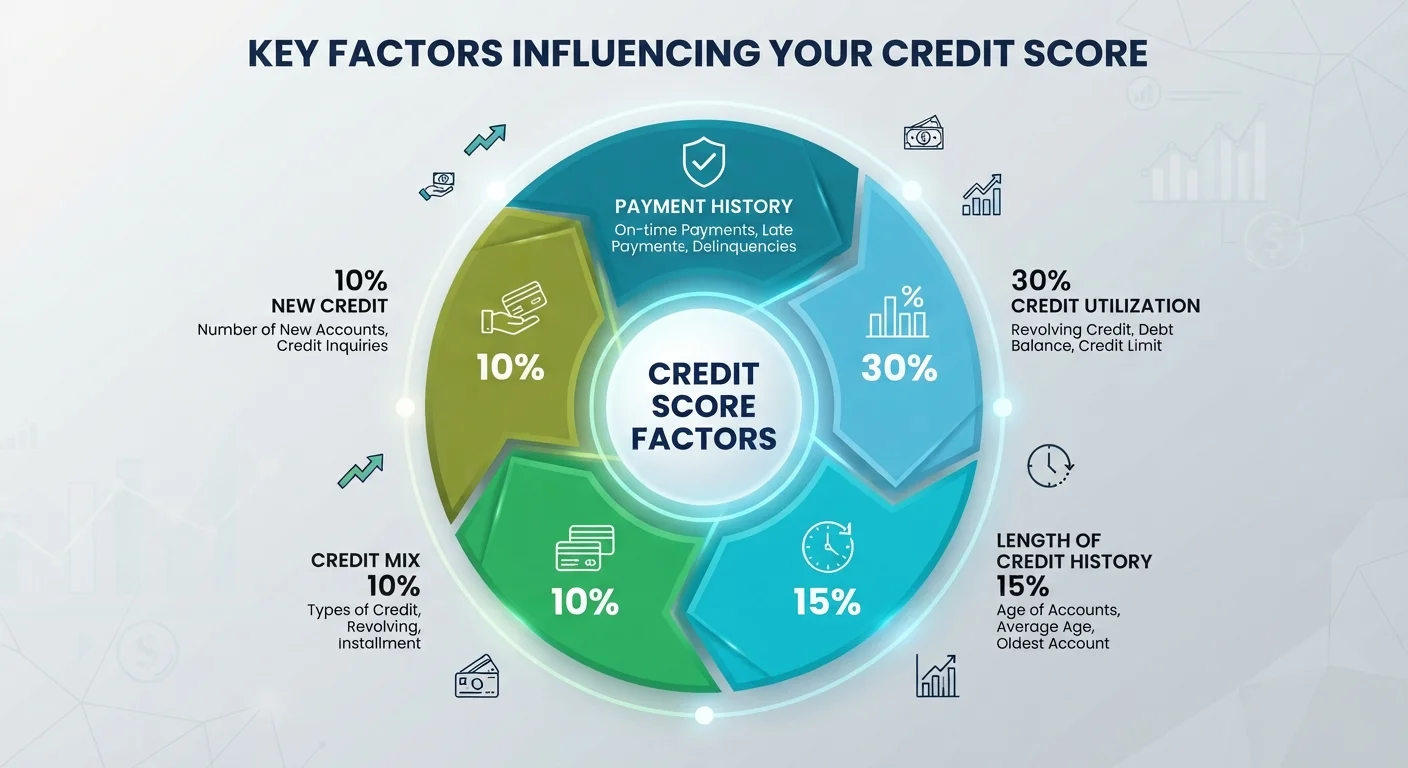
| Payment History Weight | 35% of FICO Score (FICO scoring model) |
| Credit Utilization Weight | 30% of FICO Score (FICO scoring model) |
| Length of Credit History Weight | 15% of FICO Score (FICO scoring model) |
| Credit Mix Weight | 10% of FICO Score (FICO scoring model) |
| New Credit / Inquiries Weight | 10% of FICO Score (FICO scoring model) |
| Recommended Utilization Threshold | Below 30% (General credit guidance; lower is typically better) |
| Days Before a Late Payment Is Reported | Typically 30 days past due (Standard industry practice; varies by lender) |
Why Your Credit Score Has Five Moving Parts
Most Americans know their credit score matters - but far fewer understand what actually determines it. Your score isn't a mystery number assigned at random. It's calculated from a specific set of factors drawn directly from your credit report. Understanding those factors is the first step toward improving or protecting your score.
The dominant scoring model used by lenders - the FICO® Score - weights five categories of credit behavior. Each carries a different percentage of influence. Knowing the breakdown lets you focus your energy where it actually counts.
For a broader look at what credit scores measure and why different bureaus can report different numbers for the same person, see our Credit Scores Explained guide.
| Payment History Weight | 35% of FICO Score (FICO scoring model) |
| Credit Utilization Weight | 30% of FICO Score (FICO scoring model) |
| Length of Credit History Weight | 15% of FICO Score (FICO scoring model) |
| Credit Mix Weight | 10% of FICO Score (FICO scoring model) |
| New Credit / Inquiries Weight | 10% of FICO Score (FICO scoring model) |
| Recommended Utilization Threshold | Below 30% (General credit guidance; lower is typically better) |
| Days Before a Late Payment Is Reported | Typically 30 days past due (Standard industry practice; varies by lender) |
The Five Factors, Explained
1. Payment History (35%)
This is the single most influential factor in your score. Lenders want to know: do you pay what you owe, on time? Late payments, defaults, charge-offs, and accounts sent to collections all leave negative marks here. Even one 30-day late payment can meaningfully lower a strong score. Positive payment history - months and years of on-time payments - gradually builds the strongest possible foundation.
2. Credit Utilization (30%)
Utilization measures how much of your available revolving credit (primarily credit cards) you're currently using. It's expressed as a percentage. If your combined credit limit across all cards is $10,000 and your balances total $3,000, your utilization rate is 30%. Most credit experts suggest keeping utilization below 30%, and lower is generally better. High utilization signals financial strain to lenders, even if you pay on time.
3. Length of Credit History (15%)
Scoring models reward experience. This factor considers the age of your oldest account, your newest account, and the average age of all your accounts. A longer history gives lenders more data to assess your behavior. Closing old accounts can shorten your average account age and reduce your available credit - both of which can negatively affect your score.
4. Credit Mix (10%)
Lenders generally favor borrowers who can manage different types of credit responsibly. Credit mix looks at whether your credit profile includes a variety of account types - revolving accounts (like credit cards) and installment loans (like auto loans, student loans, or mortgages). You don't need every type to have a strong score, but diversity can help at the margins.
5. New Credit and Recent Inquiries (10%)
Every time you apply for new credit, the lender typically performs a hard inquiry on your report. Each hard inquiry can cause a small, temporary dip in your score. Opening several new accounts in a short window signals elevated risk to lenders. Note that rate-shopping for a single loan type (mortgage, auto) within a short period is generally treated as a single inquiry by most scoring models.
FICO® Score
The most widely used credit scoring model, developed by Fair Isaac Corporation. Scores range from 300 to 850, with higher scores indicating lower credit risk to lenders.
Credit Utilization Rate
The percentage of your available revolving credit that you are currently using. Calculated by dividing total balances by total credit limits across all revolving accounts.
Hard Inquiry
A credit check initiated when you apply for new credit, such as a loan or credit card. Hard inquiries are recorded on your credit report and can temporarily lower your score by a small amount.
Revolving Credit
A type of credit account with a variable balance and a set limit, such as a credit card or home equity line of credit. Borrowers can spend up to the limit, repay, and borrow again.
Installment Loan
A loan repaid in fixed, regular payments over a set period. Common examples include auto loans, mortgages, student loans, and personal loans.
Charge-Off
A classification lenders use when a debt is considered unlikely to be collected, typically after several months of non-payment. A charge-off is a serious negative mark on a credit report.
Before applying for any major loan, it's worth reviewing your full credit picture. Our pre-application credit checklist walks through what to look for and how to address issues before a lender sees your file.
How to Use This Knowledge Practically
Because payment history and utilization together account for 65% of your FICO Score, these are the highest-leverage areas for most people. Automating minimum payments eliminates the risk of accidental late payments. Paying down revolving balances - or requesting a credit limit increase without increasing spending - directly lowers your utilization ratio.
The remaining 35% takes more patience. Account age grows on its own; the best strategy is simply to keep older accounts open and active. Credit mix improves naturally as your financial life grows. And limiting unnecessary credit applications reduces inquiry impact over time.
Your credit report is the raw source for all of these calculations. Understanding what's in it - accounts, inquiries, public records - is essential to interpreting your score accurately. Our field-by-field credit report guide explains every section in plain terms.
If you're working toward a mortgage, be aware that lenders apply stricter score thresholds for certain loan programs. See how credit scores shape mortgage options for a breakdown of how lenders typically evaluate your file.
This article is for general informational and educational purposes only and does not constitute personalized financial or credit advice. Consult a qualified financial professional for guidance specific to your situation.