

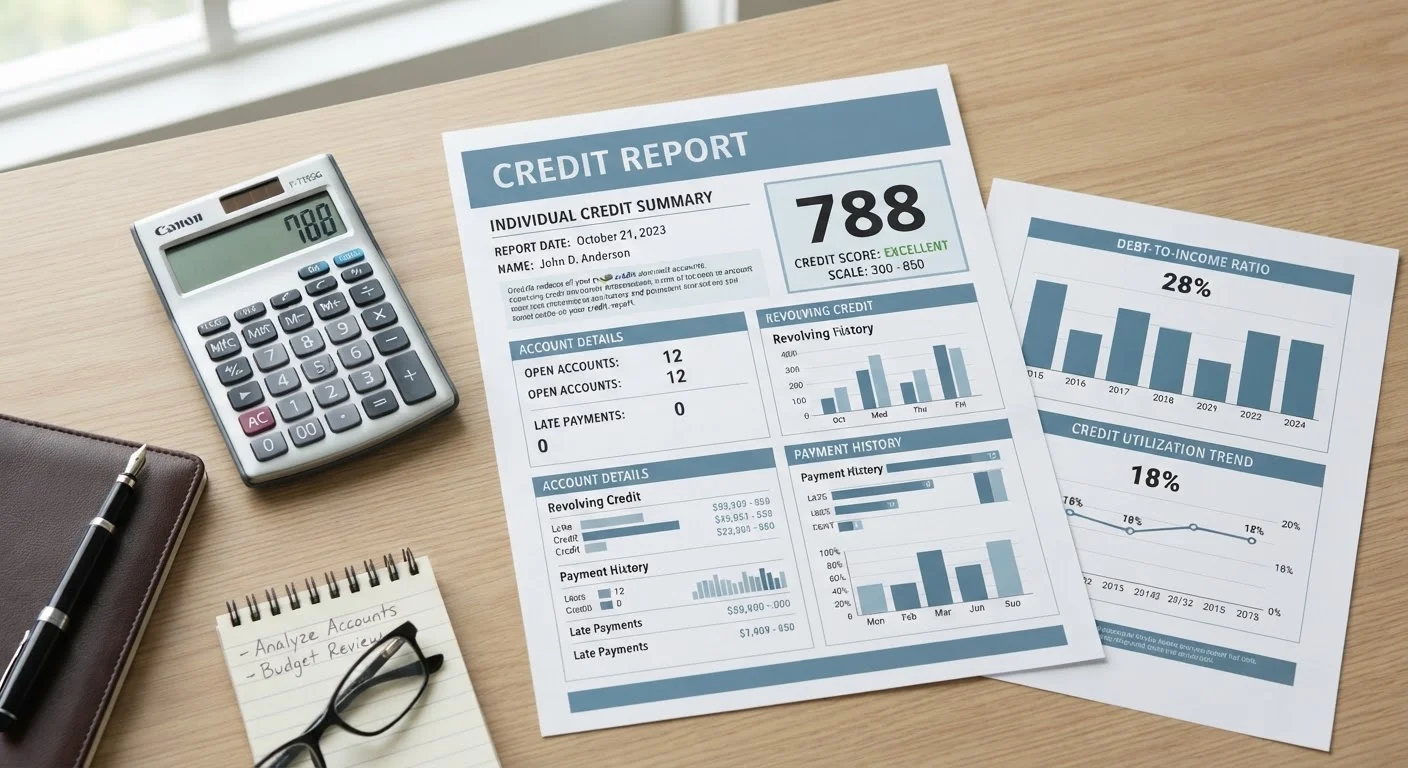
Key Takeaways
- Credit scores range from 300 to 850 and reflect your history of managing borrowed money.
- Five core factors - including payment history and credit utilization - drive most scoring models.
- Scores can differ across the three major bureaus because not all lenders report to all three.
- Checking your own credit score does not lower it; only hard inquiries from lenders do.
- Multiple scoring models exist, so the score a lender sees may differ from what you see online.
Credit Score
A credit score is a three-digit number - typically ranging from 300 to 850 - that summarizes how reliably you've managed borrowed money. Lenders use it to quickly assess the likelihood that you'll repay a new loan or credit card on time. The higher the score, the lower the perceived risk to a lender.
The most widely used scoring model is the FICO® Score, developed by the Fair Isaac Corporation, though VantageScore is another common model. Both use data from your credit reports but weight factors differently, which is why scores can vary across models.
What a Credit Score Actually Represents
A credit score isn't a measure of your wealth, income, or financial savvy in a broad sense. It measures one specific thing: how consistently you've managed debt obligations over time. Think of it as a snapshot of your borrowing track record, compressed into a three-digit number that a lender can evaluate in seconds.
That number is generated by a mathematical model - most commonly the FICO® Score or VantageScore - that analyzes the data inside your credit report. Both models output scores on the same 300-850 scale, but they assign different weights to certain behaviors, which is one reason the number you see can shift depending on which model is used.
Understanding what the score represents - and what it doesn't - is the first step to using it strategically. It tells lenders how risky it is to extend you credit; it doesn't reflect your net worth, your bank balance, or your overall financial health.
~28%
U.S. adults with a credit score below 600
According to data from the Consumer Financial Protection Bureau, a significant share of American adults have subprime scores that limit access to mainstream credit products.
300-850
Standard credit score range for FICO and VantageScore
Both major scoring models use this scale, though industry-specific FICO scores for auto and mortgage lending can use a slightly different range.
45 million
Americans estimated to be 'credit invisible'
The Consumer Financial Protection Bureau estimates this many U.S. adults lack enough credit history to generate a score under standard models.
Where the Number Comes From
Your score is calculated from information in your credit report, which is maintained separately by three major consumer reporting agencies: Equifax, Experian, and TransUnion. Each bureau collects data independently, and because not every lender reports to all three, the information - and therefore the scores - can differ slightly across bureaus.
The core inputs that drive most models include your history of on-time payments, how much of your available credit you're using, how long your accounts have been open, the mix of credit types you carry, and how recently you've applied for new credit. For a full breakdown of each input, see the five factors behind your credit score.
One important distinction: scoring models treat the same underlying behaviors differently. A late payment from three years ago carries less weight over time in most models, but a recent missed payment can cause a sharp drop. If you've noticed your score fall unexpectedly, understanding what each cause means can help you diagnose and address it.
Review Your Credit Reports Regularly
You're entitled to free credit reports from all three major bureaus through AnnualCreditReport.com. Reviewing them periodically helps you catch errors or unfamiliar accounts that could be dragging your score down. Disputing inaccurate information is a legitimate, straightforward process - and correcting errors can improve your score meaningfully.
Why the Same Person Can Have Many Different Scores
It surprises many people to learn that you don't have a single, universal credit score. You have dozens of potential scores, depending on which bureau's data is used and which scoring model is applied. A mortgage lender, an auto lender, and a credit card issuer may each pull a different version of your score - and receive different numbers.
This is normal, not a sign that something is wrong. The key is to focus less on the precise number and more on the general range and trend. A score in the mid-700s at one bureau is broadly consistent with creditworthiness, even if another bureau's model puts you at 720 or 740.
Your credit score also has very real downstream consequences. It influences not just whether you're approved for credit, but the terms you're offered. In mortgage lending, even a modest score difference can translate to meaningfully different interest rates - see how your credit score shapes your mortgage options for how lenders typically apply score thresholds.
A renter with no credit cards or loans applies for an apartment. The landlord pulls a credit report and finds no score exists.
Two people apply for the same mortgage. One has a 760 score; the other has a 680. Both are approved, but the lender offers different interest rates.
Someone checks their credit score through their bank's app, sees 725, then applies for a car loan and learns the dealer pulled a score of 708.
What a Credit Score Doesn't Tell You
Credit scores are deliberately narrow. They don't account for your income, your savings, your employment stability, or whether you live within your means. A high earner with chaotic borrowing habits can have a lower score than someone with a modest salary who pays every bill on time.
They also don't capture every financial obligation. Rent payments, utility bills, and subscription services typically don't appear on credit reports unless they go to collections - though some newer services allow consumers to add rent payment data to their reports voluntarily.
Understanding these gaps matters because it shapes how you interpret the number. A strong credit score is a signal of reliable debt management, not a comprehensive financial health certificate. Use it as one metric among several when evaluating your overall financial picture.
This article is for informational and educational purposes only and does not constitute financial or legal advice. For guidance specific to your situation, consult a qualified financial professional.