

Key Takeaways
- Tires lose roughly 1 PSI per month and 1 PSI for every 10°F drop in temperature.
- Under-inflated tires increase rolling resistance, reducing fuel economy by up to 3%.
- Overinflation causes uneven tread wear and reduces the tire's ability to absorb road impacts.
- The correct PSI for your vehicle is on the driver's door jamb - not the tire sidewall.
- Checking tire pressure monthly costs nothing and can prevent premature tire replacement.
Tire Pressure (PSI)
Tire pressure refers to the amount of air inside a tire, measured in pounds per square inch (PSI). Every vehicle has a manufacturer-specified PSI range that optimizes safety, fuel efficiency, and tire longevity. When pressure falls outside that range - either too low or too high - performance and safety are compromised.
PSI is a measure of force per unit area. The correct pressure for your vehicle is listed on the driver's door jamb sticker or in the owner's manual - not on the tire sidewall, which shows the tire's maximum rated pressure.
What Tire Pressure Actually Does
Air pressure is what carries the weight of your vehicle. The inflated tire creates a cushion between the wheel rim and the road surface, distributing load evenly across the tread. When that pressure is correct, the tire makes optimal contact with the road - maximizing grip, minimizing rolling resistance, and wearing the tread evenly across its full width.
When pressure is off in either direction, that contact patch changes shape. Too little air, and the tire bulges outward, placing most wear on the outer edges. Too much air, and the tire rounds out, wearing only the center strip. Both conditions shorten tire life and alter how the vehicle handles - often in ways drivers don't immediately notice.
Up to 3%
Fuel economy improvement with correct inflation
The U.S. Department of Energy estimates properly inflated tires can improve gas mileage by up to 3% compared to under-inflated tires.
1 PSI
Pressure lost per 10°F temperature drop
This temperature-pressure relationship is a consistent physical property of gases, meaning seasonal swings require regular pressure adjustments.
25%
Below recommended PSI when TPMS light triggers
Most factory Tire Pressure Monitoring Systems only alert drivers when pressure has already fallen roughly 25% below the vehicle's recommended level.
The Real Cost of Ignoring Tire Pressure
The U.S. Department of Energy has noted that proper tire inflation can improve fuel economy by up to 3%. That may sound modest, but across a year of driving, it adds up to real money at the pump. Under-inflated tires create more rolling resistance - meaning the engine works harder to move the vehicle forward.
Tires are also among the more expensive routine replacement items on a vehicle. A set of four tires can easily run several hundred dollars or more depending on the vehicle. Running consistently under-inflated tires can cut tread life by thousands of miles. As explained in our guide on small car problems, what seems like a minor issue has a way of compounding into a much larger bill. And as part of what drivers should plan for in long-term maintenance costs, premature tire replacement is one of the most avoidable expenses.
Check Pressure When Tires Are Cold
Always measure tire pressure before driving, or at least three hours after the vehicle has been parked. Driving heats the air inside the tire, temporarily raising the PSI reading by 4-6 points. Checking hot tires can cause you to under-inflate, undoing the purpose of the check.
Temperature, Seasons, and Pressure Drift
Tire pressure is not a set-it-and-forget-it measurement. Two natural forces work against you constantly: gradual air permeation through the tire wall (approximately 1 PSI per month) and temperature-driven pressure change (roughly 1 PSI lost for every 10°F drop in outside temperature).
This means a tire inflated correctly on a 75°F fall afternoon could read 4-5 PSI low by the time a cold January morning arrives - without any leak or damage. That's exactly why seasonal checks matter. It's also why TPMS (Tire Pressure Monitoring System) warning lights alone aren't enough: most systems don't alert until pressure has dropped roughly 25% below the recommended level, at which point the damage to fuel economy and tread wear is already underway.
Include a pressure check as part of your pre-trip safety routine before any significant journey, and build it into your monthly habit year-round. For a broader view of how routine upkeep protects your investment, see the long-term payoff of consistent maintenance.
How to Check and Correct Tire Pressure Properly
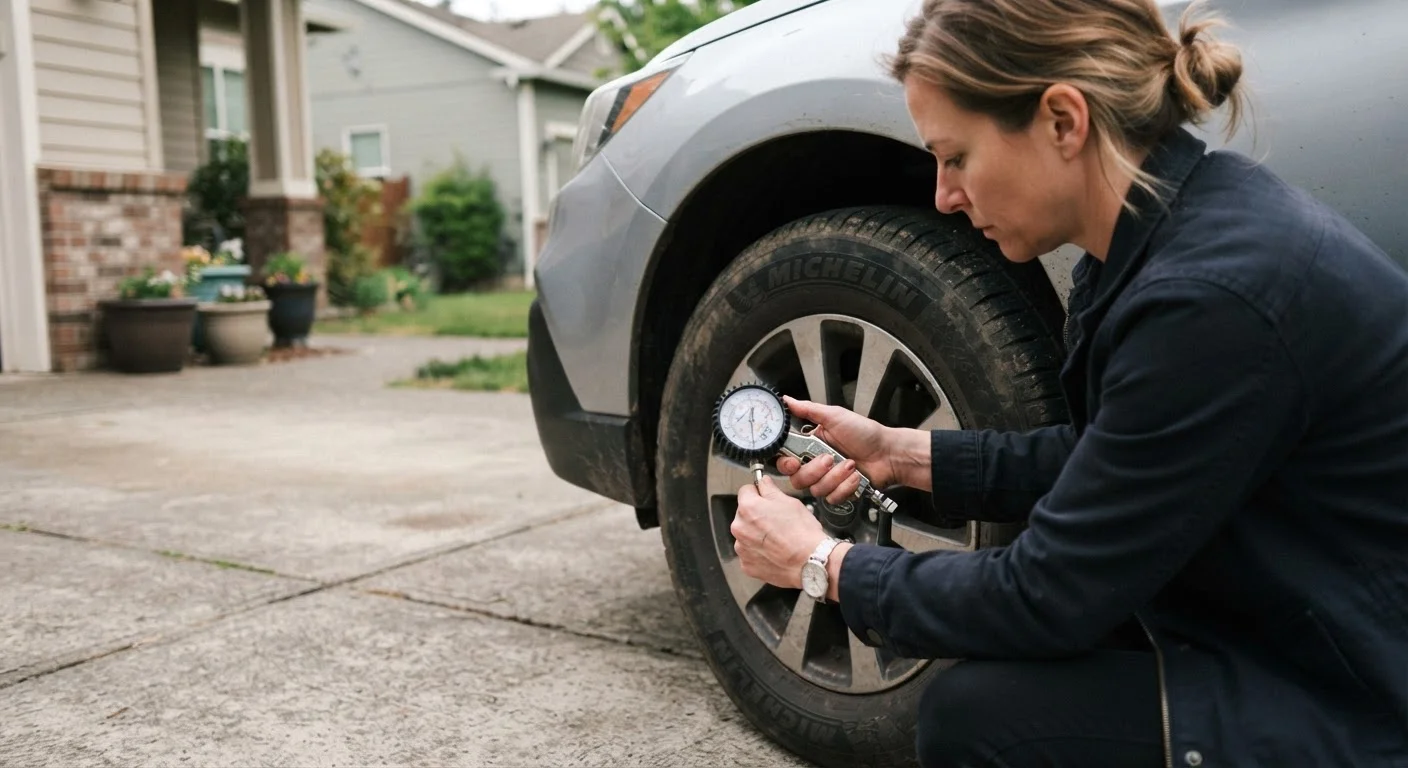
You need two things: a reliable tire pressure gauge (digital or stick-style) and access to an air source. Check pressure when the tires are cold - meaning the vehicle has been parked for at least three hours or driven fewer than a mile. Heat from driving temporarily increases pressure readings by 4-6 PSI, which can lead you to under-inflate.
- Locate your vehicle's recommended PSI on the door jamb sticker or owner's manual.
- Remove the valve stem cap from each tire.
- Press the gauge firmly onto the valve stem and read the PSI.
- Add air if the reading is below the target; release air (using the small pin on the valve) if it's above.
- Recheck after adjusting, then replace the valve cap.
Don't forget the spare tire - it's often overlooked until it's urgently needed. A spare that has been sitting for years may have lost significant pressure.
Front and Rear PSI May Differ
Some vehicles specify different recommended pressures for front and rear tires. This is common on vehicles with rear-engine configurations or those designed to carry heavier rear loads. Always check the door jamb sticker for axle-specific recommendations rather than applying a single number to all four tires.