

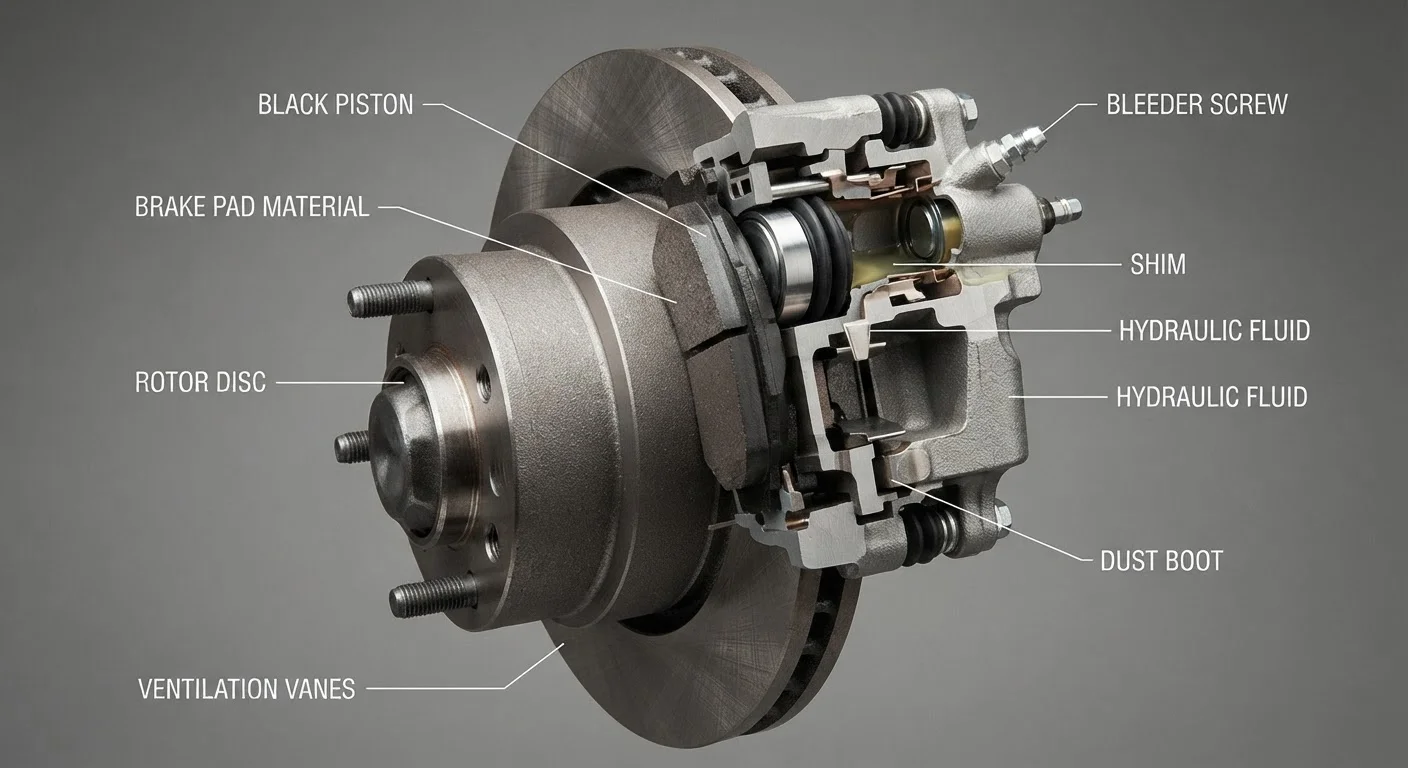
Key Takeaways
- Brake pads are the friction material that wear down over time and need periodic replacement.
- Rotors are the metal discs that pads clamp against; they can warp or develop grooves with age.
- Calipers apply the hydraulic clamping force and can seize if not maintained properly.
- Squealing or grinding sounds often signal brake wear that needs prompt professional attention.
- Brake fluid connects your foot pressure to the caliper - it matters as much as the mechanical parts.
- Ignoring early brake warning signs typically leads to more expensive repairs down the road.
Disc Brake System
A disc brake system stops your vehicle by using hydraulic pressure to squeeze friction material (brake pads) against a spinning metal disc (the rotor). The component that holds and applies the pads is called the caliper. Together, these three parts convert your vehicle's kinetic energy into heat, slowing the wheels.
Most modern vehicles use disc brakes on all four wheels, though some still use drum brakes at the rear. The hydraulic pressure driving the calipers originates at the master cylinder when you press the brake pedal.
The Three Parts That Stop Your Car
Every time you press the brake pedal, three components work in rapid coordination to bring several thousand pounds of moving vehicle to a halt. Understanding each one makes it far easier to recognize when something is wrong.
Brake pads are slabs of friction material bonded to a metal backing plate. They press against the rotor surface to create the friction that slows the wheel. Because they absorb that friction directly, they are the component that wears most quickly - most pads have a built-in metal wear indicator that produces a high-pitched squeal when the material gets too thin.
Rotors (also called brake discs) are the heavy metal discs that spin with the wheel. They are designed to withstand enormous heat cycles. Over time, repeated heating and cooling can cause rotors to develop surface grooves from worn pads, or in some cases to warp slightly - which you may feel as a pulsing or vibrating sensation through the brake pedal.
Calipers are the hydraulic clamps that house the brake pads and squeeze them against the rotor. When you press the pedal, brake fluid transmits pressure from the master cylinder to pistons inside the caliper, pushing the pads inward. A stuck or seized caliper is a serious issue: it can cause uneven braking, premature pad wear, or in extreme cases a dragging wheel that generates dangerous heat. See our guide to brake fluid and other essential vehicle fluids for more on the hydraulic side of this system.
2-3mm
Minimum safe brake pad thickness
Most automotive technicians and vehicle manufacturers recommend replacing brake pads when friction material reaches approximately 2-3mm, well before metal-on-metal contact occurs.
30-70K miles
Typical brake pad lifespan range
According to general industry guidance, brake pad life varies widely - from around 30,000 miles for aggressive city drivers to 70,000 miles or more for steady highway drivers.
~125°F-500°F
Brake rotor temperature range during normal use
Rotors can reach temperatures well above 300°F during routine stops and even higher during heavy downhill braking, which is why heat dissipation is central to rotor design.
Warning Signs You Shouldn't Ignore
Your brakes communicate wear through specific, recognizable signals. Learning to identify them early is one of the most practical things any driver can do.
- Squealing or squeaking: Usually the wear indicator telling you pads are getting thin. Occasional light squeaking when brakes are cold or wet is normal; persistent squealing is not.
- Grinding or metal-on-metal noise: A sign the pad friction material is fully worn and the metal backing plate is contacting the rotor. This damages the rotor and needs immediate attention. Our guide to interpreting car noises covers additional sounds across the vehicle.
- Vibration or pulsing through the pedal: Often indicates a warped rotor. You may notice this most when braking at highway speeds.
- Pulling to one side: Can point to a seized caliper or unevenly worn pads applying different levels of force on each side.
- Soft or spongy pedal: Usually a hydraulic issue - air in the brake lines or low/contaminated brake fluid.
- Longer stopping distances: A general decline in braking effectiveness that may reflect worn pads, glazed rotors, or a combination of issues.
Schedule a Visual Brake Inspection Regularly
You can often see your brake pad thickness through the wheel spokes without removing anything - the pad should appear at least a few millimeters thick against the rotor edge. Many tire shops and quick-lube centers offer a visual brake check at no charge during routine service visits. Getting eyes on your brakes at least once a year gives you early warning before problems escalate.
Small brake problems tend to compound - a worn pad ignored long enough will score the rotor, turning a pad replacement into a more costly rotor replacement as well.
How Long Brake Components Typically Last
Brake component lifespan varies considerably based on driving habits, vehicle type, and road conditions. City driving with frequent stops wears pads far faster than highway commuting. That said, general service intervals give a useful baseline.
A driver in a busy city commutes mostly in stop-and-go traffic, pressing the brakes dozens of times per mile.
A vehicle pulling slightly to the right every time the driver applies the brakes, despite straight driving otherwise.
A driver notices a rhythmic pulsing through the brake pedal that becomes more pronounced when slowing from highway speeds.
After leaving a car parked outdoors for two weeks in damp weather, the driver hears a scraping sound on the first few stops.
Rotors generally outlast pads by a factor of two to three, but that holds true only if worn pads aren't left in place too long. Calipers, when functioning properly, can last the life of the vehicle - but their rubber seals and slide pins need periodic lubrication and inspection.
When brakes are inspected, a mechanic will typically measure pad thickness using a gauge (most pads start around 10-12mm and should be replaced around 2-3mm), check rotor thickness against the manufacturer's minimum specification, and test caliper movement. Rotors below minimum thickness can't dissipate heat safely and must be replaced rather than resurfaced.
Understanding how braking interacts with traction on slippery roads is equally important - a well-maintained brake system works alongside your tires, not independently of them. For the broader picture of scheduled vehicle care, see the long-term value of routine maintenance.