
Living Out of a Carry-On: What It Takes to Travel Light Across Multiple Countries

Key Takeaways
- A carry-on for multi-country travel works best when you commit to a versatile, neutral wardrobe and plan to do laundry.
- Toiletries are where most carry-on packers lose space - decant and edit ruthlessly before every trip.
- Airline size and weight rules vary by carrier and route; always verify before you fly.
- The mindset shift matters as much as the gear - light travel requires accepting you won't have everything.
- Packing cubes and compression sacks help organize space but don't create it; editing your list is the real work.
- Doing laundry on the road is a normal part of carry-on travel, not a last resort.
What you will need
What You're Really Committing To
Living out of a carry-on across multiple countries isn't a packing trick - it's a travel philosophy. It means accepting that you will wear the same pair of pants in three different cities, that you'll hand-wash a shirt in a hostel sink, and that souvenirs may need to be shipped home. The upside is real: no checked-bag fees, no waiting at baggage claim, and the genuine freedom of moving quickly between destinations without dragging heavy luggage through cobblestone streets.
Before diving into strategy, it helps to understand what typically derails carry-on-only trips. Most people pack for the worst-case scenario - the fancy dinner they might attend, the cold snap that probably won't happen, the outfit they'd want if everything else is dirty. That kind of defensive packing fills a bag fast. See our guide on why overpacking happens for a deeper look at the psychology behind it.
The carry-on constraint is also not one-size-fits-all. If your trip crosses climates - say, cool Northern Europe followed by warm Southeast Asia - the clothing math gets harder. Trip length matters less than most people expect; a well-edited bag for two weeks looks almost identical to one for six weeks, because both rely on the same laundry cadence.
What you will need
Building Your Carry-On Strategy Step by Step
The steps below walk you through the process of going from a full closet to a single carry-on that genuinely works for extended international travel. For a ready-made checklist of specific items to consider, see The Carry-On Packing List That Works for Nearly Any Trip.
Verify Your Bag's Dimensions Against Every Airline You'll Fly
Carry-on size and weight limits differ meaningfully between carriers - a bag that sails through a major U.S. hub may be gate-checked on a regional European budget airline. Before packing a single item, look up the specific carry-on allowances for every airline on your itinerary. Pay attention to both linear dimensions and weight limits, which some international carriers enforce strictly. If one leg of your trip uses a carrier with restrictive rules, that airline sets your effective maximum.
Choose a Versatile, Neutral Clothing Palette
Pick three to five colors that mix and match easily across every item you pack. Neutral tones - navy, gray, black, olive, white - allow any top to pair with any bottom, multiplying your outfit options without adding items. Aim for clothing that can be dressed up slightly (a dinner out) or dressed down (a travel day), and prioritize fabrics that dry quickly after washing. Merino wool and lightweight synthetic blends are popular for this reason, though any fast-drying fabric works.
A practical starting point for a two-week trip: three to four shirts or tops, two bottoms, one light layer (jacket or cardigan), one pair of comfortable walking shoes worn on travel days, and one pair of sandals or lightweight alternate shoes in the bag. Adjust for climate and any specific activities.
Edit Your Toiletries Down to the Essentials
Toiletries are where carry-on travelers most commonly run into trouble. The TSA's 3-1-1 rule (liquids in containers of 3.4 oz or less, all fitting in one quart-sized clear bag) applies to U.S. departures and similar restrictions apply in many countries. Decant products into small reusable containers, eliminate anything you can buy locally, and be honest about what you'll actually use daily. Solid formulas - shampoo bars, solid sunscreen, bar soap - sidestep the liquids rule entirely and save significant space.
Organize with Packing Cubes - Then Do a Weight Check
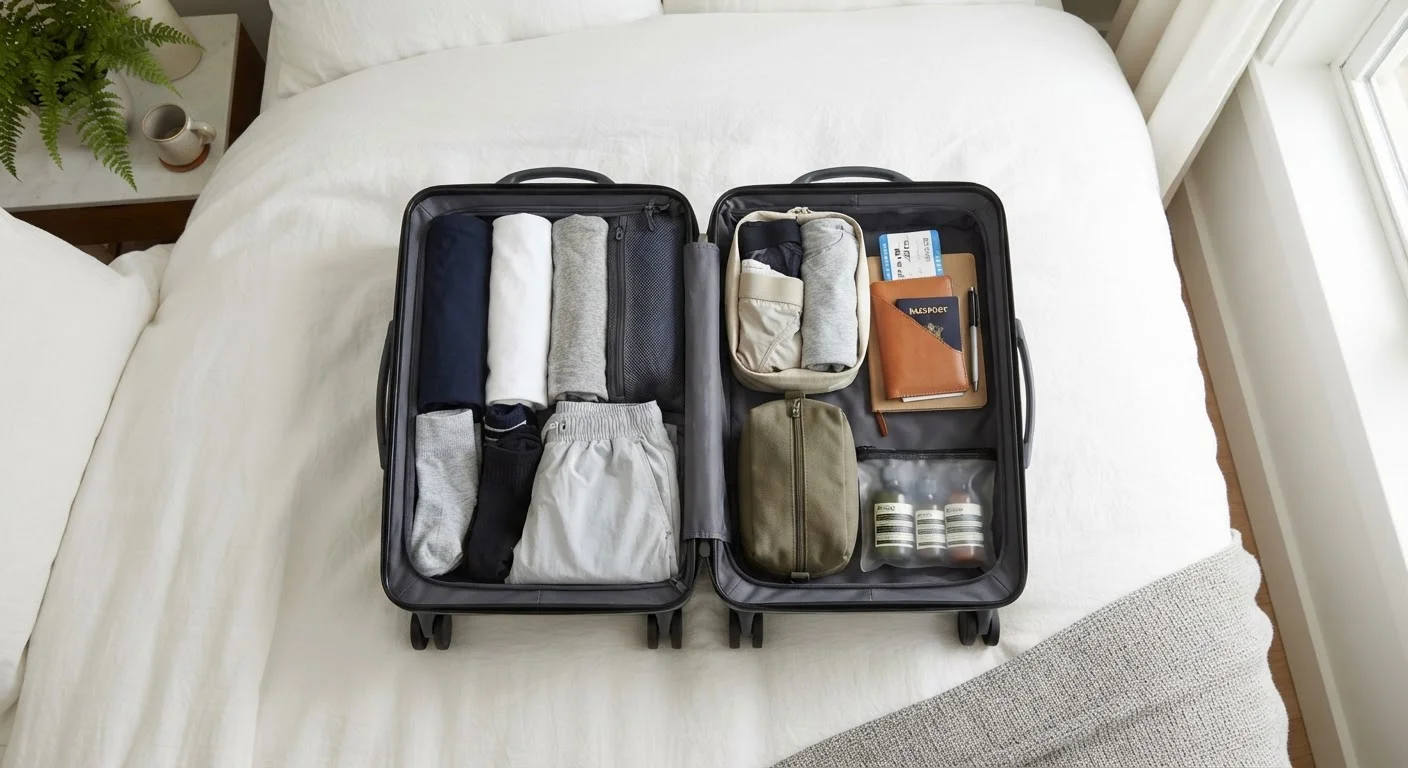
Packing cubes help you find items quickly and keep the bag from turning into a jumble, but they add a small amount of weight themselves. Use two to three cubes maximum: one for clothing, one for toiletries and cables, one for miscellaneous items. Once everything is packed, weigh the bag on a home scale. If you're close to your airline's limit, remove items - not swap them for lighter versions of the same thing, but actually remove them. Ask yourself which items you'd genuinely miss on day twelve of the trip.
Plan Your Laundry Cadence Before You Leave
Carry-on travel doesn't work without a laundry plan. Before you go, identify laundry options at each destination: hotel laundry service, self-service laundromats (search the local term - "laundrette" in the UK, "lavandería" in Spanish-speaking countries), or sink washing. Plan to do laundry every five to seven days. That cadence means you need about a week's worth of clothing, not two or three weeks' worth - which is the core insight that makes a carry-on viable for long trips. See Carry-On vs. Checked Luggage to weigh whether this trade-off suits your specific trip.
Do a Full Dress Rehearsal Pack at Home
Pack the bag completely at least two days before departure - not the night before. Live with it for 48 hours. Try to retrieve items you'd need mid-flight. Notice what feels missing and what you haven't touched. Items you don't reach for at home are items you probably won't reach for abroad. Remove them. This rehearsal step consistently reveals redundancies that are invisible when packing in the abstract.
Your Personal Item Is Part of the System
Most airlines allow both a carry-on and a personal item (backpack, tote, or small bag). Use the personal item strategically: keep your travel documents, passport, medications, electronics, and anything you'll need during the flight within easy reach. This frees your carry-on for clothing and checked-accessible items, and means you're never digging through the overhead bin mid-flight.
Staying Flexible on the Road
Even a perfectly packed bag meets reality once you're traveling. Laundry access varies - some accommodations offer it free, others charge by the piece, and in some destinations, laundromats are easy to find. Build your itinerary with at least one laundry day every five to seven days, and you'll never feel truly stuck.
Toiletries run out and can be replenished locally in almost every country. Buying shampoo or sunscreen at a local pharmacy or market is often cheaper than buying travel sizes at home, and it frees up space in your liquids bag. For anything more specialized - prescription medications, specific skincare - bring enough from home and store it in your personal item or a small pouch that's easy to access. Managing money across borders is its own skill, and the same minimalist thinking applies: carry what you need, know where to get more.
If you're new to international travel overall, the carry-on discipline fits naturally into broader trip planning. Our first international trip planning framework covers the full picture - from passports and visas to packing decisions - so you're not solving every problem at once.
Not Every Trip Is Right for Carry-On Only
Carry-on-only travel works best for trips where you're moving frequently and laundry is accessible. If your itinerary includes very formal events, extreme climate swings, or extended backcountry travel with specialized gear, a checked bag may genuinely serve you better. See Carry-On vs. Checked Luggage to think through which approach fits your specific situation.