

Key Takeaways
- An eSIM is a programmable chip built into the device; no plastic card is required.
- Physical SIMs are removable, making carrier swaps as simple as popping in a new card.
- Most flagship smartphones released after 2020 support eSIM, and some newer models are eSIM-only.
- eSIM offers a clear advantage for international travel, allowing multiple carrier profiles at once.
- Physical SIMs still dominate in regions where eSIM infrastructure is limited or unavailable.
- Both technologies connect to the same carrier networks - the underlying service quality is identical.
Option A
eSIM
The embedded, software-based evolution of mobile connectivity.
Best for: Travelers, frequent plan-switchers, and anyone with a recent smartphone who wants a streamlined setup.
Option B
Physical SIM
The familiar, removable chip that has powered mobile networks for decades.
Best for: Users in regions with limited eSIM support, older device owners, or anyone who needs a simple, hardware-based swap.
If you travel internationally and want to switch local carriers without buying a new SIM card abroad
eSIM
eSIM lets you download a local carrier profile remotely, often before you even land, avoiding roaming fees and airport SIM hunts. See also: staying connected abroad.
If you frequently switch between carriers to chase better prepaid deals
eSIM
Switching carriers is entirely digital - no waiting for a card in the mail and no risk of losing a tiny piece of plastic.
If you own an older phone or live in an area with limited eSIM carrier support
Physical SIM
Physical SIMs are universally compatible and work on virtually every carrier network worldwide, making them the more reliable choice in these scenarios.
If you share or hand off phones regularly and need simple hardware-level swaps
Physical SIM
Swapping a physical SIM between devices takes seconds and requires no account access, app, or internet connection to complete.
If you just bought a new flagship smartphone and want the simplest setup
eSIM
Most new flagship devices support carrier activation directly through the setup screen, making eSIM the fastest path from unboxing to a working number.
What Each Technology Actually Is
A physical SIM (Subscriber Identity Module) is the small plastic chip you slide into a tray on your phone. It stores a unique identifier that tells your carrier who you are and authenticates your device on the network. Swap it into another phone, and your number and plan go with it.
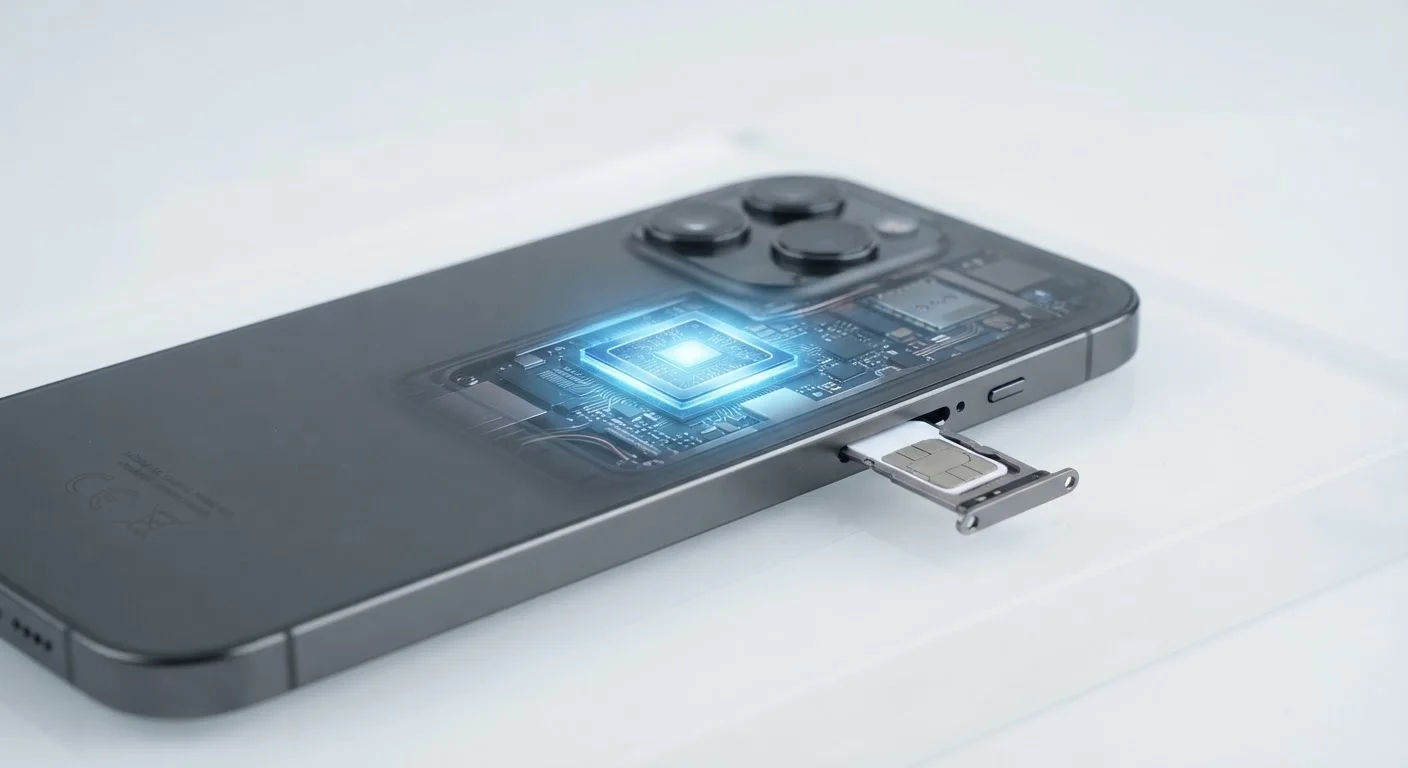
An eSIM (embedded SIM) is a tiny chip soldered directly onto the phone's circuit board - it cannot be removed. Instead of swapping hardware, you switch carriers by downloading a new carrier profile digitally, either through the carrier's app, a QR code scan, or an automated setup flow. A single eSIM can store multiple profiles, though only one is active at a time on most devices.
Crucially, both technologies do the same job: they authenticate your device on a carrier's network. The difference is entirely in how that authentication is delivered and managed.
| Criterion | eSIM | Physical SIM |
|---|---|---|
| Hardware | Soldered into device; not removable | Removable plastic chip |
| Carrier switching | Digital profile download | Physical card swap |
| International use | Download local profile remotely | Purchase and insert local SIM card |
| Multiple profiles | Yes; one active at a time | Only with dual-SIM tray device |
| Activation requirement | Internet connection needed | No internet needed |
| Device compatibility | Most flagships from ~2018+ | Nearly universal |
| Risk of loss/damage | None - chip is internal | Small card can be lost or damaged |
| MVNO support | Growing but not universal | Broadly supported |
Where Each One Has a Real Advantage
eSIM shines in flexibility. Because carrier profiles are software-based, switching plans takes minutes rather than days. For international travelers, this is especially valuable - you can add a local carrier plan before your flight lands, avoiding roaming charges without hunting for a SIM card vendor at a foreign airport. Our guide to staying connected abroad without surprises covers your full range of options.
Physical SIMs still hold advantages in specific situations. They are universally compatible - if a phone has a SIM tray, you can use virtually any carrier's card worldwide. They also work without an internet connection to activate, which matters in areas with poor connectivity. For users experimenting with mobile virtual network operators (MVNOs) - carriers that resell network capacity at lower prices - physical SIM availability varies; not all MVNOs have fully rolled out eSIM support.
eSIM-only
U.S. iPhone 14 and later models
Apple removed the physical SIM tray from iPhones sold in the United States starting with the iPhone 14 series in 2022.
200+
Countries with eSIM-capable carrier networks
According to GSMA data, eSIM support has expanded significantly, though depth of consumer plan availability varies widely by market.
Dual SIM
Common on many Android flagships
Many Android devices offer one physical SIM slot plus eSIM capability, allowing users to run two numbers simultaneously.
One practical note: some eSIM-only phones (notably certain recent iPhone models sold in the U.S.) have removed the physical SIM tray entirely. If you travel to a country where eSIM carrier support is sparse, this is worth researching before you go.
Setting Up and Switching: How the Experience Differs
Activating a physical SIM is purely mechanical: insert the card, and your carrier recognizes the device almost immediately. No app, no internet connection, no account credentials required at that moment.
Activating an eSIM requires a working internet connection (usually Wi-Fi) and interaction with your carrier - via QR code, an activation app, or a customer service call. Once set up, switching between stored profiles is done through your phone's settings menu. When setting up a new smartphone, eSIM profiles often transfer automatically through manufacturer migration tools, though this depends on your device and carrier.
If you're weighing plan types alongside this decision, understanding how prepaid and postpaid plans differ is a useful parallel step - both plan types are available on eSIM and physical SIM. And before committing to any new plan, review what to check before signing a phone contract, including whether your device is carrier-locked, which affects eSIM profile portability.
This article provides general information about mobile technologies and is not affiliated with or endorsed by any carrier or device manufacturer. Technology availability and carrier support vary by region and device - verify current details with your carrier before making a decision.