

Key Takeaways
- A higher interest rate raises your monthly payment, reducing how much home you can afford.
- Rising rates can slow price growth by reducing buyer demand, but they rarely cause immediate price drops.
- The relationship between rates and home prices is indirect and shaped by supply, demand, and regional factors.
- Your personal rate depends on your credit score, loan type, and lender - not just national averages.
- Understanding rate dynamics helps buyers and sellers read market signals more clearly.
Mortgage Interest Rate
A mortgage interest rate is the percentage a lender charges you to borrow money to buy a home. It determines how much of your monthly payment goes toward interest rather than reducing the loan balance. Higher rates mean larger monthly payments for the same loan amount - effectively making homes less affordable even if listing prices haven't changed.
Mortgage rates are influenced by benchmark rates set by the Federal Reserve, but are also shaped by bond market activity, lender competition, and individual borrower risk factors such as credit score and loan-to-value ratio.
The Core Mechanic: Rates and Buying Power
Interest rates shape housing affordability in a very direct way: they determine how much of your monthly budget goes to the lender versus the loan balance itself. When rates are low, buyers can borrow more for the same monthly payment. When rates rise, the same payment buys less house.
Consider a straightforward example. At a 4% interest rate, a borrower paying $2,000 per month (principal and interest) might qualify for roughly a $420,000 loan. At 7%, that same $2,000 monthly payment supports only around $300,000 in borrowing - a difference of $120,000 in purchasing power. The home's list price hasn't moved, but the buyer's reach has shrunk significantly.
This is why shifts in mortgage rates can reshape a housing market even when sellers haven't changed their asking prices. For a deeper look at how these loan mechanics work, see how a mortgage works over time.
~$120K
Buying power lost when rate rises from 4% to 7%
Based on a fixed $2,000 monthly principal-and-interest payment on a 30-year loan - illustrating how rate changes reshape affordability without any change in home prices.
~38%
Share of U.S. mortgage holders with rates below 4%
Estimates from housing research suggest a large share of existing homeowners carry low-rate loans acquired before 2022, contributing to reduced resale inventory.
30 years
Standard U.S. mortgage term
The 30-year fixed-rate mortgage remains the most common loan structure in the U.S., making long-term rate levels especially consequential for household budgets.
Why Rates Don't Automatically Push Prices Down
A common assumption is that rising interest rates will cause home prices to fall. The logic sounds intuitive: if buyers can afford less, sellers must lower prices. In practice, the relationship is far less predictable.
Housing supply plays an equally important role. When the number of available homes is low - as has been the case across much of the U.S. for several years - sellers face less pressure to reduce prices even if the buyer pool shrinks. Competition among the remaining qualified buyers can keep prices elevated.
There is also the so-called "lock-in effect." Homeowners who secured mortgages at historically low rates are often reluctant to sell and take on a new, higher-rate loan. This keeps existing inventory off the market, further constraining supply and supporting prices.
For a broader look at why prices sometimes defy economic gravity, see why home prices rise even when the economy slows.
A first-time buyer in the Midwest is pre-approved for a $350,000 loan when rates are at 5%. Six months later, rates rise to 7% and their pre-approval drops to around $275,000 - without any change to their income.
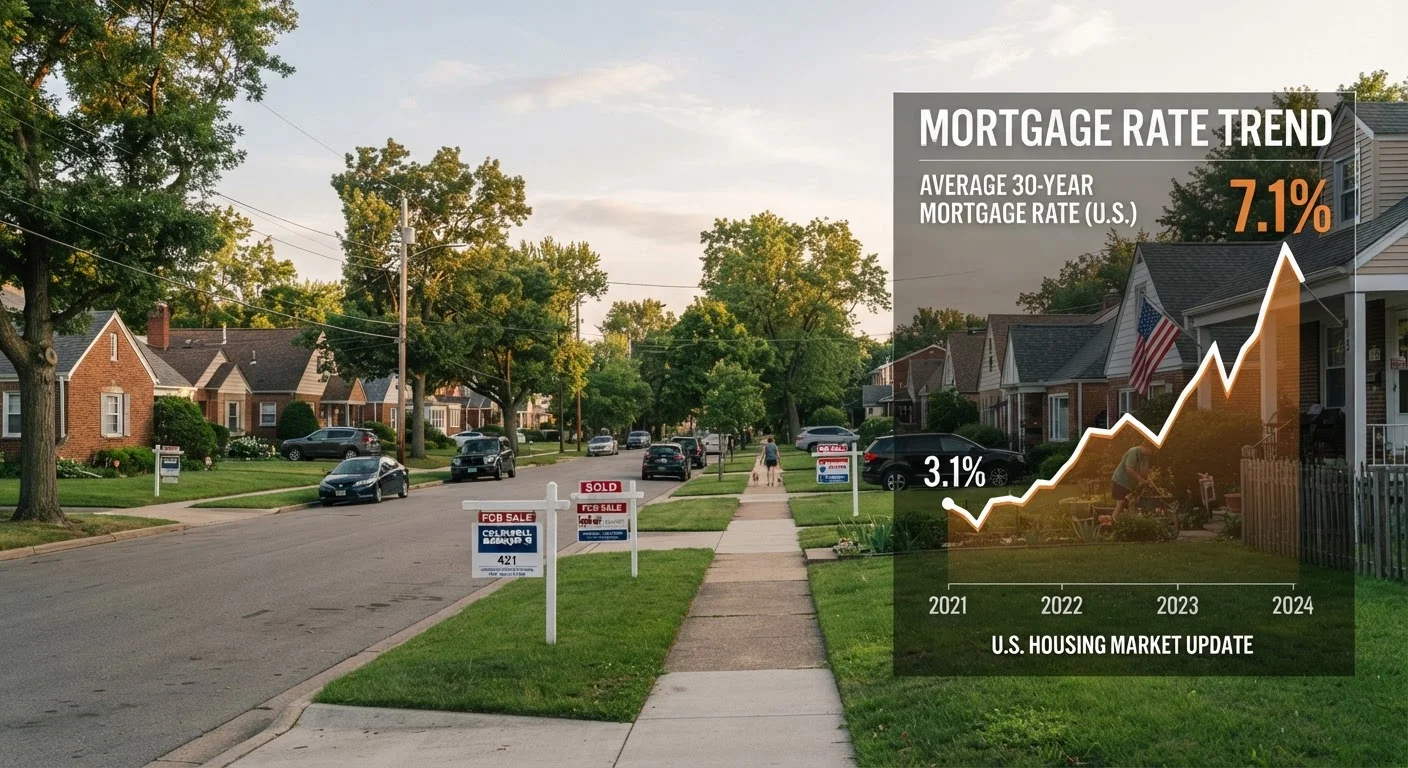
A homeowner who locked in a 3% mortgage rate in 2021 decides not to sell in 2024, when prevailing rates are near 7%, because buying a replacement home would cost far more per month.
A buyer in a high-demand coastal market finds that even with rates above 6.5%, homes are receiving multiple offers and selling near or above asking price.
How Your Personal Rate Is Determined
National mortgage rate headlines reflect averages - your actual rate will likely differ. Lenders assess individual borrowers based on several factors.
- Credit score: Higher scores typically qualify for lower rates because they signal lower default risk to lenders.
- Down payment: A larger down payment reduces the lender's exposure and often results in better rate offers.
- Loan type: Conventional, FHA, VA, and USDA loans each carry different rate structures and eligibility rules.
- Debt-to-income ratio: Lenders look at how much of your gross monthly income is already committed to debt payments.
Understanding how these variables interact gives buyers more agency. Your credit score shapes your mortgage options in ways that go beyond simple approval or denial - it influences the rate you're offered on every loan type.
If you're weighing loan structures, understanding fixed-rate vs. adjustable-rate mortgages is a useful next step.
This article is for general informational and educational purposes only and does not constitute financial, mortgage, or investment advice. Consult a licensed mortgage professional or financial adviser for guidance specific to your situation.