

Key Takeaways
- A mortgage lets you buy a home now and repay the cost gradually over many years.
- Your monthly payment covers both principal (the loan balance) and interest (the lender's fee).
- In the early years, most of each payment goes toward interest rather than reducing your balance.
- Amortization is the schedule that determines how your payments are split over the life of the loan.
- A larger down payment reduces the amount you need to borrow and can lower your interest costs.
- Your credit score and debt-to-income ratio are key factors lenders use to evaluate your application.
Mortgage
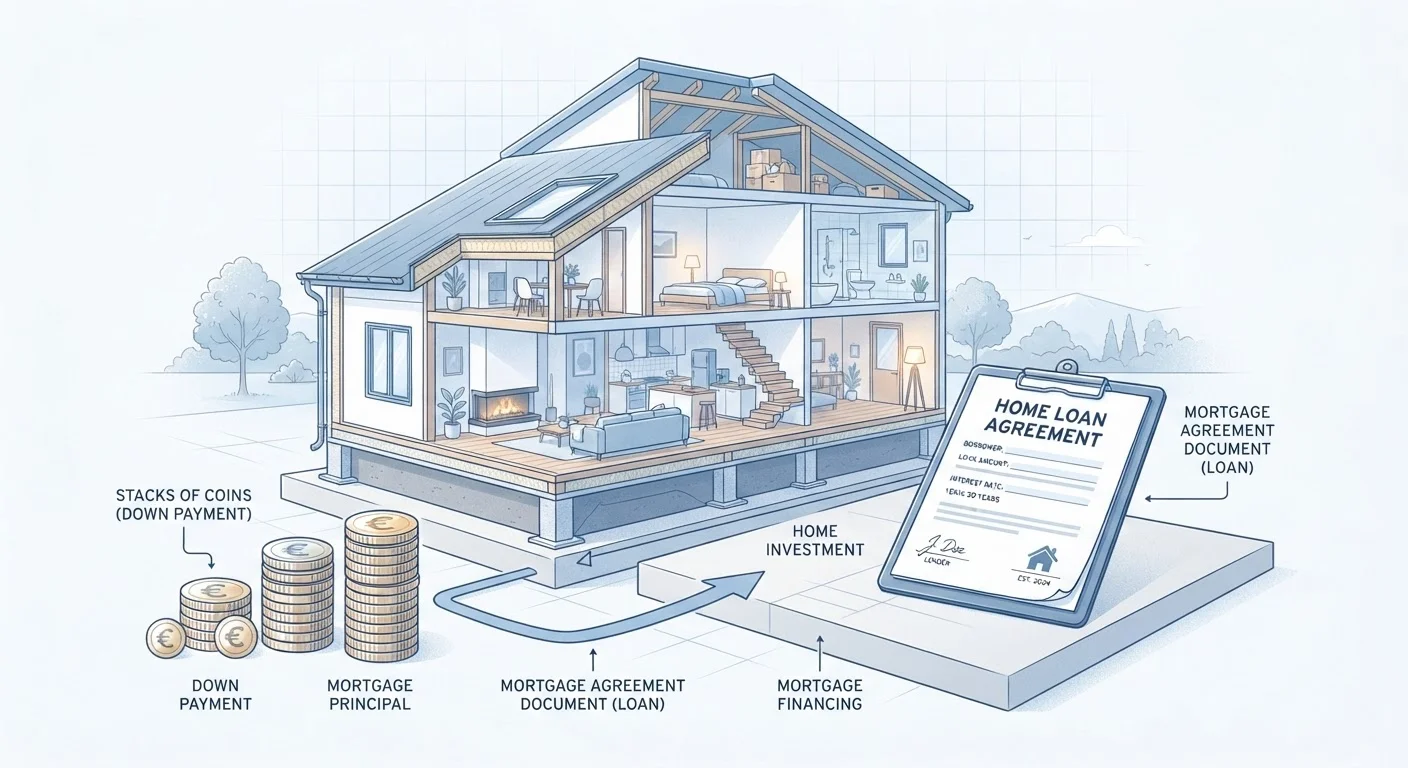
A mortgage is a loan used to purchase real estate, where the property itself serves as collateral. You borrow a sum of money from a lender, then repay it - plus interest - over a set period, typically 15 or 30 years. If you stop making payments, the lender has the legal right to take ownership of the property through a process called foreclosure.
Legally, a mortgage involves two documents: a promissory note (your promise to repay) and a deed of trust or mortgage instrument (which pledges the property as security for the loan).
The Basic Structure of a Home Loan
When you take out a mortgage, you are entering a long-term financial agreement with a lender - usually a bank, credit union, or mortgage company. The lender pays the seller for the home on your behalf, and you agree to repay that amount, plus interest, over a defined period.
Every mortgage has a few core components:
- Principal: The total amount you borrow. If a home costs $350,000 and you put down $50,000, your principal is $300,000.
- Interest rate: The annual cost of borrowing, expressed as a percentage. A lower rate means less paid over the life of the loan.
- Loan term: How long you have to repay - most commonly 15 or 30 years in the US.
- Monthly payment: A fixed amount (on most loans) that covers principal and interest, and often includes property taxes and insurance held in escrow.
To understand how fixed and adjustable rate options compare, see our overview of fixed vs. adjustable-rate mortgages.
How Amortization Works - and Why It Matters
Amortization is the process of spreading your loan repayment across equal monthly payments over the loan term. Each payment is the same dollar amount, but the split between principal and interest changes every single month.
Here is why: interest is calculated on your remaining balance. At the start of a 30-year mortgage, your balance is at its highest, so interest takes up the largest share of your payment. As you gradually reduce the balance, less interest accrues, and more of each payment goes toward principal.
30 years
Most common US mortgage loan term
The 30-year fixed-rate mortgage has been the dominant home loan structure in the United States for decades, according to the Consumer Financial Protection Bureau.
~89%
Share of first payment going to interest (example)
On a $300,000 loan at 7% over 30 years, roughly 88-89% of the first monthly payment covers interest rather than principal reduction.
20%
Down payment threshold to avoid PMI
Conventional loan guidelines generally require private mortgage insurance (PMI) when a borrower puts down less than 20% of the purchase price.
For example, on a $300,000 loan at a 7% interest rate over 30 years, your first payment might allocate roughly $1,750 to interest and only about $245 to principal. By year 25, those proportions have flipped substantially. This is why homeowners who sell or refinance early may find they have built less equity than they expected - they have been paying mostly interest during those first years.
This same math principle - interest compounding on a balance over time - works in the opposite direction when you are building savings. The mechanics of compound interest explain why time in the market matters so much for investors.
What the Lender Evaluates Before Approving You
Before agreeing to lend you money, lenders assess the risk that you might not repay. They look at several factors:
- Credit score: A numerical summary of your borrowing history. Higher scores generally lead to better interest rate offers.
- Debt-to-income ratio (DTI): The percentage of your gross monthly income that goes toward debt payments. Most conventional lenders prefer a DTI below 43%.
- Down payment: A larger down payment reduces the lender's risk and your loan balance. Putting down less than 20% on a conventional loan typically triggers a requirement for private mortgage insurance (PMI).
- Employment and income stability: Lenders want confidence that your income is reliable enough to sustain payments for the loan term.
Get Pre-Approved Before You Shop
A mortgage pre-approval gives you a realistic sense of what you can borrow based on your actual financial profile - not just a rough estimate. It also signals to sellers that you are a serious buyer. Gather recent pay stubs, tax returns, and bank statements before approaching lenders, as these documents are typically required.
Understanding these factors before you apply helps you identify where to focus your preparation. For a deeper look at how your credit history affects your loan options, see how your credit score shapes your mortgage options.
If you want broader context on what drives home prices and the market conditions you are buying into, the housing market primer is a useful starting point.
This article is for general informational and educational purposes only and does not constitute financial, legal, or mortgage advice. Consult a qualified financial professional or HUD-approved housing counselor for guidance specific to your situation.