

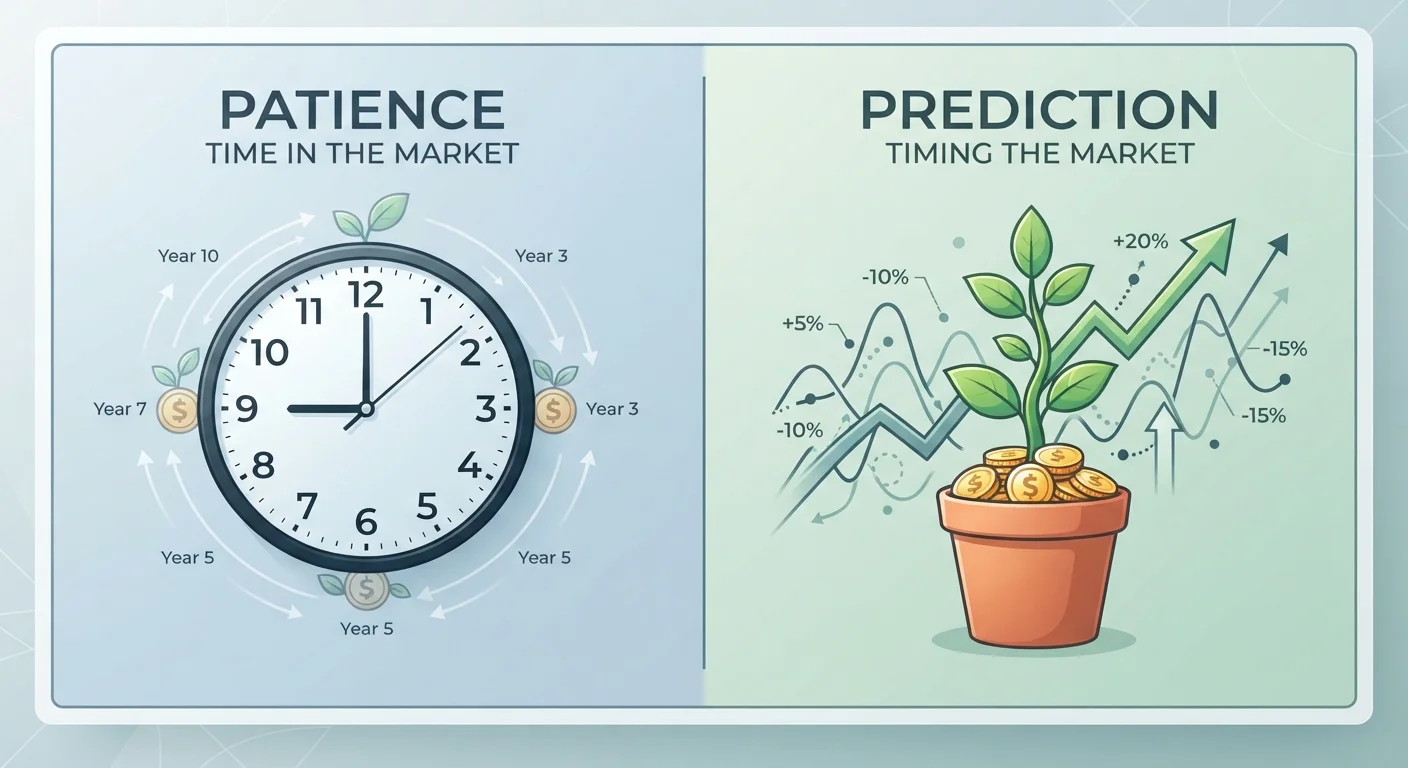
Key Takeaways
- Market timing - predicting when to buy low and sell high - is notoriously difficult even for professional investors.
- Missing just a handful of the market's best days can significantly reduce long-term returns.
- Staying invested over the long term has historically rewarded patient investors more consistently than active timing.
- Dollar-cost averaging is a practical strategy that removes the pressure of picking the 'perfect' entry point.
- No strategy guarantees returns; always consult a qualified financial adviser for decisions suited to your situation.
Our Verdict
Research consistently suggests that staying invested over the long term tends to outperform attempts to predict market movements for most individual investors. Market timing demands near-perfect foresight that even seasoned professionals rarely achieve. For beginners building wealth, time in the market - combined with steady contributions and diversification - offers a more reliable foundation than trying to outsmart short-term fluctuations.
| Best for | Recommended |
|---|---|
| Beginners and long-term wealth builders | Time in the Market |
| Those with high risk tolerance and significant research capacity | Market Timing (with caution) |
| Investors who want to reduce emotional decision-making | Time in the Market |
What Each Approach Actually Means
Market timing is the strategy of moving money in and out of investments based on predictions about future price movements - buying before prices rise and selling before they fall. It sounds logical in theory: if you could reliably foresee a market drop, why wouldn't you exit first?
Time in the market, by contrast, means staying invested consistently over many years, regardless of short-term volatility. The underlying premise is that markets have historically trended upward over long periods, and that the compounding growth of staying invested outweighs the gains from perfectly timed trades.
These two approaches represent fundamentally different assumptions about what drives investment success - skill and prediction on one side, patience and consistency on the other. Understanding the distinction is essential for anyone starting to build a portfolio. For a related look at how timing misconceptions play out in real estate decisions, see how timing mistakes trip up buyers and sellers.
The Evidence on Market Timing
Decades of research paint a consistent picture: accurately timing the market is extraordinarily difficult. Studies of mutual fund performance have repeatedly found that the majority of actively managed funds - run by experienced, well-resourced professionals - underperform their benchmark index over 10-to-20-year periods, in part because of the costs and missteps that come with frequent trading.
One often-cited illustration involves the outsized impact of missing the market's single best days. Because strong recoveries frequently cluster immediately after sharp sell-offs, an investor who exits during a downturn may miss the rebound entirely. Missing even a small number of the market's strongest trading days over a decade can meaningfully reduce overall returns - though the exact figures vary by time period studied.
~80%
Active funds underperforming over 20 years
According to S&P Dow Jones Indices' SPIVA reports, roughly 80-90% of actively managed U.S. equity funds have underperformed their benchmark index over 20-year periods in multiple report cycles.
10-20 days
Best market days that dramatically affect returns
Research from multiple financial institutions consistently shows that missing a small number of the market's best trading days over a decade can substantially reduce long-term portfolio returns.
The psychological dimension also matters. Fear and euphoria drive many timing decisions, and those emotions tend to push investors toward buying high (when confidence is at its peak) and selling low (when panic sets in) - the opposite of the intended strategy.
The Case for Staying Invested
Long-term investors benefit from two powerful forces: compounding and time. Compounding means that returns generate their own returns over time - a process that accelerates significantly over decades rather than years. The longer money stays invested, the more aggressively compounding can work.
Broad market indexes have historically delivered positive long-run returns despite recessions, corrections, and periods of significant uncertainty. That historical trend does not guarantee future results, and all investing involves risk - including the possibility of loss. But for investors with long time horizons, short-term downturns have generally resolved over time without requiring precise timing to recover from.
Try Dollar-Cost Averaging to Stay Consistent
Instead of investing a lump sum at one moment in time, consider contributing a fixed dollar amount on a regular schedule - monthly, for example. This approach means you automatically buy more shares when prices are lower and fewer when prices are higher. Over time, it can smooth out the impact of volatility and help remove emotional decision-making from the process.
Dollar-cost averaging (DCA) - investing a fixed amount at regular intervals regardless of market conditions - is one practical way to implement a time-in-the-market philosophy. It removes the pressure of choosing the ideal entry point and can reduce the emotional impact of volatility. This pairs naturally with passive investment vehicles; for more context on fund types, see how index funds compare to actively managed funds.
Comparing the Two Approaches
Neither approach is entirely without merit, but they differ substantially in complexity, risk, and what they demand from an investor.
| Market Timing | Time in the Market | |
|---|---|---|
| Core assumption | Prices can be predicted reliably | Markets reward patience over time |
| Skill required | High - demands accurate, consistent prediction | Lower - focus on discipline and consistency |
| Trading frequency | Frequent, reactive to conditions | Infrequent, largely passive |
| Cost exposure | Higher - fees, taxes on short-term gains | Lower - fewer transactions, long-term tax rates |
| Emotional demand | High - requires resisting fear and greed | Moderate - requires patience during downturns |
| Historical success rate | Low for most individual investors | Stronger over long time horizons historically |
For most everyday investors - particularly those just starting out - the evidence favors consistency over prediction. That said, no single strategy is universally appropriate. Individual circumstances, risk tolerance, and time horizons all matter, which is why speaking with a licensed financial adviser before making significant investment decisions is strongly recommended.
This article is for general informational and educational purposes only and does not constitute personalized financial, investment, or tax advice. Past market performance does not guarantee future results. Consult a qualified financial professional before making decisions about your own finances.