

| Primary asset classes | Stocks, bonds, cash/cash equivalents |
| Key allocation factors | Time horizon, financial goals, risk tolerance |
| Typical equity share in early career | 80-90% (general guideline) (Common financial planning framework; varies by individual) |
| Typical equity share near retirement | 40-60% (general guideline) (Common financial planning framework; varies by individual) |
| Rebalancing frequency | Annually or when allocation drifts significantly |
| Target-date funds | Auto-adjust allocation as retirement year approaches |
What Asset Allocation Actually Means
Asset allocation is how you divide your investment portfolio among different asset classes - primarily stocks (equities), bonds (fixed income), and cash or cash equivalents. The core idea is that different asset classes behave differently in various market conditions, and mixing them can help manage overall risk.
| Primary asset classes | Stocks, bonds, cash/cash equivalents |
| Key allocation factors | Time horizon, financial goals, risk tolerance |
| Typical equity share in early career | 80-90% (general guideline) (Common financial planning framework; varies by individual) |
| Typical equity share near retirement | 40-60% (general guideline) (Common financial planning framework; varies by individual) |
| Rebalancing frequency | Annually or when allocation drifts significantly |
| Target-date funds | Auto-adjust allocation as retirement year approaches |
The right allocation for you isn't determined by a formula alone. It reflects three interacting factors: your time horizon (how many years until you need the money), your financial goals (retirement, a home purchase, education costs), and your risk tolerance - meaning both your financial ability to absorb losses and your emotional comfort with market volatility.
As any of those three factors shift, your allocation should be revisited. That's why allocation isn't a one-time decision - it's an ongoing part of managing a portfolio. See our guide on rebalancing a portfolio for how investors keep their allocations on track over time.
This article is for general educational purposes only and does not constitute personalized investment advice. Consult a licensed financial professional for guidance suited to your specific situation.
Allocation by Life Stage: A General Framework
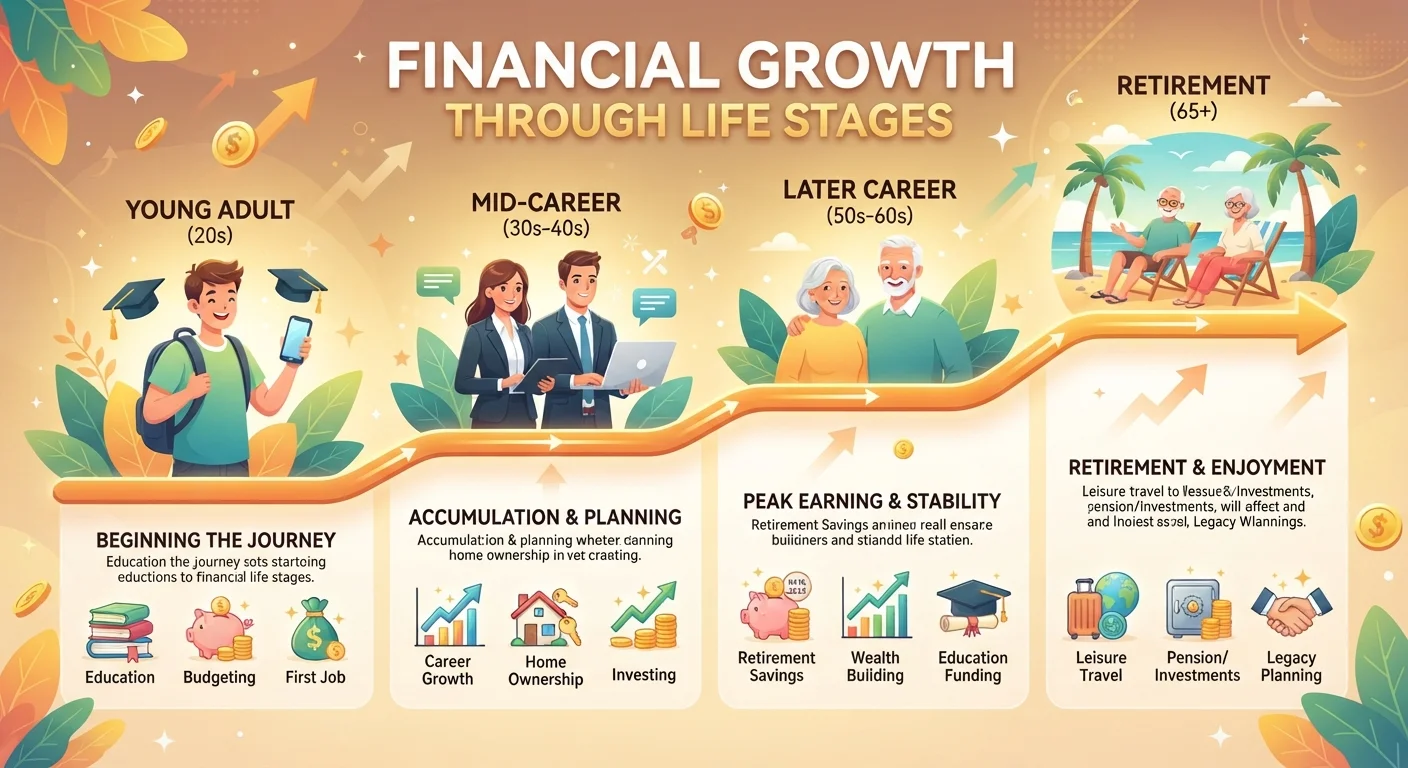
Financial educators and planners commonly describe how allocation priorities shift across four broad life stages. These are generalizations - individual circumstances vary widely - but they illustrate the underlying logic.
Asset allocation
The strategy of dividing a portfolio among different asset classes - such as stocks, bonds, and cash - to balance risk and potential return based on individual goals and circumstances.
Equities (stocks)
Ownership shares in a company. Stocks have historically offered higher long-term growth potential than bonds, but with greater short-term price volatility.
Fixed income (bonds)
Debt instruments that typically pay regular interest and return principal at maturity. Bonds generally carry lower risk than stocks but also lower long-term growth potential.
Time horizon
The length of time an investor expects to hold a portfolio before needing to draw on it. A longer time horizon generally allows for greater risk-taking because there's more time to recover from market downturns.
Capital preservation
An investment objective focused on protecting the original amount invested, prioritizing stability over growth. Common among investors closer to or in retirement.
Diversification
Spreading investments across different asset classes, sectors, or geographies to reduce the impact of any single poor-performing investment on the overall portfolio.
20s and Early 30s: Growth-Oriented
Younger investors typically have the longest time horizon before retirement, which means market downturns have time to recover. A common approach at this stage is a higher concentration in equities - sometimes 80-90% of a portfolio - with a smaller share in bonds. The rationale: equities have historically offered greater long-term growth potential, but with more short-term volatility. With decades ahead, that volatility is more tolerable.
This is also the stage to take advantage of tax-advantaged accounts like 401(k)s and IRAs, where compound growth can work over the longest possible timeline.
40s and 50s: Balancing Growth and Preservation
As retirement approaches within 15-25 years, many investors begin gradually shifting toward a more balanced mix - perhaps 60-70% equities and 30-40% bonds. The goal is to maintain enough growth to build wealth while reducing exposure to severe market swings that could meaningfully damage a portfolio with less time to recover.
Peak earning years in this stage may also allow for higher contribution rates and diversification into additional asset classes such as real estate investment trusts (REITs) or international equities. Comparing index funds vs. actively managed funds becomes a more pressing question as portfolio size grows.
60s and Beyond: Income and Capital Preservation
Near and in retirement, preserving capital and generating reliable income typically takes priority over aggressive growth. Many investors in this stage shift to a higher proportion of bonds, dividend-paying stocks, and other lower-volatility assets. A common reference point is holding enough in stable assets to cover several years of living expenses without needing to sell equities during a downturn.
That said, retirement can last 20-30 years or more, so abandoning growth entirely can create its own risk - particularly inflation eroding purchasing power. Maintaining some equity exposure into retirement is a widely discussed consideration, though the right balance depends heavily on individual income sources, expenses, and health circumstances.
Common Rules of Thumb - and Their Limits
You've likely encountered shorthand rules for allocation. The old "100 minus your age" guideline suggested your stock percentage should equal 100 minus your age - so a 40-year-old would hold 60% stocks. A newer version uses 110 or 120 as the base, reflecting longer life expectancies and the ongoing need for growth.
Rules of Thumb Have Real Limitations
Allocation guidelines like "110 minus your age" are useful mental shortcuts, not personalized prescriptions. They ignore pension income, Social Security, debt, health status, and other household assets. A financial adviser can help translate general frameworks into a plan that fits your specific situation - and that's particularly valuable as you approach major transitions like retirement.
These rules offer a starting point, not a destination. They don't account for personal debt levels, other income sources (like a pension or Social Security), dependents, health, or specific financial goals. A 55-year-old with a defined-benefit pension and no debt may reasonably carry more equity risk than someone the same age with no other retirement income.
Target-date funds - mutual funds that automatically shift allocation as a target retirement year approaches - are one popular way investors implement this life-stage logic without managing it manually. Understanding how they work can be valuable context even if you don't use them directly.
The most durable principle behind any allocation framework: align your portfolio's risk level with both your capacity to absorb losses and your need to take risk to meet your goals. Neither factor alone tells the full story.