

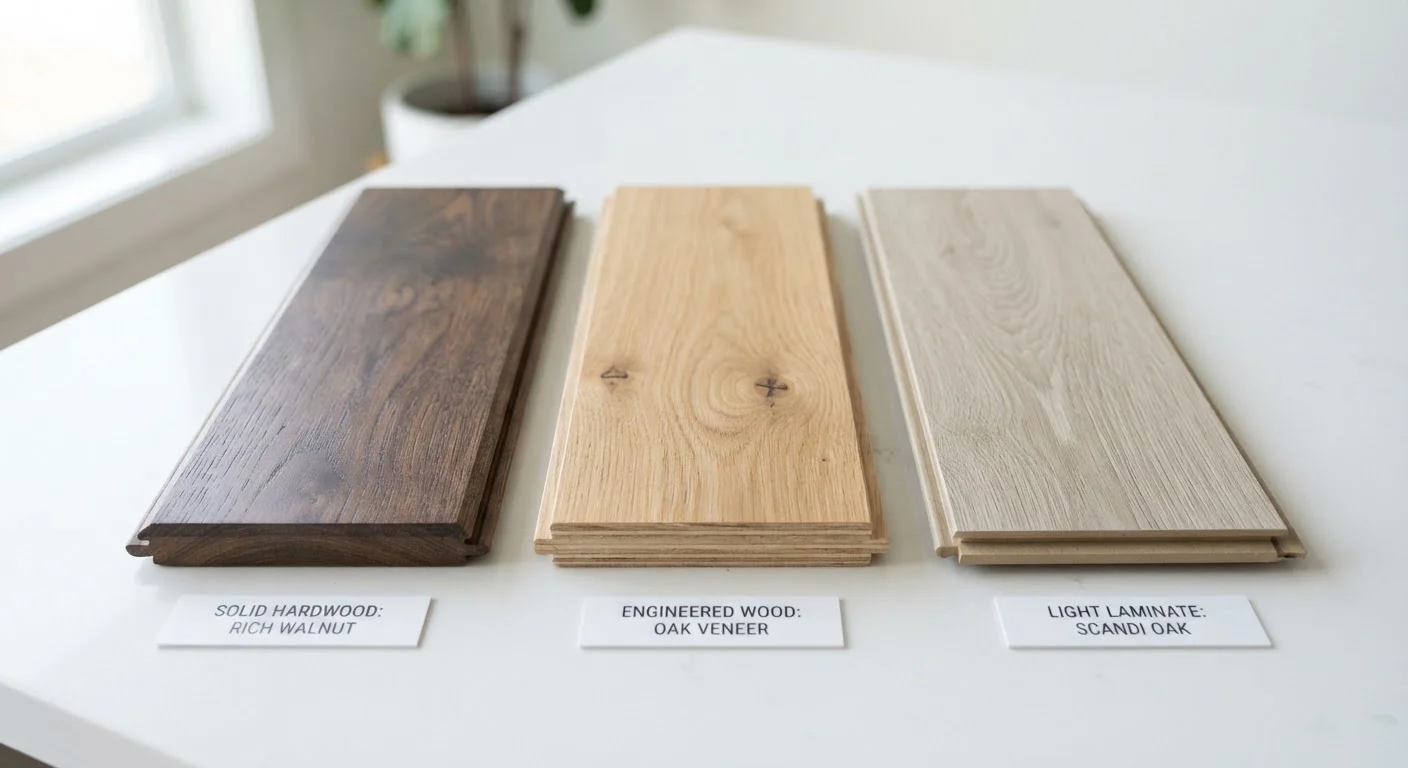
Key Takeaways
- Solid hardwood can be refinished multiple times but is vulnerable to moisture and humidity changes.
- Engineered wood offers real wood appearance with better dimensional stability in damp environments.
- Laminate is the most budget-friendly option but cannot be refinished once the surface layer wears through.
- Installation method and subfloor condition significantly influence which material is the right fit.
- All three options can add visual value to a home, but long-term performance depends on room conditions.
Our Verdict
Each flooring type serves a different homeowner profile. Solid hardwood rewards those who plan to stay long-term and want a floor that ages gracefully and can be renewed. Engineered wood bridges the gap between authenticity and practicality in moisture-prone spaces. Laminate suits budget-conscious projects where aesthetics matter more than longevity.
| Best for | Recommended |
|---|---|
| Homeowners wanting a long-lasting, refinishable floor in dry living areas | Solid Hardwood |
| Kitchens, finished basements, or regions with humidity swings | Engineered Wood |
| Rental properties or rooms with tight renovation budgets | Laminate |
| DIYers installing over concrete subfloors | Engineered Wood or Laminate |
What Sets Each Material Apart
Understanding what these floors are made of is the foundation for every other comparison. Solid hardwood is milled from a single piece of timber - typically oak, maple, hickory, or walnut - and is usually ¾ inch thick. That thickness is what allows it to be sanded and refinished multiple times over decades.
Engineered wood is constructed differently: a thin veneer of real hardwood sits on top of several layers of plywood or high-density fiberboard (HDF). The cross-grain construction makes it significantly more resistant to the expansion and contraction caused by humidity changes.
Laminate contains no real wood in the visible layer. Its surface is a high-resolution photographic image of wood (or stone or tile) protected by a clear wear layer, bonded to a composite core. Modern laminate has become convincing visually, but it remains a manufactured product with physical limits that real wood does not share.
| Solid Hardwood | Engineered Wood | Laminate | |
|---|---|---|---|
| Core material | Single solid timber plank | Hardwood veneer over plywood/HDF | Photographic layer over composite core |
| Refinishable | Yes, 4-6+ times | Once or twice (veneer-dependent) | No |
| Moisture resistance | Low - avoid wet areas | Moderate - handles humidity better | Moderate - avoid standing water |
| Subfloor compatibility | Wood subfloor only | Wood or concrete | Wood or concrete |
| Relative material cost | Highest | Mid-range | Lowest |
| DIY installation ease | Moderate to difficult | Moderate | Easiest |
| Typical lifespan (with care) | 50+ years | 25-40 years | 10-25 years |
Durability, Moisture Resistance, and Refinishability
Solid hardwood is the most durable surface underfoot over a long time horizon - provided it stays dry. Wood expands and contracts with changes in moisture and temperature, so it is not recommended below grade (basements) or in bathrooms. The payoff: a well-maintained hardwood floor can be sanded and refinished four to six times, effectively resetting its surface appearance.
Engineered wood handles humidity better because the plywood core resists the cupping and warping that affects solid planks. Some engineered products can be lightly sanded and refinished once or twice, depending on the veneer thickness - typically 2 mm to 6 mm. Thinner veneers may not tolerate any refinishing at all, so it's worth checking manufacturer specifications before purchasing.
Laminate's wear layer is scratch-resistant and easy to clean, making it practical for high-traffic households with pets or children. However, once the wear layer erodes or the core gets saturated - even briefly - the floor is at or near end of life. Repair usually means replacing affected planks rather than refinishing.
Check Veneer Thickness Before You Buy
If refinishability is important to you and you're considering engineered wood, ask specifically about veneer thickness. A 2 mm veneer generally cannot tolerate sanding, while a 4-6 mm veneer typically allows one or two refinishes. Thicker veneers usually cost more but extend the floor's useful life considerably.
Installation, Cost, and Subfloor Considerations
Installation cost and complexity vary meaningfully. Solid hardwood generally requires nail-down or staple-down installation over a wood subfloor, and the floor must acclimate in the home for several days before installation. It carries the highest material cost of the three, though that varies by species and grade.
Engineered wood is more versatile: it can be glued, nailed, or floated (snapped together without fasteners) over concrete or wood subfloors. This flexibility reduces labor complexity for DIYers. Material costs generally fall between solid hardwood and laminate.
Laminate is typically the easiest for DIY installation - most products use a click-lock floating method that sits over a thin foam underlayment. Subfloor prep matters regardless of which product you choose: high spots, dips, or moisture issues in the subfloor will telegraph through any of these materials and shorten their effective life. For significant subfloor irregularities or suspected moisture problems in a slab, consulting a flooring professional before installing any product is a sound investment. Just as choosing the right material matters for walls - see our material-by-material breakdown for kitchen backsplash installation - the same logic applies to floors.
Making the Right Choice for Your Space
Before committing to a material, answer three practical questions: What is the room's moisture exposure? What is the subfloor type and condition? How long do you plan to stay in the home?
Rooms with consistent indoor climate control and wood subfloors - living rooms, dining rooms, bedrooms - are ideal candidates for solid hardwood. Spaces with concrete subfloors or periodic humidity changes are better suited to engineered wood. Laminate is a reasonable solution for spaces where budget is the primary constraint and moisture exposure is minimal.
Longevity projections depend heavily on maintenance: regular sweeping, prompt spill cleanup, humidity control (generally 35-55% relative humidity is recommended for wood-based floors), and protective pads under furniture legs all extend the life of any flooring material. No floor type eliminates the need for basic care.
This article is for general informational purposes. Flooring installation involving subfloor repairs, structural concerns, or significant moisture issues should be evaluated by a qualified flooring professional. Local building codes may have specific requirements - verify before beginning any project.