

| Typical battery lifespan | 3-5 years (General industry guidance from battery manufacturers) |
| Battery chemistry (most vehicles) | Lead-acid (flooded or AGM) |
| Fully charged resting voltage | ~12.6 volts |
| Key performance metric for cold starts | Cold Cranking Amps (CCA) |
| Primary lifespan killers | Extreme heat, short trips, deep discharge |
| Most accurate test type | Conductance testing |
How Long Do Car Batteries Actually Last?
The standard lead-acid car battery is generally rated for three to five years under typical driving conditions. That range isn't arbitrary - it reflects how the battery's internal chemistry degrades through repeated charge and discharge cycles, temperature swings, and sitting unused for extended periods.
| Typical battery lifespan | 3-5 years (General industry guidance from battery manufacturers) |
| Battery chemistry (most vehicles) | Lead-acid (flooded or AGM) |
| Fully charged resting voltage | ~12.6 volts |
| Key performance metric for cold starts | Cold Cranking Amps (CCA) |
| Primary lifespan killers | Extreme heat, short trips, deep discharge |
| Most accurate test type | Conductance testing |
Climate plays a measurable role. Extreme heat accelerates internal corrosion; extreme cold reduces the battery's ability to deliver the cold cranking amps (CCA) needed to start a cold engine. Drivers in the Sun Belt may see batteries wear out closer to three years, while those in more temperate climates sometimes push toward six.
Driving patterns matter too. Short trips - particularly those under 20 minutes - don't give the alternator enough time to fully recharge the battery after startup. Frequent short-trip driving is one of the more common causes of premature battery failure, especially in colder months. Staying on top of routine maintenance, including battery checks, is part of keeping your vehicle reliable long-term.
Warning Signs That a Battery Is Wearing Out
Battery decline is gradual, which means most drivers notice a pattern of small symptoms before a hard failure. Learning to read those signs early gives you time to plan rather than react.
Cold Cranking Amps (CCA)
A rating that measures how much current a battery can deliver for 30 seconds at 0°F (-18°C) while maintaining a minimum voltage. Higher CCA ratings indicate better cold-start performance.
Lead-acid battery
The most common type of automotive starting battery, which uses lead plates submerged in a sulfuric acid electrolyte solution to store and release electrical energy.
AGM (Absorbent Glass Mat)
A sealed, maintenance-free variant of the lead-acid battery where the electrolyte is absorbed into fiberglass mats. AGM batteries are common in vehicles with start-stop systems and high electrical demands.
Conductance testing
A diagnostic method that measures a battery's internal resistance to estimate remaining capacity. It provides an accurate health assessment without fully discharging the battery.
Deep discharge
A condition where a battery is drained significantly below its normal operating voltage, often caused by leaving lights or accessories on. Repeated deep discharges shorten battery life considerably.
Alternator
The engine-driven generator that recharges the battery while the vehicle is running and powers the electrical system. A failing alternator can drain or damage an otherwise healthy battery.
- Slow engine crank: The engine turns over sluggishly or hesitates before starting. This is often the clearest early sign that the battery is losing capacity.
- Frequent need for jump-starts: A healthy battery should not require external help under normal conditions. Needing a jump more than once is a reliable indicator something is wrong.
- Dim headlights or interior lighting: Electrical accessories that seem weaker than usual - particularly at idle - can point to a battery struggling to hold charge.
- Battery warning light: Most modern vehicles illuminate a dashboard warning light when the charging system detects a voltage issue. This light can signal a failing battery, alternator problem, or both.
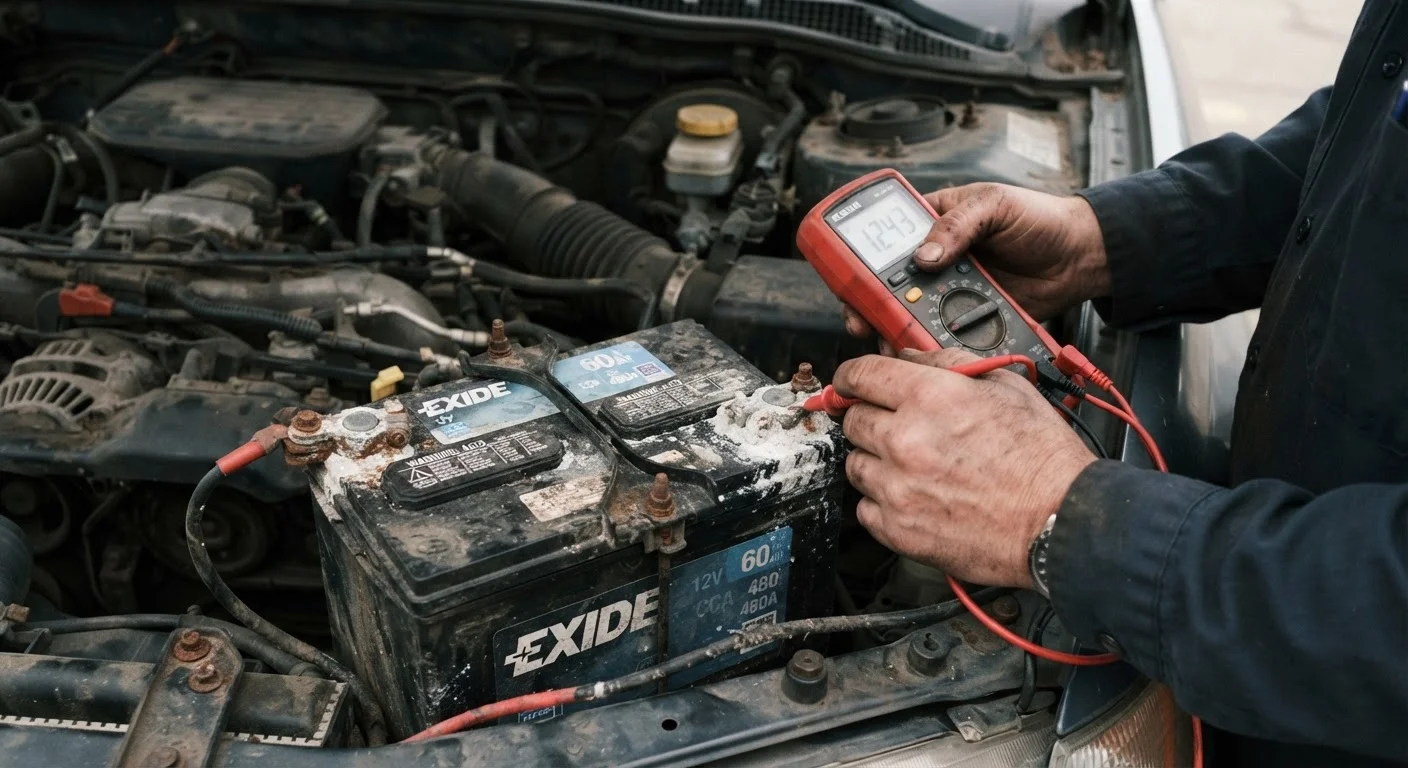
- Visible corrosion: A white or blue-gray powdery buildup around the terminals indicates acid leakage and can interfere with the electrical connection. It doesn't always mean the battery is dead, but it warrants cleaning and inspection.
- Swollen or misshapen case: Excessive heat can cause the battery casing to bulge. A physically deformed battery should be replaced promptly and handled with care.
Owners of high-mileage vehicles should be especially attentive - older vehicles have less margin for electrical system stress.
What Battery Testing Actually Tells You
A visual inspection can flag obvious problems, but it can't tell you how much usable life remains. That requires testing.
12.6V
Healthy resting battery voltage
A fully charged lead-acid battery at rest should measure approximately 12.6 volts; readings below 12.0 volts indicate significant capacity loss.
3-5 years
Average car battery lifespan
Industry guidance from battery manufacturers suggests most lead-acid automotive batteries reach the end of their useful life within this window under normal use.
20 min+
Minimum drive time to recharge after startup
Shorter trips may not give the alternator sufficient time to restore the charge used during engine startup, accelerating battery wear over time.
Voltage testing with a basic multimeter is the most accessible option. A fully charged battery at rest should read approximately 12.6 volts. Readings below 12.4 volts suggest a partial charge or early capacity loss; anything below 12.0 volts indicates significant discharge or a failing cell.
Load testing goes a step further by measuring how the battery performs under a simulated electrical load - mimicking what happens during engine startup. Many auto parts stores and shops offer this service at no charge. A battery that reads fine at rest but drops sharply under load is nearing the end of its useful life.
Conductance testing is the most accurate method and is increasingly used by professional shops. It measures the battery's internal resistance rather than just its voltage, giving a clearer picture of actual remaining capacity without requiring a full discharge cycle.
If a battery fails a load or conductance test, replacement is generally the practical next step. Attempting to recondition a failing battery with repeated charging cycles may temporarily restore voltage but rarely restores full capacity. Understanding these maintenance costs in advance is worthwhile - battery replacement fits into a broader pattern of vehicle upkeep expenses.
When Replacement Makes Sense
Replacing a battery before it fails outright - rather than after it leaves you stranded - is almost always the more practical decision. A few guidelines help clarify the timing:
- Age alone is a reasonable trigger. If a battery is approaching or past four years old and hasn't been tested recently, proactive testing is worthwhile. If testing shows reduced capacity, replacement before winter or summer (the two seasons hardest on batteries) is sensible.
- Failed load or conductance test. Once a battery cannot sustain adequate voltage under load, it is unlikely to recover reliably. Replacement is appropriate regardless of visible symptoms.
- Recurring jump-start dependence. A battery that requires repeated jump-starts has already demonstrated it cannot perform reliably. Continued use risks a no-start situation at an inconvenient or unsafe time.
- Physical damage. A cracked case, severe terminal corrosion that has compromised the connection, or a visibly swollen housing are conditions where replacement is not optional.
When having a battery replaced, it's also worth asking a qualified technician to inspect the charging system - specifically the alternator output - since a faulty alternator can kill a new battery prematurely. Proper installation matters too; many modern vehicles require a battery registration or reset procedure to maintain charging system efficiency.
This article is for general informational purposes. For specific diagnosis or repair work, consult a qualified automotive technician.