

| Agency responsible | Transportation Security Administration (TSA), part of the U.S. Dept. of Homeland Security |
| Carry-on liquid container limit | 3.4 oz (100 ml) or less per container (TSA 3-1-1 rule) |
| Liquids bag size | 1 quart-sized, clear, zip-top bag per traveler (TSA 3-1-1 rule) |
| Laptop screening (standard lanes) | Must be removed from bag and placed in separate bin |
| TSA PreCheck lanes | Shoes, laptops, and liquids can stay in your bag |
| Recommended domestic arrival time | At least 2 hours before departure (TSA general guidance) |
| Recommended international arrival time | At least 3 hours before departure (TSA general guidance) |
How the TSA Screening Process Actually Works
The TSA is the federal agency responsible for security at U.S. commercial airports. Every traveler passes through a checkpoint before boarding, and the process follows a predictable sequence - once you know what to expect, it rarely feels stressful.
| Agency responsible | Transportation Security Administration (TSA), part of the U.S. Dept. of Homeland Security |
| Carry-on liquid container limit | 3.4 oz (100 ml) or less per container (TSA 3-1-1 rule) |
| Liquids bag size | 1 quart-sized, clear, zip-top bag per traveler (TSA 3-1-1 rule) |
| Laptop screening (standard lanes) | Must be removed from bag and placed in separate bin |
| TSA PreCheck lanes | Shoes, laptops, and liquids can stay in your bag |
| Recommended domestic arrival time | At least 2 hours before departure (TSA general guidance) |
| Recommended international arrival time | At least 3 hours before departure (TSA general guidance) |
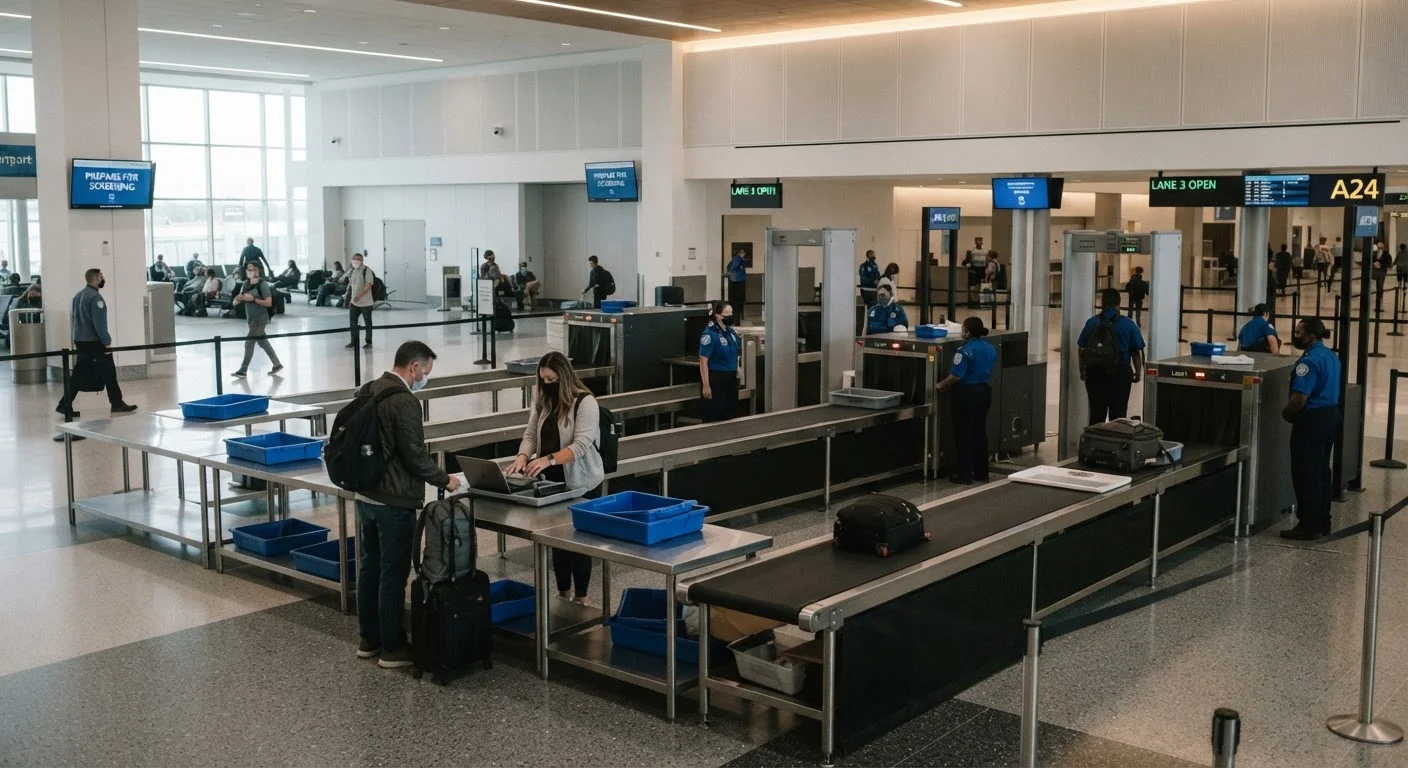
When you reach the front of the line, you'll present a valid government-issued ID (or passport for international flights) and your boarding pass. TSA agents verify that your identity matches your ticket. From there, you'll move through physical screening, which typically involves one of three machines:
- Walk-through metal detectors - the traditional archway style, still common at smaller airports.
- Advanced Imaging Technology (AIT) scanners - millimeter-wave scanners that generate a generic body outline, not an actual image of the person. Most major airports use these.
- X-ray and CT conveyor belts - your carry-on bags and personal items pass through separately while you walk through the body scanner.
Your belongings are screened simultaneously, so timing everything - shoes off, laptop out, liquids bag visible - helps the line move faster for everyone.
The Rules That Catch Travelers Off Guard
Most checkpoint delays stem from a handful of well-established rules that are easy to forget until you're standing at the belt. Here's a clear breakdown of the ones that matter most.
The Liquids Rule (3-1-1)
All liquids, gels, aerosols, creams, and pastes in your carry-on must be in containers of 3.4 ounces (100 ml) or less, all fitting into one quart-sized, clear, zip-top bag, with one bag per person. Items that exceed this limit - including full-size shampoo, water bottles with liquid, or large sunscreen - will be confiscated unless they're packed in your checked luggage. Exceptions exist for medications, baby formula, and breast milk; those should be declared separately at the checkpoint.
Electronics and Laptops
At standard checkpoints, laptops must come out of your bag and go into a separate bin. Tablets, e-readers, and other large electronics often need to be removed as well. If you're enrolled in TSA PreCheck (see glossary), you can leave these items in your bag.
Prohibited Items
Sharp objects like knives, scissors with blades longer than 4 inches, and firearms (unless properly checked and declared) are not permitted in carry-ons. The TSA maintains a full prohibited items list on its official website - it's worth a quick check if you're packing anything unusual. See our carry-on packing guide for help organizing what goes where.
TSA PreCheck
A U.S. government trusted traveler program that allows pre-approved, low-risk passengers to use expedited security lanes. Members typically don't need to remove shoes, laptops, or liquids from their bags.
Global Entry
A U.S. Customs and Border Protection program that speeds up customs clearance for pre-approved international travelers returning to the U.S. Enrollment automatically includes TSA PreCheck benefits.
Advanced Imaging Technology (AIT)
Millimeter-wave body scanners used at most major U.S. airports. They detect objects on the body without producing a photo of the individual, displaying a generic outline instead.
3-1-1 Liquids Rule
TSA shorthand for the carry-on liquids policy: containers of 3.4 oz (100 ml) or less, in 1 quart-sized clear bag, with 1 bag per traveler. Items exceeding these limits must go in checked luggage.
Secondary Screening
An additional, more detailed security check that may involve a pat-down, hand-wand, or manual bag inspection. It can be triggered by an alarm, an unclear X-ray image, or random selection.
CT Scanner
A computed tomography conveyor belt system used at some airports to produce detailed 3D images of bag contents, allowing officers to better identify prohibited items without always needing to open the bag manually.
What Triggers Additional Screening - and What to Expect
Being pulled aside for additional screening is more common than people think, and it's rarely cause for alarm. Triggers include:
- An alarm from the body scanner or metal detector
- A bag that shows a suspicious or unclear image on the X-ray
- Randomly assigned secondary screening (required by TSA protocols)
- Liquid containers not properly separated, or electronics still inside a bag
Additional screening typically involves a hand-wand sweep, a brief pat-down, or a TSA officer manually checking your bag. You have the right to request a private screening room and to have a witness present. Officers are trained to explain each step before it happens.
If you travel frequently and want to reduce these moments, trusted traveler programs like TSA PreCheck (for domestic travel) or Global Entry (which includes PreCheck benefits and expedited customs return for international travel) can significantly streamline your experience. Both require a background check, an application fee, and an in-person appointment - details are available through the TSA and U.S. Customs and Border Protection websites respectively.
For a broader look at what to prepare before departure, see the pre-departure checklist for international travel - it covers documents, health prep, and more.
Practical Habits That Make the Checkpoint Easier
Small habits add up to a noticeably smoother experience:
- Wear slip-on shoes - you'll almost certainly need to remove them.
- Pack your liquids bag at the top of your carry-on so it's the first thing you pull out.
- Empty your pockets before you reach the belt - coins, keys, and phones can all trigger alarms.
- Arrive with time to spare. TSA recommends arriving at least 2 hours before a domestic flight and 3 hours before an international one, though actual wait times vary widely by airport and time of day.
- Keep your ID and boarding pass accessible until you've cleared the checkpoint entirely.
These aren't insider secrets - they're the kind of knowledge that simply makes travel less frantic. For a fuller picture of what surprises first-time and returning travelers alike, see what travelers wish they'd looked up before arriving.
This article provides general educational information about TSA procedures in the United States. Policies can change; always verify current rules at the TSA's official website (tsa.gov) before you travel.