
The Pacific Northwest vs. New England: Two Iconic American Regions, Very Different Trips

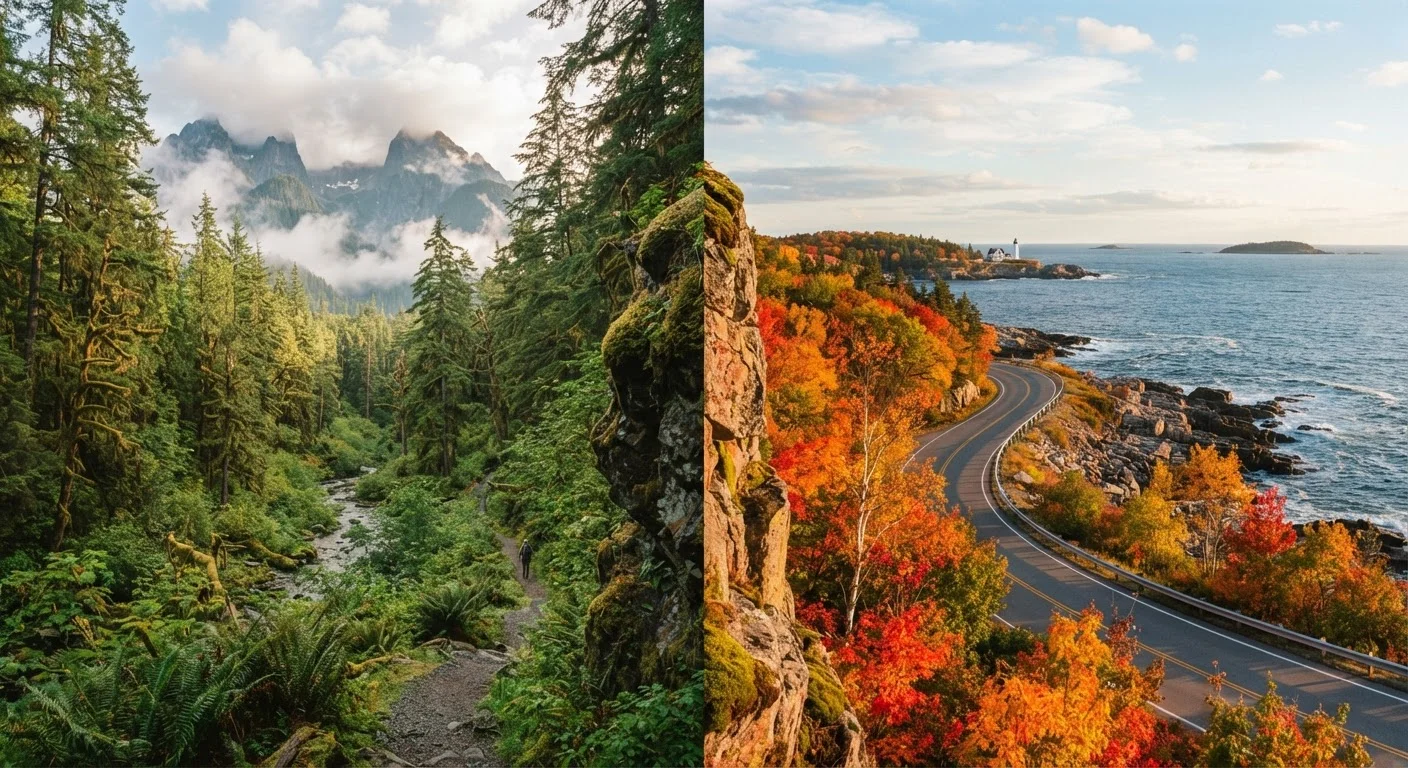
Key Takeaways
- The Pacific Northwest excels at dramatic wilderness - think old-growth rainforests, volcanic peaks, and wild Pacific coastlines.
- New England offers unmatched fall foliage, deep American history, and a string of walkable coastal towns.
- Both regions have strong food cultures: Pacific Northwest leans on salmon and farm-to-table; New England centers on lobster and chowder.
- Shoulder seasons (spring in the PNW, early fall in New England) tend to offer the best conditions with fewer crowds.
- Your ideal pick depends on whether you prioritize raw nature and outdoor adventure or historic atmosphere and scenic drives.
Option A
Pacific Northwest
The dramatic, wild, and deeply outdoorsy choice.
Best for: Travelers who want old-growth forests, volcanic peaks, rugged coastlines, and vibrant urban food scenes all in one trip.
Option B
New England
The historically rich, seasonally spectacular alternative.
Best for: Travelers drawn to colonial history, charming small towns, brilliant fall foliage, and classic seafood culture.
If you want serious outdoor adventure and dramatic scenery
Pacific Northwest
Mt. Rainier, Crater Lake, Olympic National Park, and the rugged Oregon Coast give outdoor enthusiasts an almost overwhelming range of landscapes to explore.
If fall foliage and historic small towns are your priority
New England
Vermont, New Hampshire, and coastal Maine deliver some of North America's most celebrated autumn color paired with genuinely charming town centers.
If you want a strong urban base alongside nature access
Pacific Northwest
Seattle and Portland are world-class cities with excellent food, culture, and transit, yet national parks sit within a few hours' drive of each.
If history and cultural depth matter as much as landscapes
New England
Boston, Salem, Plymouth, and the Freedom Trail offer layers of American history you simply won't find concentrated anywhere else in the country.
If you're planning a mixed-interest group trip
New England
Its compact geography and variety - cities, beaches, mountains, and museums in close proximity - makes it easier to keep everyone engaged. See our guide to planning for mixed groups for strategies.
Landscapes and Natural Highlights
The Pacific Northwest deals in superlatives. Washington state's Olympic Peninsula holds one of the only temperate rainforests in North America, where Sitka spruce and mossy maples create an almost surreal green canopy. Mt. Rainier - a glaciated active volcano - dominates the Seattle skyline on clear days and anchors one of the country's most beloved national parks. Oregon adds Crater Lake, the deepest lake in the US, and a coast that alternates between sandy dunes, dramatic sea stacks, and small fishing villages.
New England's natural appeal is seasonal in a way the Pacific Northwest's is not. Come late September through mid-October, Vermont and New Hampshire hillsides ignite in red, orange, and gold - a show that draws visitors from across the country. The Acadia National Park coastline in Maine offers rugged Atlantic drama, and the White Mountains provide solid hiking year-round. If underrated national parks appeal to you, our article on lesser-known US national parks highlights spots in both regions worth adding to your itinerary.
| Criterion | Pacific Northwest | New England |
|---|---|---|
| Signature landscape | Rainforests, volcanoes, wild coast | Foliage, Atlantic coast, mountains |
| Best season to visit | July-September (dry season) | Late September-October (foliage) |
| Urban anchor cities | Seattle, Portland | Boston, Portland (ME) |
| Iconic food experience | Pacific salmon, Dungeness crab | Lobster roll, clam chowder |
| Historical depth | Moderate (Indigenous, pioneer history) | Very high (colonial, revolutionary) |
| Getting around | Car essential outside cities | Car needed; Boston walkable |
| National park access | Olympic, Rainier, Crater Lake | Acadia (Maine) |
| Crowd levels at peak | High at parks in summer | High along foliage routes in fall |
Cities, Culture, and Food
Seattle and Portland anchor the Pacific Northwest experience. Both cities have thriving food scenes built on local seafood - particularly Pacific salmon and Dungeness crab - alongside a strong coffee culture and farm-to-table dining that reflects the region's agricultural diversity. Pike Place Market in Seattle and Portland's food cart culture each reward an afternoon of wandering. The arts, music, and independent bookshop scenes in both cities are genuinely excellent.
Boston is New England's cultural heavyweight: world-class museums, a walkable historic core, and a college-town energy year-round. Lobster rolls, clam chowder, and oysters from local bays are regional staples you'll find done well from Portland, Maine to Cape Cod. Small-town charm reaches its peak in places like Woodstock, Vermont, or Rockport, Massachusetts - the kind of towns where a slow morning feels like the whole point.
3.6M+
Annual visitors to Olympic National Park
According to the National Park Service, Olympic consistently ranks among the most visited parks in the western US.
~4 weeks
Peak foliage window in New England
Foliage typically progresses from northern Vermont in late September to southern Connecticut by mid-October, giving travelers a rolling window.
3.5M+
Annual visitors to Acadia National Park
The National Park Service reports Acadia as one of the most visited parks east of the Mississippi River.
Planning Practicalities: Timing, Cost, and Getting Around
Both regions reward flexible timing. The Pacific Northwest is rainiest from November through March - summer (July-September) brings reliably dry weather, though popular parks fill up fast. Spring offers lush greenery and smaller crowds if you're comfortable with occasional showers. New England's peak season is fall foliage (late September to mid-October), when accommodation prices spike and popular routes get congested. Summer is ideal for coastal Maine and Cape Cod; spring mud season in Vermont is widely considered the least appealing time to visit.
Getting around the Pacific Northwest generally requires a car, particularly outside the Seattle-Portland corridor. New England is similarly car-dependent for rural exploration, though Boston itself is navigable by public transit. Road trips suit both regions well - the American road trip planning guide can help you map out a realistic route for either coast. If you're still deciding what kind of experience you're after, our traveler style guide can help you match these regions to your personal travel personality.