

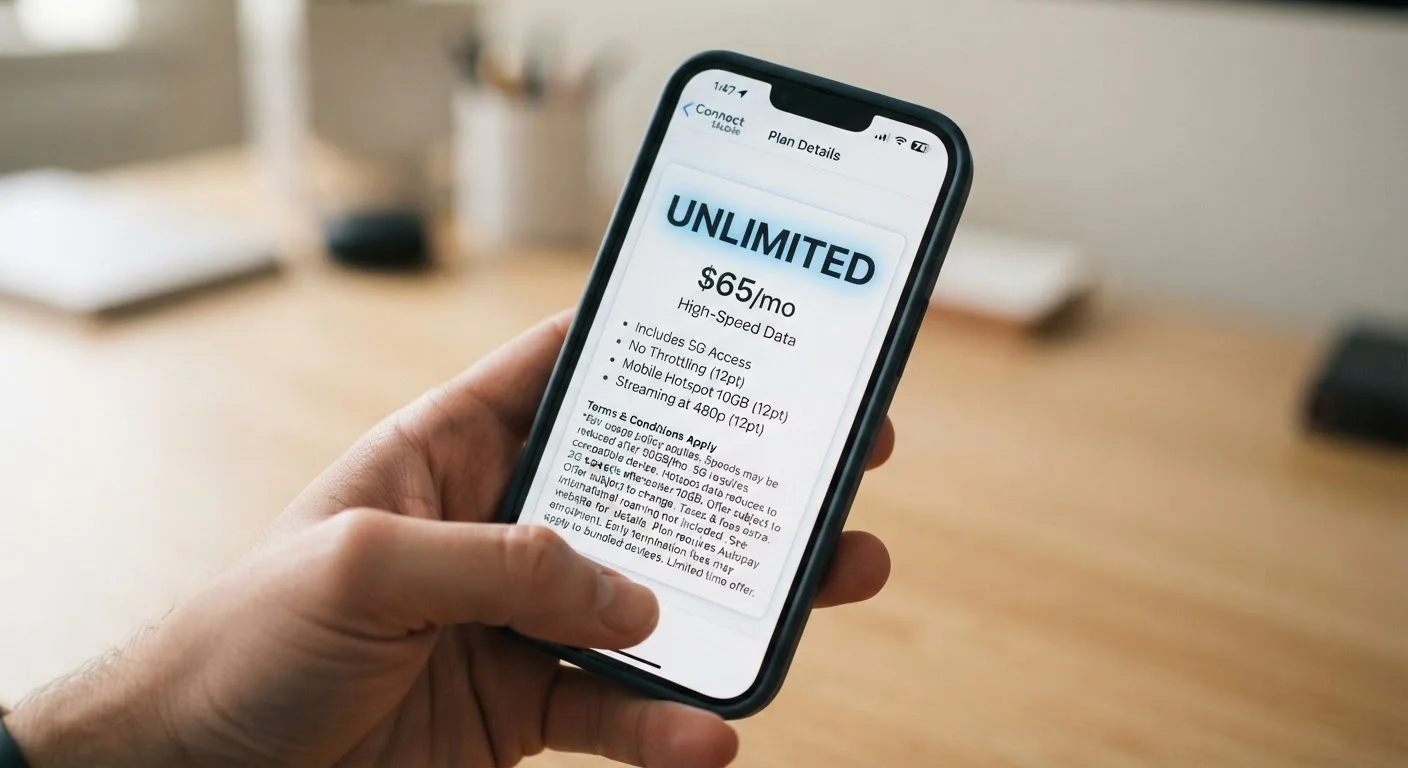
Key Takeaways
- Most unlimited plans slow your speeds after you hit a monthly data threshold - often as low as 22-50 GB.
- Hotspot data on unlimited plans is almost always capped at a separate, lower data allowance.
- Deprioritization means your connection can slow dramatically in congested areas, regardless of your plan tier.
- Video streaming on unlimited plans is frequently throttled to lower resolutions by default.
- Reading the plan's full terms - not just the marketing page - is the only reliable way to know what you're buying.
Why "Unlimited" Is a Marketing Term, Not a Technical One
The word "unlimited" on a phone plan label is a legal and marketing construct, not a technical guarantee. Carriers are permitted to call a plan unlimited as long as they disclose restrictions elsewhere - typically in the plan's terms of service or a separate fine-print disclosure page. The result is a wide gap between what consumers expect and what the plan actually delivers.
Understanding what unlimited really means starts with knowing the three main levers carriers use to manage network load without technically cutting off your data: speed throttling, deprioritization, and feature-tier caps. Each operates differently, and each is commonly misunderstood. For a deeper look at how misleading labels appear across the connectivity industry, see how advertised speeds differ from real-world performance.
Myth
Unlimited data means you can use as much data as you want at full speed, all the time.
Fact
Nearly all unlimited plans reduce your speeds after you consume a set amount of high-speed data in a billing cycle.
Carriers refer to this threshold as a deprioritization limit or premium data allowance. Once you exceed it - commonly ranging from 22 GB to 100 GB depending on the plan tier - your data is not cut off, but your connection may be slowed during times of network congestion. On some plans, speeds drop regardless of congestion (called hard throttling). The distinction matters: deprioritization affects you mainly in busy areas, while hard throttling applies everywhere.
Myth
Unlimited plans include unlimited hotspot data for tethering your other devices.
Fact
Hotspot data is almost always capped at a specific allowance that is separate from your phone's data, and speeds typically drop sharply once that cap is reached.
Mobile hotspot - also called tethering - lets your phone act as a router for other devices. On most unlimited plans, this feature draws from a distinct data bucket, often 15 GB to 50 GB depending on the plan tier. After that allowance is consumed, hotspot speeds are typically reduced to 600 Kbps or lower, which is too slow for most video calls or streaming. This limit applies even if you have theoretically unlimited data left on your phone line itself.
Myth
All unlimited plans deliver the same experience - the word means you're getting everything.
Fact
Unlimited is a tiered product category, and significant differences exist between base, mid-tier, and premium unlimited plans from the same carrier.
Carriers typically offer multiple unlimited plan tiers at different price points. Lower tiers usually carry smaller premium data thresholds before deprioritization, lower hotspot allowances, capped video resolution, and exclusions from features like international roaming or 5G access. Premium tiers may include higher-speed thresholds, better hotspot data, and 4K video streaming. Reading plan comparison tables carefully - rather than relying on the "unlimited" label alone - is the only way to distinguish between them.
Myth
Deprioritization only affects people who use extremely large amounts of data.
Fact
Deprioritization thresholds on many plans are low enough to affect moderate users, particularly those who stream video or work remotely.
A single hour of HD video streaming consumes roughly 3 GB of data. A user who streams two hours of video daily could approach a 22 GB deprioritization threshold within two weeks. Remote workers relying on video conferencing face similar consumption rates. Deprioritization is not a penalty reserved for extreme outliers - it can affect consumers with ordinary usage habits, especially midway through a billing cycle.
Myth
Video streaming on unlimited plans is always at full quality.
Fact
Most carriers cap video resolution by default on base and mid-tier unlimited plans, often at 480p or 720p.
Carriers frequently apply video optimization - a term for resolution throttling - as a default setting on lower plan tiers. This limits streaming to standard definition or basic HD, regardless of what your device or the streaming platform can support. Some carriers allow users to disable this restriction within their account settings, while others require a plan upgrade. Checking the video streaming policy before selecting a tier prevents unexpected quality limitations after signing up.
Hotspots, Video, and Other Hidden Limits
Beyond general data speed, two features catch consumers off guard most often: mobile hotspot usage and video streaming quality. Both are almost universally restricted on unlimited plans, even premium tiers.
~3 GB
Data consumed per hour of HD video streaming
Streaming at 1080p resolution typically uses around 3 GB per hour, making it easy to approach deprioritization thresholds mid-cycle.
22-100 GB
Typical premium data range before deprioritization
Deprioritization thresholds vary widely across carrier plan tiers; lower-priced unlimited plans often set the limit at the lower end of this range.
Hotspot data - using your phone as a Wi-Fi router for a laptop or tablet - draws from a completely separate bucket on most plans. Once that hotspot allowance is exhausted, the connection either stops or drops to a speed too slow for most tasks. This is true even if you have technically "unlimited" phone data remaining.
Video streaming is another common restriction point. Many carriers default to capping video resolution at 480p (standard definition) or 720p (HD) on base unlimited tiers. Higher-resolution streaming may require a premium plan tier. These restrictions are usually opt-out rather than opt-in, meaning they apply unless you actively change a setting or upgrade.
Hotspot and Phone Data Are Not the Same Pool
Many consumers assume that unlimited phone data extends to all the devices connected through their hotspot. It does not. Hotspot data is allocated separately on virtually every unlimited plan, and exhausting it can leave laptops or tablets with a near-unusable connection - even while your phone itself still has data. Always check the hotspot allowance specifically, not just the overall data description.
Before choosing any unlimited plan, reviewing the full terms is essential. Our guide on reading an ISP's terms of service covers exactly where these clauses are buried and what language to watch for. If you're new to comparing plans altogether, the ground-up overview of phone plans breaks down every key concept without jargon.
How to Evaluate an Unlimited Plan Accurately
Comparing unlimited plans requires looking past the headline. The most useful questions to ask before committing to any plan include: What is the full-speed data threshold before deprioritization or hard throttling kicks in? How much hotspot data is included, and at what speed after the cap? What resolution does video default to, and can it be changed? Are there any additional per-line fees not reflected in the advertised price?
Carriers are required by the FCC to disclose network management practices in their broadband consumer labels, which became mandatory for mobile providers. These labels provide a standardized way to compare throttling thresholds and deprioritization policies side by side. Look for them on each carrier's plan detail pages - they offer a more reliable comparison point than the marketing copy.
For a structured approach to evaluating any connectivity plan before signing, see our practical checklist for reviewing plan terms. And for decoding the specific language carriers use - terms like "deprioritization," "network management," and "premium data" - the carrier jargon decoder is an efficient reference.