

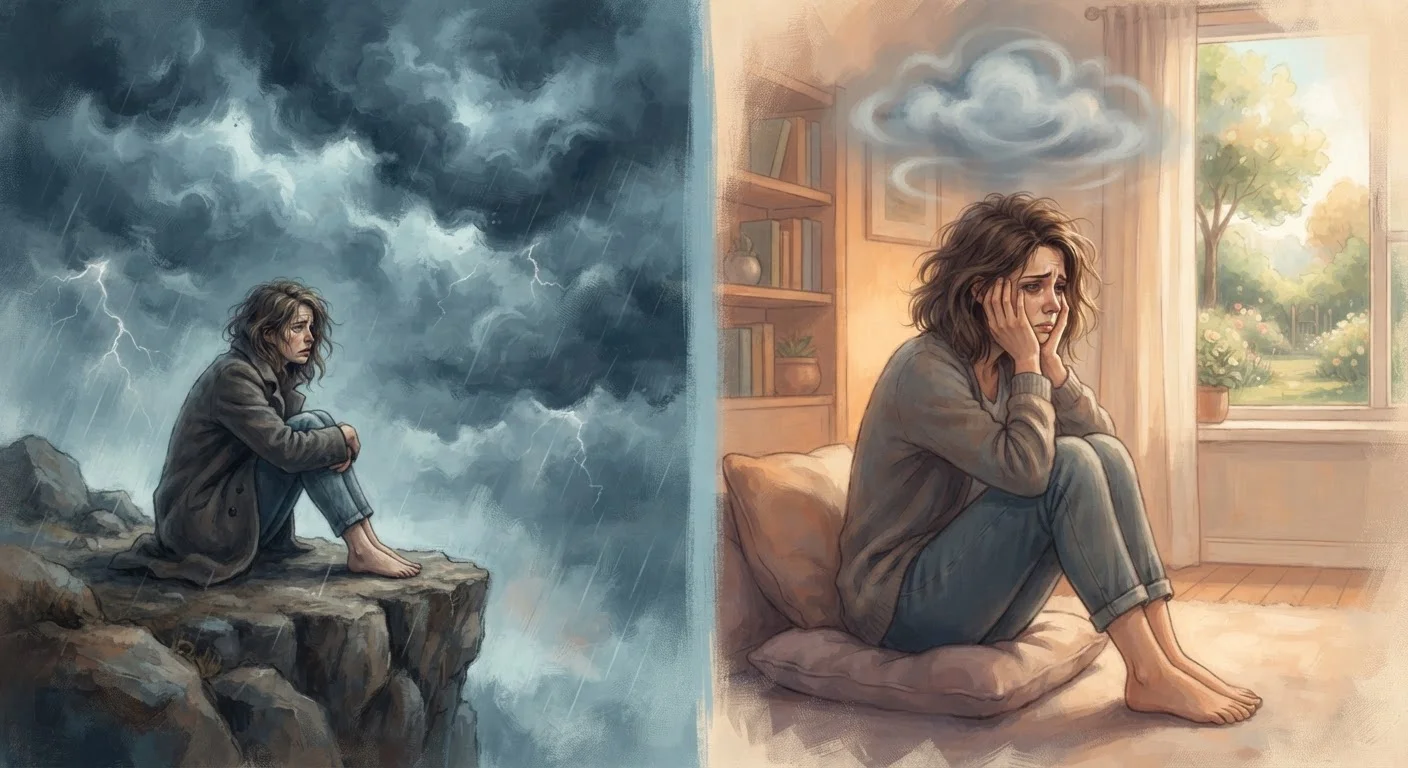
Key Takeaways
- Stress is typically triggered by an identifiable external cause; anxiety often persists without one.
- Both activate the body's fight-or-flight system, producing overlapping physical and emotional symptoms.
- Anxiety disorders are among the most common mental health conditions in the United States, affecting millions of adults.
- Telling the two apart matters because effective coping strategies and professional care paths differ.
- Neither stress nor anxiety is a character flaw - both are normal human responses that exist on a spectrum.
- Consult a qualified healthcare professional if worry is persistent, intense, or interfering with daily life.
Option A
Stress
The body's response to an identifiable external demand.
Best for: Understanding when your tension is tied to a specific, real-world situation that can be addressed or resolved.
Option B
Anxiety
Persistent worry that outlasts or exists independently of any clear trigger.
Best for: Recognizing when worry has become self-sustaining and may benefit from professional evaluation or targeted support.
If your tension is tied to a clear, temporary situation like a deadline or conflict
Stress framing
Addressing the external stressor directly - through problem-solving, time management, or social support - is typically the most effective path forward.
If worry persists long after a situation has resolved, or arises without an obvious trigger
Anxiety framing
Anxiety that is disproportionate or unprompted by circumstance may warrant a conversation with a mental health professional for proper evaluation.
If physical symptoms like racing heart or sleep disruption are affecting daily functioning
Anxiety framing
Chronic physical activation beyond a clear stressor is a common signal that anxiety - not just situational stress - may be at play.
If you're unsure which applies and symptoms have lasted more than a few weeks
Anxiety framing
Duration is one of the clearest distinguishing factors; persistent symptoms regardless of label merit professional input.
Why the Distinction Matters
At first glance, stress and anxiety seem like two words for the same thing. Both can make your heart race, disrupt your sleep, and leave you feeling overwhelmed. But mental health professionals treat them as distinct experiences - and for good reason. Reaching for the right framework helps you choose more effective coping strategies and, when needed, seek the right kind of support.
Stress and anxiety are not a binary - they exist on a continuum and can overlap. But understanding what separates them gives you a more useful map of your own experience, rather than a one-size-fits-all label.
For a closer look at what happens when everyday worry intensifies, see signs that everyday worry may warrant attention.
| Criterion | Stress | Anxiety |
|---|---|---|
| Primary trigger | Identifiable external stressor | Internal; often no clear cause |
| Duration | Resolves when stressor is removed | Persists beyond or without stressor |
| Proportionality | Feels matched to circumstances | Often feels excessive or uncontrollable |
| Physical symptoms | Tension, fatigue, disrupted sleep | Same, plus possible panic or avoidance |
| Outlook during episode | Usually future-focused on a specific problem | Diffuse worry; hard to pinpoint or resolve |
| When professional care is typical | Chronic or overwhelming life stress | Persistent, impairing, or unexplained worry |
What Stress Actually Is
Stress is the body's physiological and psychological response to an external demand - something identifiable, like a looming work deadline, a difficult conversation, or a financial pinch. The American Psychological Association describes stress as typically resolving once the stressor is removed or addressed. In that sense, stress has a built-in expiration date.
This response, sometimes called the fight-or-flight reaction, is managed by the autonomic nervous system. Hormones like cortisol and adrenaline surge, preparing the body to act. Short-term, this is adaptive. Chronic stress - where the stressor is ongoing or stressors pile up without relief - is where health consequences accumulate, including elevated cardiovascular risk and immune suppression, according to research published in sources such as the Annual Review of Psychology.
Importantly, stress tends to feel proportionate to circumstances. Ask someone why they feel tense, and they can usually point to something specific.
~19%
U.S. adults with an anxiety disorder annually
According to the National Institute of Mental Health (NIMH), anxiety disorders are the most common mental health condition category in the United States.
77%
Adults who report physical symptoms from stress
The American Psychological Association's Stress in America surveys have consistently found the majority of adults experience physical manifestations of stress.
What Anxiety Actually Is
Anxiety shares the same physiological machinery as stress - your nervous system doesn't care whether the threat is real or anticipated. What distinguishes anxiety is that the worry often persists in the absence of a clear external trigger, or it feels disproportionate to the actual situation.
Clinical anxiety disorders - which include generalized anxiety disorder (GAD), panic disorder, social anxiety disorder, and specific phobias - are formally defined in the Diagnostic and Statistical Manual of Mental Disorders (DSM-5) by criteria like duration, intensity, and impairment to daily functioning. According to the National Institute of Mental Health (NIMH), anxiety disorders affect roughly 19% of U.S. adults in a given year, making them the most prevalent category of mental health condition in the country.
That said, anxiety as an everyday experience - not meeting clinical diagnostic thresholds - is entirely common and human. The concern arises when it becomes persistent, difficult to control, or begins interfering with work, relationships, or physical health.
Understanding anxiety is also connected to broader questions of mental well-being. If you're curious how misconceptions cloud the picture further, our article on what evidence says about depression myths explores how stigma shapes public understanding of mental health more broadly.
Overlapping Symptoms - and the Key Differences
Because both states activate the same stress-response system, the symptom overlap can be significant: muscle tension, irritability, difficulty concentrating, sleep disruption, and elevated heart rate are common to both. This is part of why people - and even clinicians during initial conversations - may not immediately distinguish between them.
The clearest practical distinctions come down to trigger, duration, and proportionality:
- Trigger: Stress typically has an identifiable cause. Anxiety often doesn't - or the trigger feels minor relative to the intensity of the response.
- Duration: Stress tends to ease when circumstances change. Anxiety can persist even after a stressor has resolved.
- Proportionality: Stress generally feels matched to the situation. Anxiety can feel excessive, uncontrollable, or hard to rationalize away.
Neither is inherently worse than the other. But anxiety that is frequent, intense, or long-lasting tends to benefit from structured support - whether that's evidence-based self-management tools, therapy, or a medical evaluation.
Practices like mindfulness may support both states. Our evidence-based look at mindfulness and meditation separates what research actually supports from common overclaims.
When to Seek Professional Guidance
Self-awareness about stress versus anxiety is a useful starting point, but it has limits. If you're experiencing symptoms that are persistent (lasting weeks rather than days), significantly interfering with daily life, or accompanied by physical symptoms you cannot explain, speaking with a qualified healthcare professional is the appropriate next step - not a sign of weakness or overreaction.
A primary care physician can help rule out physical causes of anxiety-like symptoms. Mental health professionals - including therapists, psychologists, and psychiatrists - can assess whether what you're experiencing meets criteria for an anxiety disorder and discuss evidence-based treatment options like cognitive behavioral therapy (CBT) or, in some cases, medication.
For a plain-language breakdown of which professional does what, see our guide on therapy, counseling, and psychiatry differences.
Anxiety and Stress Can Coexist
It's common to experience stress and anxiety simultaneously - a high-pressure period at work, for example, can both generate situational stress and trigger underlying anxiety. The distinction isn't about labeling yourself definitively, but about understanding which dynamic is at play so you can respond more effectively. A mental health professional can help untangle the two if the picture feels unclear.
This article is for general informational and educational purposes only and does not constitute medical or mental health advice. If you are experiencing significant distress or have concerns about your mental health, please consult a qualified healthcare professional.