

Key Takeaways
- The MSRP on the sticker is a starting point for negotiation, not a fixed price.
- Fuel economy estimates come from EPA testing and reflect controlled lab conditions, not real-world results.
- Dealer-added options listed below the factory section can often be negotiated or declined.
- The sticker's safety ratings link to federal and independent crash-test programs.
- Understanding every section of the sticker helps you compare vehicles on equal terms.
Monroney Sticker
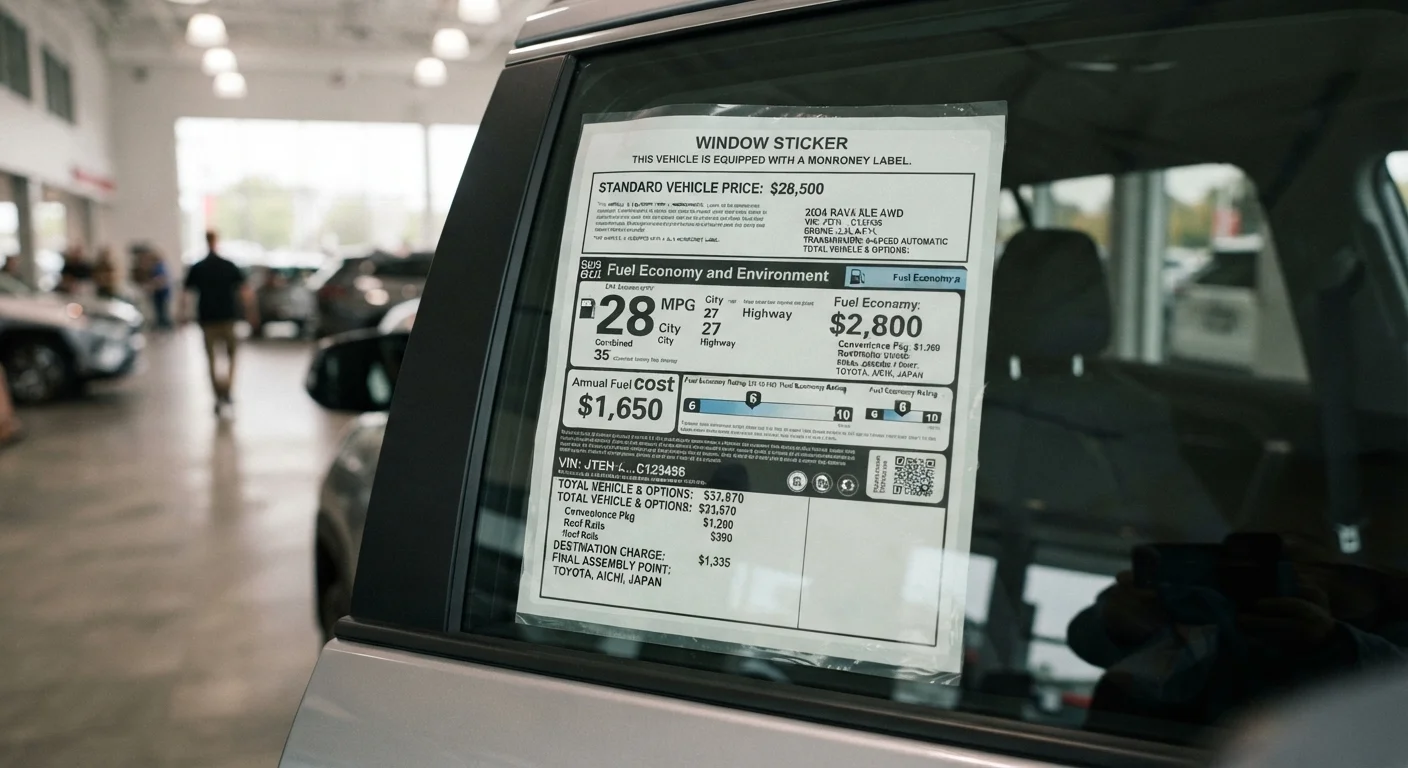
The Monroney sticker - commonly called the window sticker - is the federally mandated label affixed to every new vehicle sold in the United States. It discloses the manufacturer's suggested retail price (MSRP), standard and optional equipment, fuel economy estimates, and safety information. Dealers are legally required to keep it on the car until the moment of sale.
The sticker is named after U.S. Senator Mike Monroney, whose 1958 Automobile Information Disclosure Act made the label a federal requirement. Removing it before sale is a federal offense.
What the Window Sticker Actually Is
Walk onto any new-car lot and you'll find a printed label on every vehicle's side window. That document - the Monroney sticker - is one of the most information-dense pieces of paper in the car-buying process, yet most shoppers glance at the price and move on.
Federal law requires dealers to display the sticker on all new vehicles until the point of sale. It covers vehicle identification, pricing, equipment, fuel economy, and safety - all in a standardized format designed to help consumers make fair comparisons. If you're working through the full purchase journey, our car-buying walkthrough explains where the sticker fits into the broader process.
Breaking Down the MSRP Section
The upper portion of the sticker lists the Manufacturer's Suggested Retail Price (MSRP), broken into distinct line items:
- Base price: The cost of the vehicle in its standard configuration, without any added options.
- Factory-installed options: Each optional package or feature the manufacturer added - listed individually with its own price.
- Destination and delivery charge: A fixed fee covering transport from the assembly plant to the dealer. This charge is set by the manufacturer and is non-negotiable.
The total MSRP is the sum of these figures. It is a starting point, not a ceiling. Dealers may sell at, above, or below MSRP depending on inventory levels and demand. Your credit profile also shapes the final out-of-pocket cost - our article on why your credit score matters more than the sticker price explains why the financing terms often carry more weight than any line on the sticker.
~$48,000
Average new vehicle transaction price in the U.S.
According to industry data tracked by sources including Kelley Blue Book, the average transaction price for a new vehicle in the U.S. has exceeded $47,000-$48,000 in recent years, underlining the importance of understanding every line on the sticker.
Up to 25%
Potential real-world MPG shortfall vs. EPA estimate
The EPA notes that actual fuel economy can vary significantly from sticker estimates; aggressive driving, extreme temperatures, and highway speeds above 60 mph are among the most common factors that reduce real-world efficiency.
5 stars
Maximum NHTSA crash-test rating
NHTSA's 5-Star Safety Ratings program evaluates new vehicles across multiple crash scenarios; not all vehicles achieve the top rating in every category, making the breakdown on the sticker an important detail to read carefully.
The Dealer-Added Section: Proceed With Caution
Below the manufacturer's section, many stickers include a second block listing dealer-installed accessories - paint protection film, cargo mats, nitrogen-filled tires, or window tinting, for example. This section is not mandated by the manufacturer and the items are added at the dealer's discretion.
A few things to know about this section:
- These add-ons can carry significant markups relative to their actual cost.
- Some items may already be installed and therefore difficult to remove - but their price remains negotiable.
- If an accessory has no value to you, ask for it to be deducted from the selling price before you discuss any other terms.
Ask for an Itemized Breakdown Before Negotiating
Before discussing monthly payments or trade-in values, ask the dealer to walk you through each line on the sticker - including the dealer-added section. Getting clarity on individual charges prevents those costs from being buried in a single lump-sum price. Negotiating line by line is almost always more effective than negotiating a total number.
First-time buyers in particular should review this section carefully. Our guide on car buying for first-timers walks through the paperwork and decisions that dealers don't always volunteer to explain.
Fuel Economy and Environmental Ratings
A prominent section of the sticker is dedicated to EPA fuel economy estimates, displaying city, highway, and combined MPG figures. These numbers are generated through standardized laboratory testing, not live road conditions. Factors like aggressive acceleration, highway speeds above 60 mph, cargo weight, and cold weather all reduce real-world efficiency below the rated figure.
The sticker also shows:
- Estimated annual fuel cost: Calculated using a set price per gallon and assumed annual mileage - useful for comparing models, less useful as an absolute budget figure.
- Fuel economy range: A bar showing where this vehicle falls relative to others in its class.
- CO₂ emissions rating: Greenhouse gas output, measured in grams per mile.
These figures become especially relevant when you start calculating total cost of ownership, where fuel expenses over several years can add up to thousands of dollars.
Safety Ratings on the Sticker
The Monroney sticker references National Highway Traffic Safety Administration (NHTSA) crash-test ratings, expressed as a five-star scale. Ratings are broken out by test type - frontal crash, side crash, and rollover resistance - so you can see where a vehicle performs well and where it does not.
It's worth noting that NHTSA ratings and those from the Insurance Institute for Highway Safety (IIHS) use different testing protocols and grading scales. The sticker only reflects NHTSA results; IIHS ratings are published separately on the IIHS website. A vehicle can earn strong marks from one program and lower marks from the other, so consulting both sources gives a more complete picture of crash performance.
A shopper notices the window sticker lists a $499 'nitrogen tire inflation' charge in the dealer-added section.
Two SUVs have similar MSRPs, but their EPA-estimated annual fuel costs differ by $400.
A buyer sees a vehicle's NHTSA rollover rating is three stars out of five, while the frontal crash rating is five stars.
How to Use the Sticker Before You Negotiate
The window sticker's standardized format makes it one of the most reliable comparison tools available before you sit down to negotiate. Here's how to put it to work:
- Separate the base price from the options. Identify which features you actually want versus what was bundled in.
- Flag dealer additions separately. Don't let these get blended into a single 'price' discussion.
- Note the destination charge. It's fixed and applies to every unit - no dealer can waive it, and none should claim otherwise.
- Use the fuel economy figures comparatively. An honest apples-to-apples comparison between two models starts with the same EPA methodology.
Arriving informed - with the sticker's figures already broken down - puts you in a better negotiating position and reduces the chance of paying for options or fees that weren't clearly disclosed upfront.