

Key Takeaways
- Dealer financing routes your loan through third-party lenders, with the dealership acting as a middleman that may mark up your rate.
- Securing a pre-approved loan from your own bank or credit union before shopping gives you a concrete rate to benchmark against.
- Manufacturer-subsidized promotional rates through dealers can be genuinely competitive but often require strong credit and specific vehicle eligibility.
- Separating the price negotiation from the financing conversation typically works in the buyer's favor.
- Always compare the annual percentage rate (APR) and total loan cost - not just the monthly payment - across both options.
Option A
Dealer Financing
The convenient, one-stop financing option arranged at the dealership.
Best for: Buyers who want a seamless transaction and may qualify for manufacturer-subsidized rate promotions.
Option B
Direct Lending (Your Own Bank or Credit Union)
The independent financing route secured before you walk onto the lot.
Best for: Buyers who want to negotiate price and financing separately and have an established banking relationship.
If you want to negotiate from the strongest possible position
Direct Lending (Your Own Bank or Credit Union)
A pre-approved offer establishes a ceiling on your rate before you enter the dealership, giving you leverage to compare - or simply walk away.
If you qualify for a manufacturer-subsidized low-APR promotion
Dealer Financing
Promotional rates offered through a manufacturer's captive lender (e.g., 0% or 1.9% APR) are rarely matched by outside banks and can represent genuine savings.
If you have a long-standing relationship with a credit union
Direct Lending (Your Own Bank or Credit Union)
Credit unions frequently offer member-favorable rates and lower fees, and the approval process is fully separate from the dealership's influence.
If your credit history is limited or imperfect
Dealer Financing
Dealers work with a wide network of lenders, including those that specialize in non-prime borrowers, which may give you more options than a single bank relationship.
How Each Financing Path Actually Works
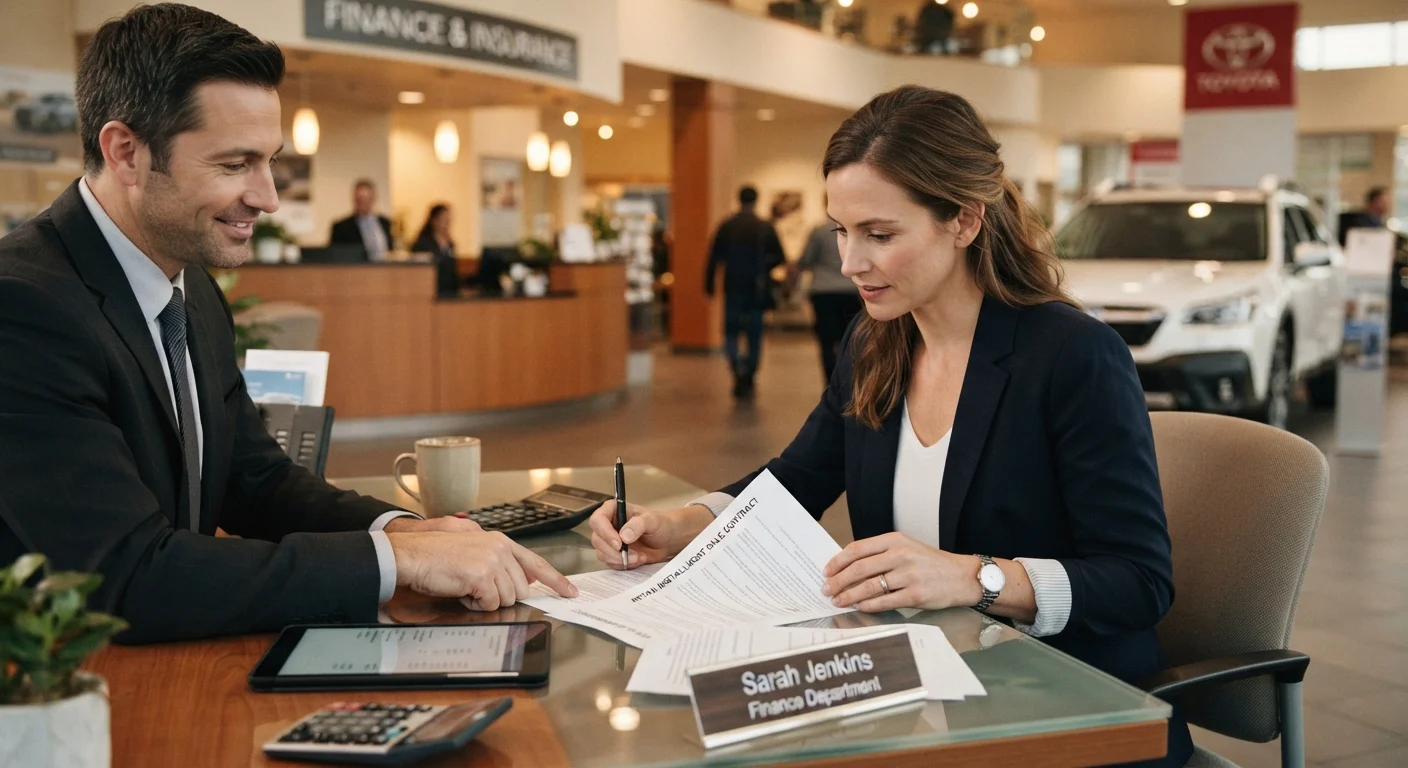
When you finance through a dealership, you're not borrowing directly from the dealer. The dealership submits your application to one or more lenders - banks, credit unions, or the automaker's own financing arm (called a captive lender) - and then presents you with an offer. The dealer often earns a fee by marking up the interest rate above what the lender actually approved, a practice sometimes called a dealer reserve. That markup is built into your monthly payment and may not be visible on the paperwork.
Direct lending works differently. You apply for a loan directly with your bank or credit union before you shop, and if approved, you receive a pre-approval letter stating the maximum amount and the interest rate you qualify for. At the dealership, you're essentially a cash buyer - the car price negotiation happens independently of how you're financing it. Once you agree on a price, your lender issues a check or draft to the dealer.
Checking your credit before beginning the process is important under either path. Your credit score heavily influences the rates you'll be offered, and knowing where you stand helps you evaluate whether any offer you receive is reasonable.
| Criterion | Dealer Financing | Direct Lending |
|---|---|---|
| Who sets your rate | Lender, possibly marked up by dealer | Your bank or credit union directly |
| Application timing | At the dealership, after choosing a vehicle | Before you shop, independent of dealer |
| Promotional rates available | Yes - manufacturer subsidized offers possible | No access to manufacturer promotions |
| Negotiating leverage on price | Lower - financing tied to purchase transaction | Higher - you negotiate as a cash buyer |
| Lender options | Multiple lenders via dealer network | Single institution you choose |
| Rate transparency | Markup may not be disclosed | Rate is clearly stated upfront |
| Best credit fit | Wide range, including non-prime borrowers | Typically strongest for established credit |
The Rate Markup Question and How to Protect Yourself
The dealer markup on interest rates is legal and widespread, but it's also one of the most common ways car buyers pay more than necessary over the life of a loan. Even a half-percentage-point difference in APR on a five-year, $30,000 loan can add hundreds of dollars in total interest paid.
The most reliable protection is arriving with a competing offer in hand. When you have a pre-approved rate from your bank or credit union, you can ask the dealership's finance office to beat it - and they sometimes can, especially if the manufacturer's captive lender is offering a subsidized promotion. If they can't match or beat your rate, you use your own financing and the dealership still closes the sale.
~1-2.5%
Typical dealer interest rate markup range
The Consumer Financial Protection Bureau has noted that dealer reserve markups commonly fall within this range above the lender's buy rate, though practices vary.
~30%
New car buyers who finance through a dealer
Industry estimates consistently show a substantial majority of new vehicle buyers use some form of dealership-arranged financing rather than bringing outside loans.
It's also worth understanding what happens in the finance and insurance (F&I) office beyond the loan itself. Dealers may present add-on products - extended warranties, GAP insurance, paint protection - that can be rolled into the loan amount. Learn more about those products in our guide to add-ons dealerships pitch in the finance office. Bundling these into a loan means you pay interest on them over the loan term, which increases their true cost.
Focus on the annual percentage rate (APR) and the total amount repaid rather than the monthly payment. Extending loan terms lowers monthly payments but raises total interest paid - a trade-off worth understanding clearly before signing.
When Dealer Financing Has a Genuine Edge
Dealer financing isn't automatically the worse choice. Manufacturer-subsidized promotional rates - sometimes as low as 0% APR for qualified buyers - are available only through the automaker's captive lender and cannot be replicated by an outside bank. If you qualify for one of these offers on a vehicle you've already decided to purchase, the math often favors taking it.
Dealers also have relationships with a broader array of lenders than most consumers maintain individually. Buyers with thin credit files or past credit challenges may find that a dealer's network surfaces approvals that a single bank declines. That said, loans for borrowers with lower credit scores typically carry higher rates regardless of the channel - so it's worth understanding the full cost before accepting.
Before you visit any dealership, do your homework. Our guide on what to research at home before you test drive covers the groundwork that puts you in a stronger position before any financing conversation begins.
Rate Shopping and Your Credit Score
Multiple auto loan inquiries within a short window - typically 14 to 45 days depending on the credit scoring model - are usually treated as a single inquiry for scoring purposes. This means applying to your bank, your credit union, and allowing the dealer to shop your application in the same period generally has a limited impact on your credit score. Getting your credit in order first is still advisable; see how to check your credit before a major financial decision.
This article provides general information about auto financing options and is not personalized financial advice. Consult a qualified financial professional before making borrowing decisions based on your specific circumstances.